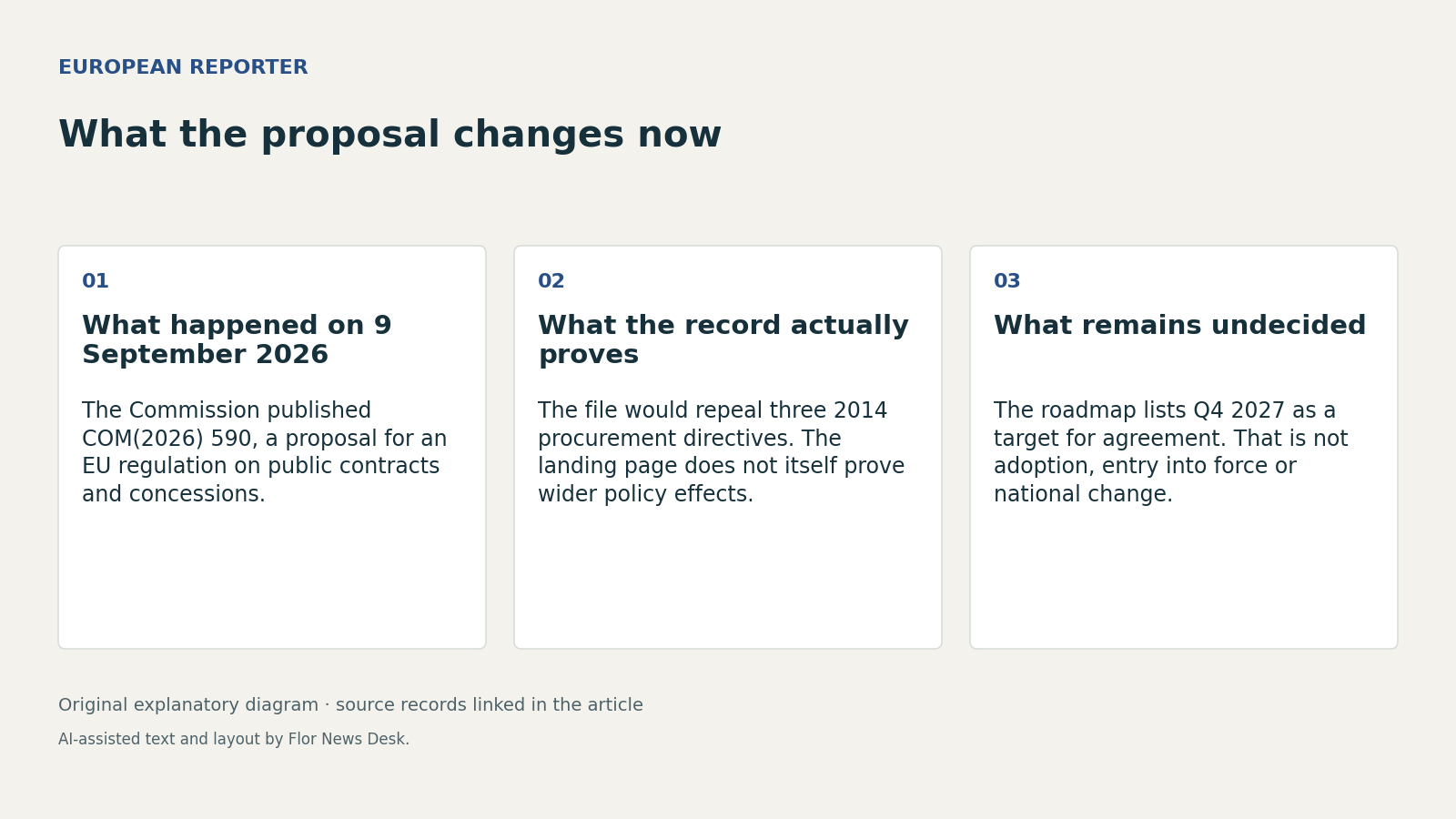

The European Commission took a concrete legislative step on 9 September 2026: it published COM(2026) 590, a proposal for a Regulation of the European Parliament and of the Council on public contracts and concessions, presented as the Public Procurement Act. The same file is listed in the Commission’s “One Europe, One Market” roadmap as a measure proposed on that date. That matters because there is now an identifiable legislative text on the table, not just a policy slogan or consultation. Commission proposal page Roadmap page
What the current record firmly establishes is narrower than some political messaging around it. The Commission publication page says the proposal would repeal Directives 2014/23/EU, 2014/24/EU and 2014/25/EU, and would amend several other EU regulations and directives named on that page. In other words, the Commission is proposing to replace the current three main EU procurement texts with one new regulation, while making related changes elsewhere in EU law. That is a significant institutional redesign at EU level. But the landing page excerpt in the source record does not itself prove which detailed procedural or policy choices inside the proposal would survive the legislative process. Commission proposal page
The other key point is what has not happened. A Commission proposal is not an adopted law, and the source record does not show approval by the European Parliament or the Council, entry into force, or implementation in member states. The roadmap page explicitly places the Public procurement act among measures proposed by the Commission and still pending final adoption, and gives Q4 2027 as a target for agreement. That is a political timetable, not evidence that the text will be agreed on schedule or that procurement practice has already changed in any country. Roadmap page
That distinction matters across Europe because procurement systems are used daily by ministries, municipalities, utilities and suppliers. As of 11 October 2026, the verified record supports only one immediate practical conclusion: contracting authorities and bidders can start reading a specific draft and its annexes, impact assessment and supporting documents, all dated 9 September 2026. It does not support saying that national procedures, award practices or enforcement have already shifted. The roadmap says the Parliament, the Council of the European Union and the Commission signed a Joint Roadmap on 24 April 2026 and will meet every quarter to assess progress, but those stocktakes are governance of a legislative push, not proof of legal effect. Commission proposal page Roadmap page
The most useful supporting context in the source set comes from a different kind of record: an 8 September 2026 Public Buyers Community post listing external studies used in the revision process. It shows the Commission had commissioned work on labels in procurement, procurement data governance, SME participation, green, social and labour considerations, and digital procurement options, including a study using TED data for 2018-2023. Those topics help explain the policy questions in circulation before the proposal appeared. But the post does not show which recommendations, if any, became Commission drafting choices in COM(2026) 590. Readers should therefore treat those studies as background to the review, not as a shortcut to what the law would become. External studies page
So the cleanest reading of the file is also the most restrained. The Commission has launched a formal attempt to recast EU public procurement law under the “One Europe, One Market” programme, and the institutions have attached a Q4 2027 target for agreement. What the evidence does not yet establish is just as important: whether co-legislators will keep the Commission’s structure, what provisions will change in negotiation, and when any final text would alter practice in member states. For now, Europe has a proposal with a political deadline, not a settled procurement regime. Commission proposal page Roadmap page