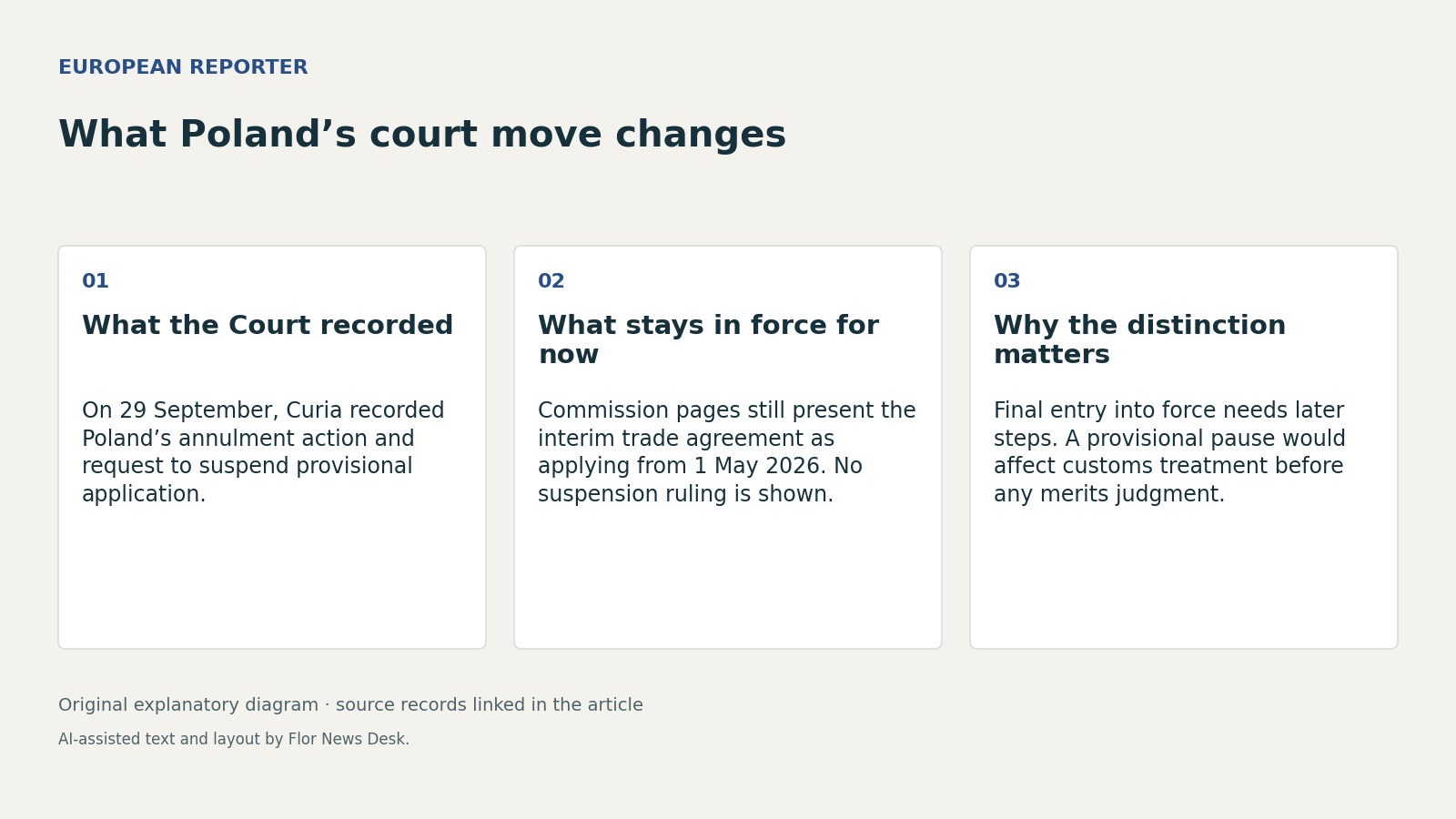
Poland’s challenge to the EU–Mercosur interim trade agreement became a live institutional issue on 29 September 2026, when the Court of Justice published an order in Case C‑460/26 R recording that Poland wants the Court to annul the Council decision authorising provisional application and is also asking for that decision’s implementation to be suspended while the main case is heard (Curia case page). What changed on that date was the legal risk around an operating trade regime, not the regime itself: the Court page does not show that suspension was granted.
That distinction matters because the Commission still presents the trade pillar as having applied provisionally from 1 May 2026, after EU countries formally endorsed the trade agreement on 9 January 2026. The same Commission explainer says final entry into force still depends on European Parliament consent (Commission explainer). In other words, the Polish action is aimed at the bridge between political approval and full ratified force. It questions the EU decision that allowed trade effects to begin before the whole process was complete.
The practical stakes are not abstract. In a 30 April 2026 announcement, the Commission said provisional application from 1 May would bring immediate tariff relief for goods including cars and pharmaceuticals, start the first tariff cut for many agri-food products such as wine, spirits and olive oil, open public procurement markets on equal terms, begin removing some technical barriers, and trigger protection for 344 EU geographical indications (Commission news). Those are the policy effects now sitting under litigation. But that announcement was published before the start date it described, so it is evidence of intended implementation, not of take-up, compliance or measured trade gains.
For exporters and customs authorities across the EU and Mercosur, the immediate consequence is uncertainty rather than an automatic rollback. The Court record establishes only that Poland requested interim relief, not that the Court ordered it (Curia case page). Analysis based on that premise is straightforward: until the legal position changes, administrations still need to apply the status the institutions say is in force. If the Court later grants suspension, the administrative problem would shift quickly from litigation to timing. A hypothetical example shows the point: a shipment cleared under preferential terms after 1 May 2026 might face different customs treatment for entries made after any future suspension date, even though the underlying merits case was still unresolved.
Agriculture explains why the case could travel beyond courtrooms. The Commission says tariff concessions for sensitive products are constrained by quotas and conditions, and it says the agreement includes a safeguard mechanism plus market monitoring, especially for agriculture (Commission explainer; Commission news). But the current record does not show safeguards being triggered, funding from the cited €6.3 billion safety net being received, or any market effect measured after 1 May 2026. Readers should treat those as institutional commitments and design features, not outcomes.
So the important reading of 29 September is narrower and more consequential than a headline about a lawsuit alone. Poland has inserted a court challenge into a trade arrangement the Commission says is already being applied, but the public record supplied here does not establish a judicial pause, a merits ruling or an economic result yet (Curia case page; Commission explainer). The next real change for businesses will not be the existence of the case. It will be any later Court decision on interim relief, or evidence from the institutions that implementation has actually been altered.