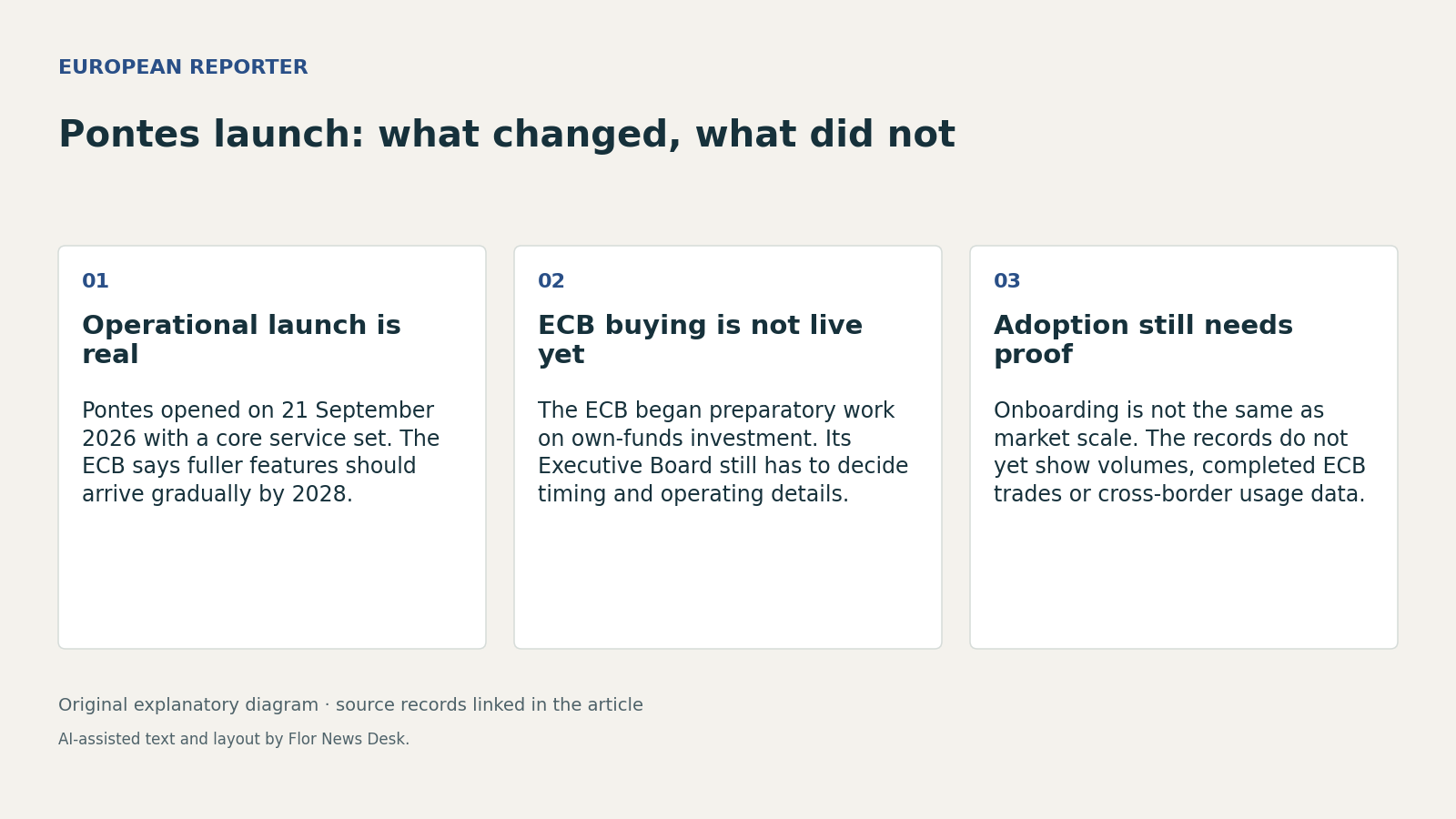

The Eurosystem took a real operational step on 21 September 2026: it launched Pontes for settlement of wholesale tokenised-asset transactions in central bank money, and the ECB said the same day that it had begun preparatory work to invest part of its own funds in tokenised securities with settlement via Pontes (Eurosystem launch; ECB own-funds announcement). What changed is that a Eurosystem link is now open for use. What did not change is equally important: the records do not establish broad market uptake, settled volumes or completed ECB purchases.
According to the ECB, Pontes lets wholesale transactions in tokenised assets settle in central bank money and starts with a core set of services, with extra features and longer operating hours to be added gradually. The ECB also said full implementation is expected by 2028 and that 13 market participants, four market DLT operators and the Deutsche Bundesbank in a market-participant capacity had completed onboarding by launch day (Eurosystem launch). That makes Pontes more than a concept note, but still less than a finished market structure. It is an implemented first layer with a stated build-out timetable, not evidence that tokenised wholesale settlement has already become routine across the euro area.
The ECB’s investment announcement is even more clearly a preparation phase. The institution said it is working toward investing a small portion of its own funds portfolio, a non-monetary-policy portfolio, in euro-denominated tokenised securities issued by euro area central governments, regional governments, agencies and European supranational institutions. But the ECB also said its Executive Board will decide the operational details and timing only after the preparatory work, taking account of issuance and wider ecosystem developments (ECB own-funds announcement). So the announcement shows institutional commitment to testing the market from the buy side, not a disclosed purchase programme with known size, start date or counterparties.
The more interesting policy signal is the settlement model the ECB is choosing. In May 2026, the ECB said Project Agorá had demonstrated atomic settlement across multiple currencies and jurisdictions using both tokenised central bank reserves and tokenised commercial bank deposits, and that those insights would feed its work on Appia and Pontes (Project Agorá findings). By September, the operational tool that actually went live was the one linked to TARGET Services and central bank money (Eurosystem launch). The analysis point is narrow but significant: the Eurosystem is not just studying tokenisation in the abstract; it is testing whether a DLT market can connect back into existing public settlement infrastructure.
That still leaves the hard questions unresolved. A July 2026 ECB focus-session programme said Pontes functionalities were being tested, that user testing was scheduled to start in August 2026, and that participants needed to prepare for operational and legal aspects ahead of go-live (Focus session programme). As of 26 September 2026, that July page is only evidence of earlier expectations, not of what those tests proved. The launch release confirms onboarding and availability, but the available records still do not establish published rules on fees, collateral treatment, cross-border usage patterns or whether legal frictions for custodians and infrastructure providers have been resolved.
For euro-area wholesale markets, that means Pontes should be read as a new settlement rail and the ECB own-funds plan as a credibility test for that rail. If the ECB later discloses executed purchases, more participating institutions, longer hours and progress toward the 2028 implementation target, the case for broader market change will strengthen. For now, the sourced record supports a more limited conclusion: Europe has moved tokenised wholesale settlement one step closer to regular infrastructure, but the evidence of scale, liquidity effects and durable adoption is still to come (Eurosystem launch; ECB own-funds announcement).