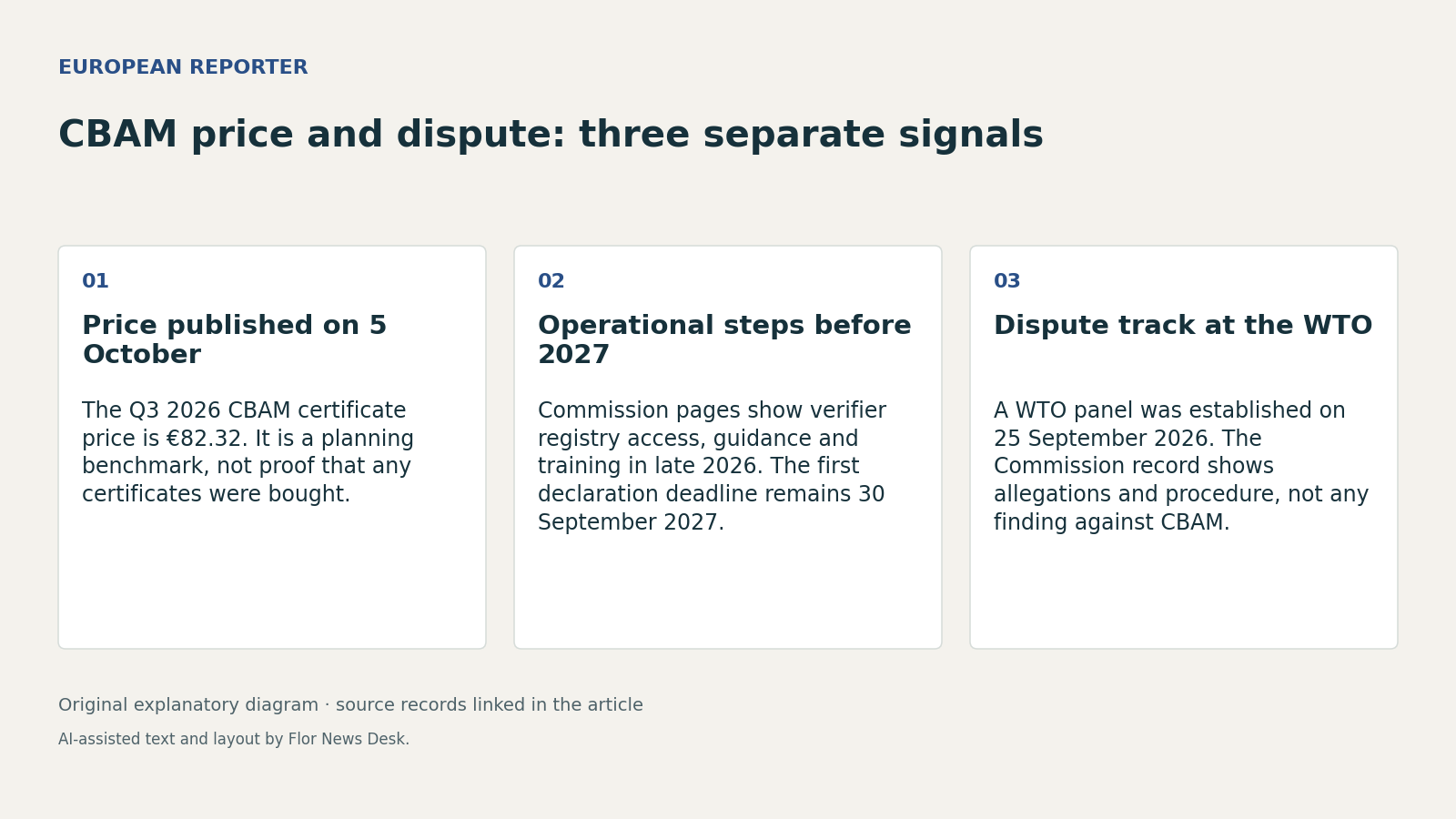
The European Commission gave businesses a more concrete CBAM cost signal on 5 October 2026 when it published the Q3 2026 certificate price at €82.32, weeks after the World Trade Organization’s Dispute Settlement Body established a panel in a Russian complaint against the measure on 25 September 2026. Taken together, those developments matter because they point in different directions: one is an operating benchmark for compliance planning, the other is a legal challenge whose outcome is not yet known. Commission CBAM price page Commission WTO dispute page
The price itself is narrow but useful. According to the Commission’s CBAM price page, 2026 uses quarterly certificate prices, with weekly prices planned from 2027, and each quarterly price applies to sales of certificates corresponding to emissions in CBAM goods imported during that quarter. The Q3 figure is above the Q1 price of €75.36 and the Q2 price of €75.28, so companies modelling 2026 exposure now have a higher reference point for the third quarter than for the first half of the year. What the page does not show is just as important: it is not evidence that importers have already bought certificates, that the sales platform is operating, or that any compliance outcome has been measured. Commission CBAM price page
That timing distinction is central to reading the update correctly on 25 October 2026. The same Commission page says CBAM certificates will be purchased on the common central platform from February 2027 onwards, while a 30 September 2026 Commission webinar note describes 30 September 2027 as the first compliance deadline for CBAM declarations and corresponding certificates. In other words, a published price is not an implementation finish line. It is a piece of the mechanism’s accounting logic that arrives before the first recorded buying window and before the first annual deadline shown in these materials. Commission CBAM price page Commission CBAM news page
The Commission’s late-September operational updates also suggest where the immediate workload sits. Its CBAM news page records a procedure published on 28 August 2026 for verifiers to obtain access to the CBAM Registry from 1 September 2026, and entries on 28 September 2026 for verifier guidance, accreditation information, operational documents and training videos. That points to a practical phase in which verification capacity, registry access and administrative roles are being set up alongside importer planning. But the landing page does not establish how many verifiers have access, whether national competent authorities are applying the process uniformly, or how many firms are ready for certificate buying. Commission CBAM news page
The WTO case belongs on a different track. The Commission’s dispute page says the Russian Federation requested consultations on 12 May 2025, requested a panel on 10 July 2026 and saw that panel established on 25 September 2026. The same page records that the EU declined to enter consultations, citing the extraordinary circumstances created by Russia’s war of aggression against Ukraine, and it lists the WTO provisions Russia says CBAM and related measures breach, including several GATT articles and rules on import licensing and subsidies. Those are allegations attributed to Russia, not findings. The Commission record does not provide a ruling timetable, a panel report or any change in CBAM’s operation. Commission WTO dispute page
For importers and exporters, the practical reading is therefore more limited than either side of the story may suggest on its own. The October price publication gives a more expensive third-quarter benchmark for budgeting; the September WTO panel confirms that CBAM now faces a formal adjudicative process. Analysis based on the Commission records supports one immediate conclusion: implementation work is continuing while the legal dispute proceeds. The same records do not yet show whether the common platform will launch smoothly in February 2027, how verification will work across member states in practice, or whether the WTO case will produce findings that force policy changes later on. Commission CBAM price page Commission CBAM news page Commission WTO dispute page