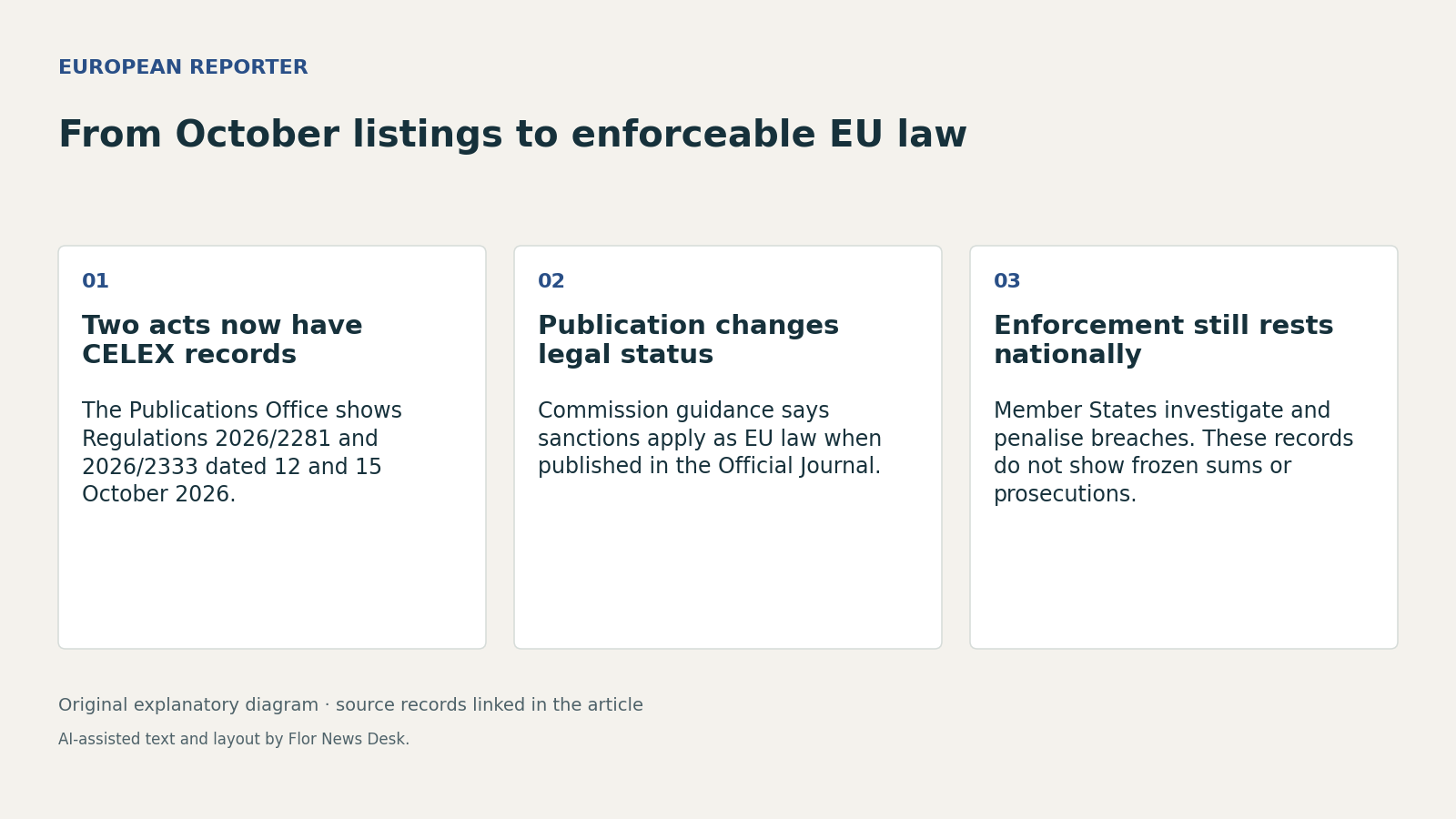

The Council’s October 2026 Russia listings crossed from political announcement into binding EU legal record when two implementing regulations appeared in the Official Journal system: Council Implementing Regulation (EU) 2026/2281, dated 12 October 2026, with CELEX 32026R2281, and Council Implementing Regulation (EU) 2026/2333, dated 15 October 2026, with CELEX 32026R2333. The Publications Office metadata establishes those acts and identifiers on the public record. Publications Office metadata for 2026/2281 Publications Office metadata for 2026/2333
Why that matters is institutional, not cosmetic. The Commission’s sanctions overview says sanctions become applicable EU law when they are published in the Official Journal, and that the resulting obligations bind EU nationals, people in the EU and those doing business there within EU jurisdiction. In other words, the mid-October publication dates are the point at which compliance checks can rely on identified legal acts rather than a policy summary alone. Commission sanctions overview
The legal hook is also specific. Both October acts are implementing regulations under Regulation (EU) No 269/2014, according to the Publications Office records. The Commission’s Russia sanctions page describes that regime for individual sanctions as using financial measures including asset freezes and a ban on making funds or economic resources available, alongside travel bans under Council Decision 2014/145/CFSP. That supports a careful distinction: the retrieved October records are enough to establish new binding regulation under the asset-freeze regime, but not, by themselves, a complete documentary record of every related travel-ban measure or every listed name. Publications Office metadata for 2026/2281 Publications Office metadata for 2026/2333 Commission page on Russia sanctions
That leaves the next stage with national authorities. The Commission says Member States are responsible for implementing sanctions, while the Commission oversees implementation, offers guidance and FAQs, and manages the consolidated list so it reflects officially adopted texts published in the Official Journal. The overview page adds that investigations into possible breaches and penalties for non-compliance fall to Member States and their national competent authorities. The practical consequence is that publication creates a common EU legal baseline, but enforcement still runs through national systems. Commission page on Russia sanctions Commission sanctions overview
Just as important is what the present record does not prove. The two Publications Office pages are metadata entries, not the full legal texts, and their stated limits matter: they confirm the acts’ existence and identifiers, but not the names listed, the operative provisions, the entry-into-force wording or any enforcement outcome. The Commission’s Russia page also cannot, on its own, verify the contents of the 15 October act or show frozen sums, seizures or prosecutions. As of 8 November 2026, this source set therefore supports a legal-status finding, not an effectiveness finding. Publications Office metadata for 2026/2281 Publications Office metadata for 2026/2333 Commission page on Russia sanctions
For European readers, that distinction is the real October development. By 15 October 2026, the Council had produced identifiable Official Journal acts that national authorities and affected operators can anchor to specific CELEX records. But publication is only the moment the rule becomes usable law. Whether those October listings produced blocked assets, denied transactions or penalties is a separate question, and the documents reviewed here do not yet answer it. Publications Office metadata for 2026/2333 Commission sanctions overview