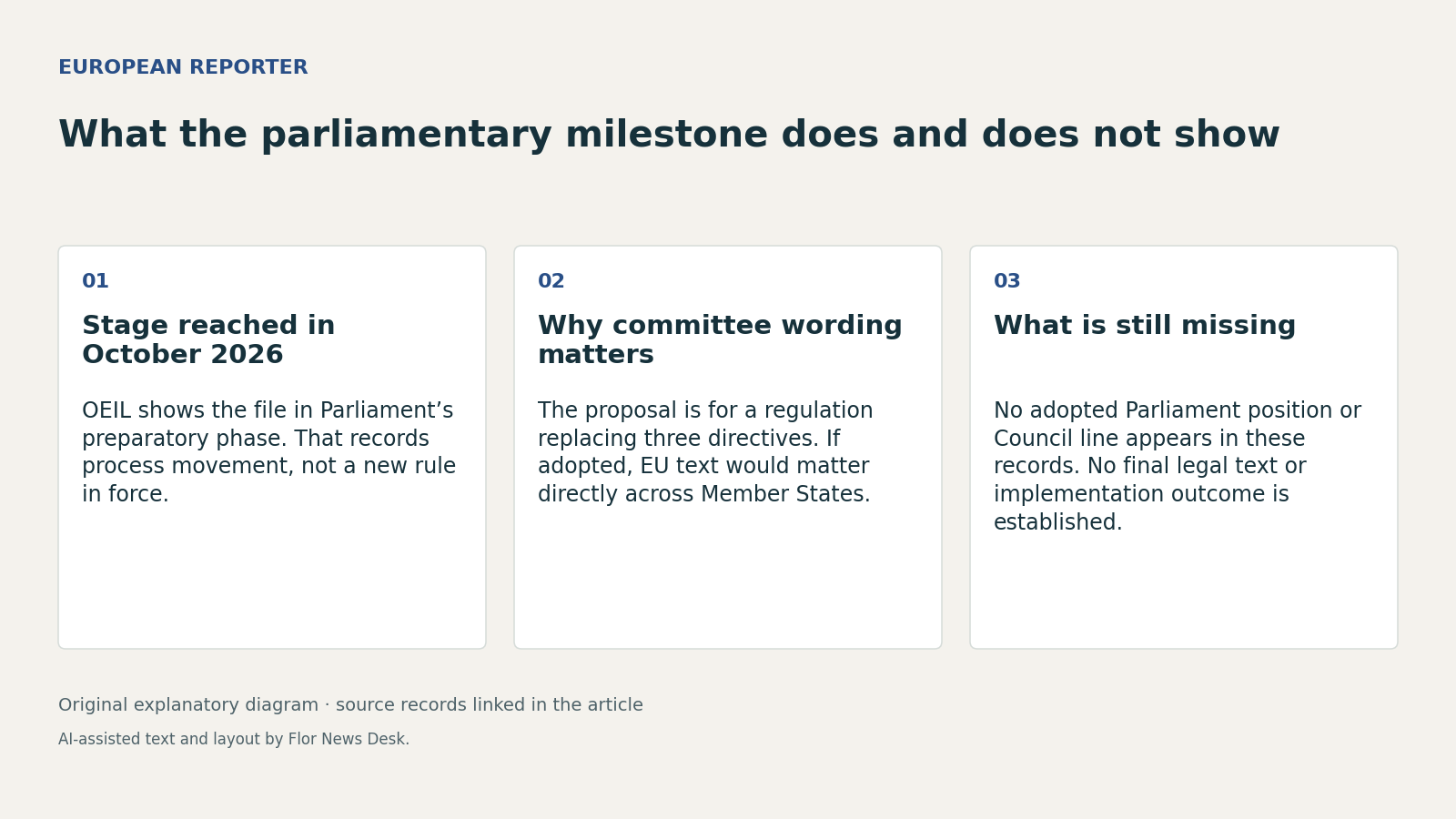

The EU’s proposed Public Procurement Act is no longer only a Commission text: the European Parliament’s OEIL procedure file now classifies it at the “Preparatory phase in Parliament” under the ordinary legislative procedure, following publication of the Commission proposal on 9 September 2026. That is a real institutional step, but not a legal one. The same OEIL record does not show an adopted Parliament position, committee report, plenary vote, Council position or final legislative text. OEIL procedure file
Why that procedural change matters is visible in the proposal’s legal form. The Commission’s 9 September package presents COM(2026)590 as a proposal for a regulation on public contracts and concessions, with annexes, an impact assessment and related staff working documents. According to the European Parliament Research Service, the proposal would repeal and replace Directives 2014/23/EU, 2014/24/EU and 2014/25/EU with one regulation that would be directly applicable in Member States if adopted. Commission proposal page EPRS briefing
That does not prove what Parliament will change, but it helps explain why committee-stage politics matters across borders. As analysis, a move from directives to a regulation would shift more of the practical argument onto the EU text itself, because national authorities and suppliers would have less scope to wait for three separate transposition exercises before assessing the operational impact. The EPRS note says public procurement accounts for about 15% of the EU-27’s combined GDP, or roughly €2.6 trillion a year, so even preparatory drafting choices have continent-wide implications if the proposal survives the legislative process. EPRS briefing
The same background note points to provisions likely to attract scrutiny once parliamentary amendments start appearing. It says the proposal would reduce the main procedure types to three, and would replace the current MEAT approach with “best quality for money”, with quality-related aspects weighted at at least 30% unless a justified exception is used. Those are still proposal contents, not adopted rules. But they are exactly the sort of drafting choices that contracting authorities, utilities and bidders in different Member States would need to track early, because they touch how tenders are structured and scored. EPRS briefing
The public record also shows the start of parliamentary positioning without yet proving a settled negotiating line. OEIL lists mandatory consultation of the European Economic and Social Committee and the European Committee of the Regions. In its transparency section, OEIL shows an IMCO shadow rapporteur entry for Jeannette Baljeu and a meeting published on 1 October 2026 with Acumen Public Affairs. That demonstrates that external contacts are appearing on the file, but OEIL’s own extract is partial and includes a “Load more” prompt, so it cannot be treated as a full map of who is shaping the debate. OEIL procedure file
The most useful conclusion for readers is therefore procedural, not predictive. The proposal has clearly entered Parliament’s working machinery, and the Parliament’s research service issued a “Legislation in Progress” briefing on 15 October 2026, showing the file is being prepared for political handling. But the available records do not establish a main rapporteur, a committee compromise, a Council negotiating position, a trilogue calendar or any implementation result. For now, the story is that EU-level text formation has begun; the story is not that Europe’s procurement law has changed. EPRS briefing OEIL procedure file