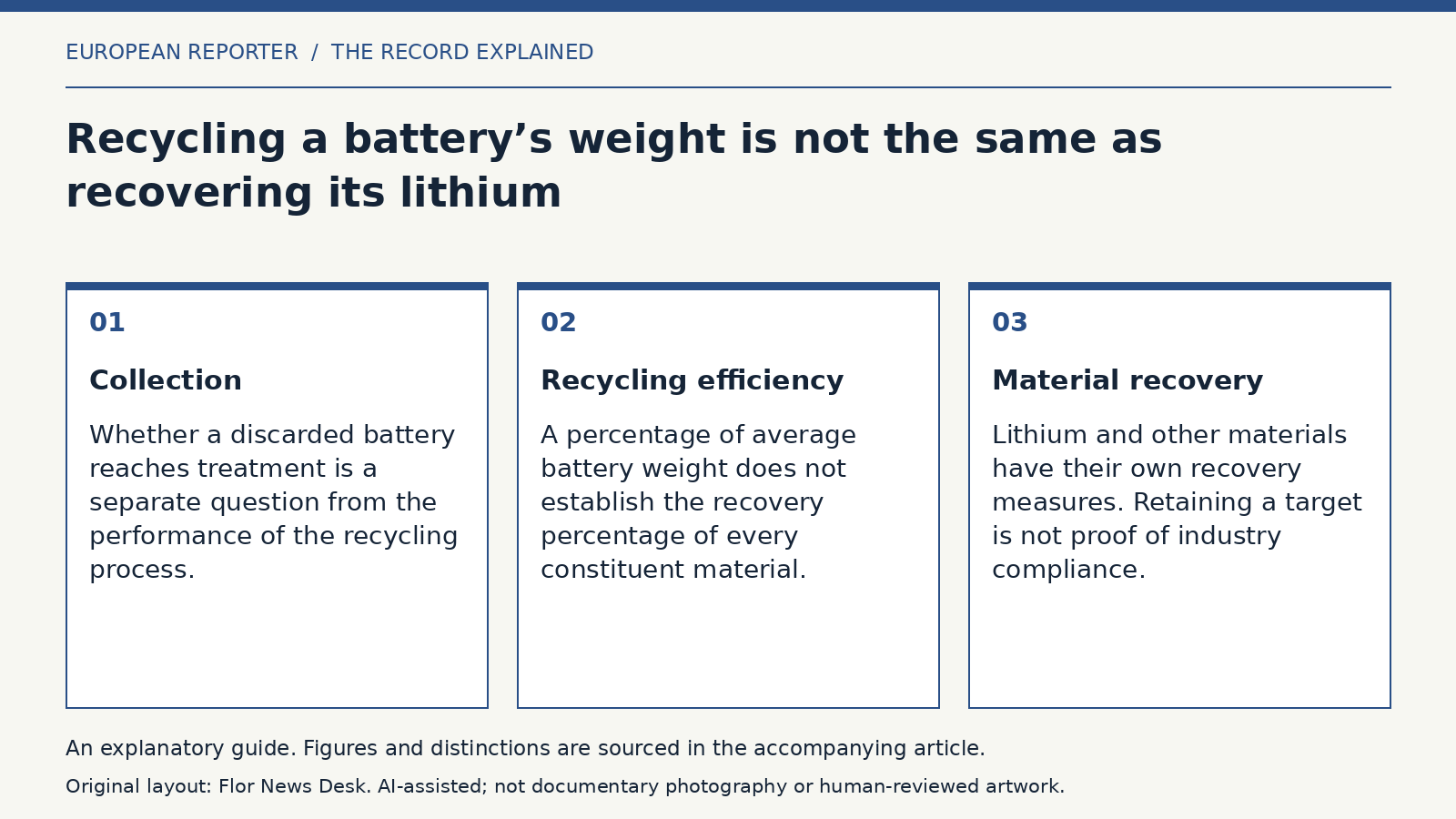
A battery-recycling percentage is incomplete information until the reader knows what is being counted. The European Commission’s September 11 assessment concludes that existing recycling-efficiency and material-recovery targets remain appropriate. That is a judgment about the targets, not a finding that every facility already meets them. It also concerns two different measures that should not be collapsed into one number.
The Commission describes a recycling-efficiency requirement of 65% by average weight for lithium-based batteries, with a deadline of December 31, 2025. It separately describes recovery of lithium at 50% by December 31, 2027. The first date is already in the past; the second remains ahead. Neither percentage can substitute for the other.
A whole product and a particular material
The distinction is one of measurement. A weight-based recycling result concerns the battery material entering and leaving a process under the relevant accounting method. A material-specific recovery result asks about a particular constituent. Describing a battery as lithium-based does not make every part of its weight lithium.
Consider a hypothetical process that recovers substantial quantities of some components while recovering less of another. Its overall result and its result for that particular material could differ. No real recycler is being described by this example. It explains why a single headline about recycled weight cannot establish the recovery performance of every material within the input.
There is a third question before either of those: whether waste batteries reach an appropriate collection and treatment route. The Commission’s battery-policy overview treats batteries across their lifecycle, including collection, reuse and recycling. A performance result for material that enters a process does not establish that all discarded batteries were collected in the first place.
Keeping a target leaves an evidence task
The September assessment says technological and market developments did not justify changing the targets. Its judgment about feasibility and ambition should remain attributed to the Commission. A statement that a requirement is suitable is not an audited observation of compliance across the industry. That distinction prevents both unwarranted reassurance and unwarranted accusations.
A useful performance account would therefore identify the reporting period, the relevant input and output, and the measure used. It would separate collection from treatment results and explain whether a figure concerns overall weight or an individual material. Without those details, comparisons can reward a change in labels rather than reveal a change in performance.
There is a legitimate argument for communicating a complex system through a small number of indicators. Simplicity becomes misleading, however, when one indicator is asked to establish something outside its definition. Clear labelling can preserve accessibility without implying that every percentage answers the same question.
The immediate policy development is the decision to retain the targets, not a newly demonstrated recycling outcome. Evaluating what happens next requires evidence matched to each measure. A credible account of circularity must show what was collected, what was recycled and which materials were recovered, without allowing one total to stand in for all three.