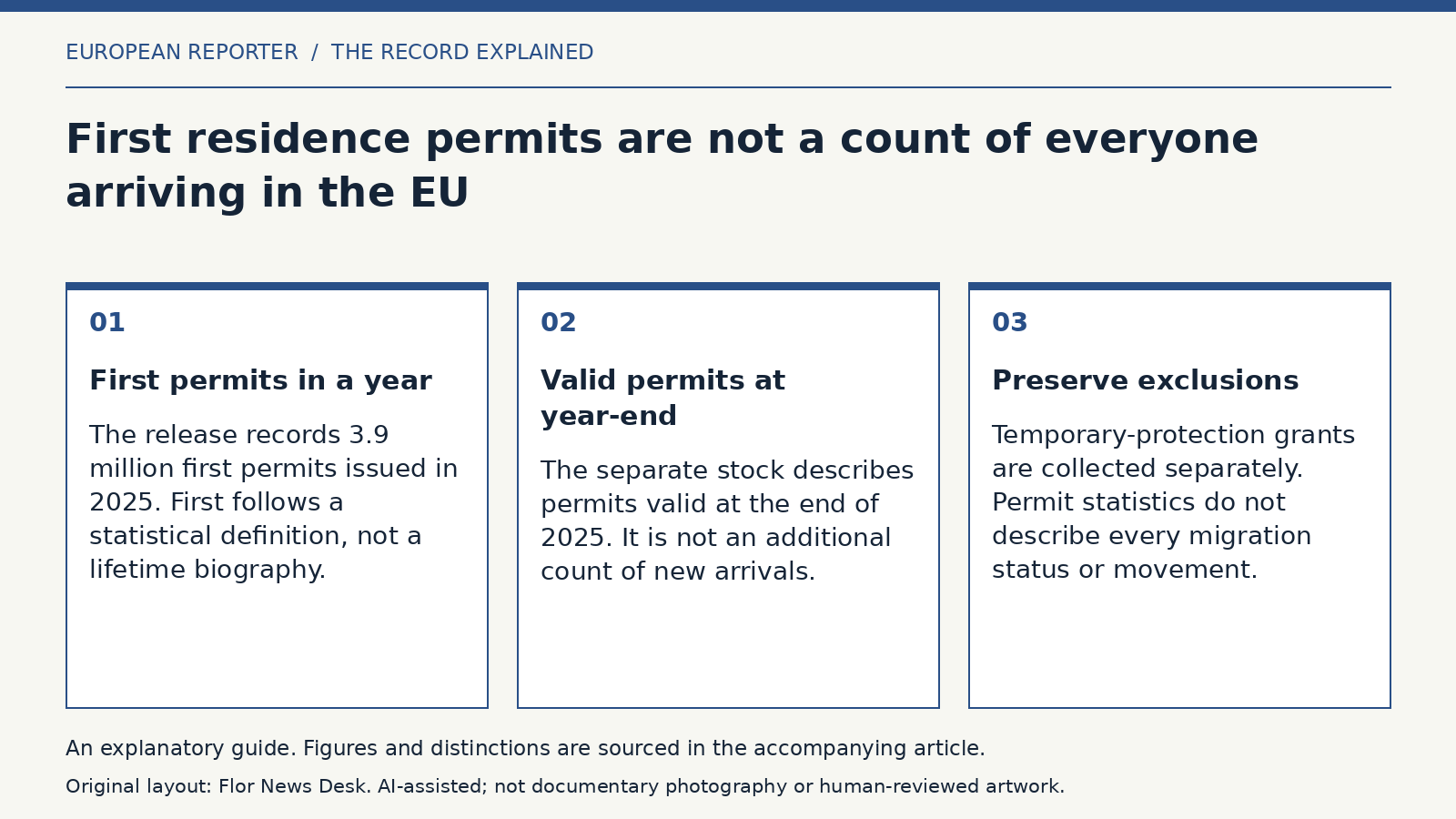

EU countries issued 3.9 million first residence permits to non-EU citizens in 2025, according to Eurostat’s September 11 release. The figure is an administrative measure for 2025, not a count of people arriving during September 2026. It also cannot be treated as a complete measure of every migration status simply because it appears under a broad migration headline.
Eurostat reports an increase of 10.1% from 2024. Employment accounted for 33.6% of the first permits and family reasons for 28.1%. Those categories describe the recorded reason for authorization. They do not, on their own, establish the later employment, household circumstances or length of stay of every permit holder.
What makes a permit first?
The statistical definition of a residence permit covers authorization to stay for at least three months. The definition of a new permit can include one issued after a gap of at least six months following the expiry of a previous permit. The word first therefore should not automatically be read as a person’s first-ever move to the country.
A hypothetical person with a previous authorization and a sufficiently long interruption illustrates the distinction. Their new permit can meet the statistical definition without establishing that they have never lived there before. That is a matter of the indicator’s construction, not evidence of an error in the count.
The release also excludes grants of temporary protection connected to Russia’s war against Ukraine, which are collected separately. Ignoring that exclusion would misstate the coverage. Equally, an excluded category cannot simply be added to the headline without checking dates, definitions and possible relationships between the measures.
An annual flow and a year-end stock
Eurostat separately reports 27.8 million valid permits at the end of 2025. That stock is not another estimate of the year’s first permits. It describes authorizations valid at a specified point, while the first-permit figure describes issuance during a period. Adding the two would not produce a meaningful total of distinct arrivals.
The distinction is important for public planning. A question about newly issued authorizations differs from a question about an existing population or demand for a particular local service. A national administrative total cannot supply a municipality’s required service forecast without information about place, timing and the relevant population.
There is a legitimate desire to understand migration through a small set of comparable figures. Comparability requires preserving the definitions rather than translating every measure into the same word, arrivals. Applications, authorizations, people present and changes in population are different observations, even when they concern related processes.
The permit series is useful precisely when its boundaries remain visible. It establishes the volume and recorded purposes of first authorizations under its definition. It does not establish every border crossing, every asylum application or the rights of a particular person. An accurate public debate should begin with that distinction before attaching a broader policy conclusion to the number.