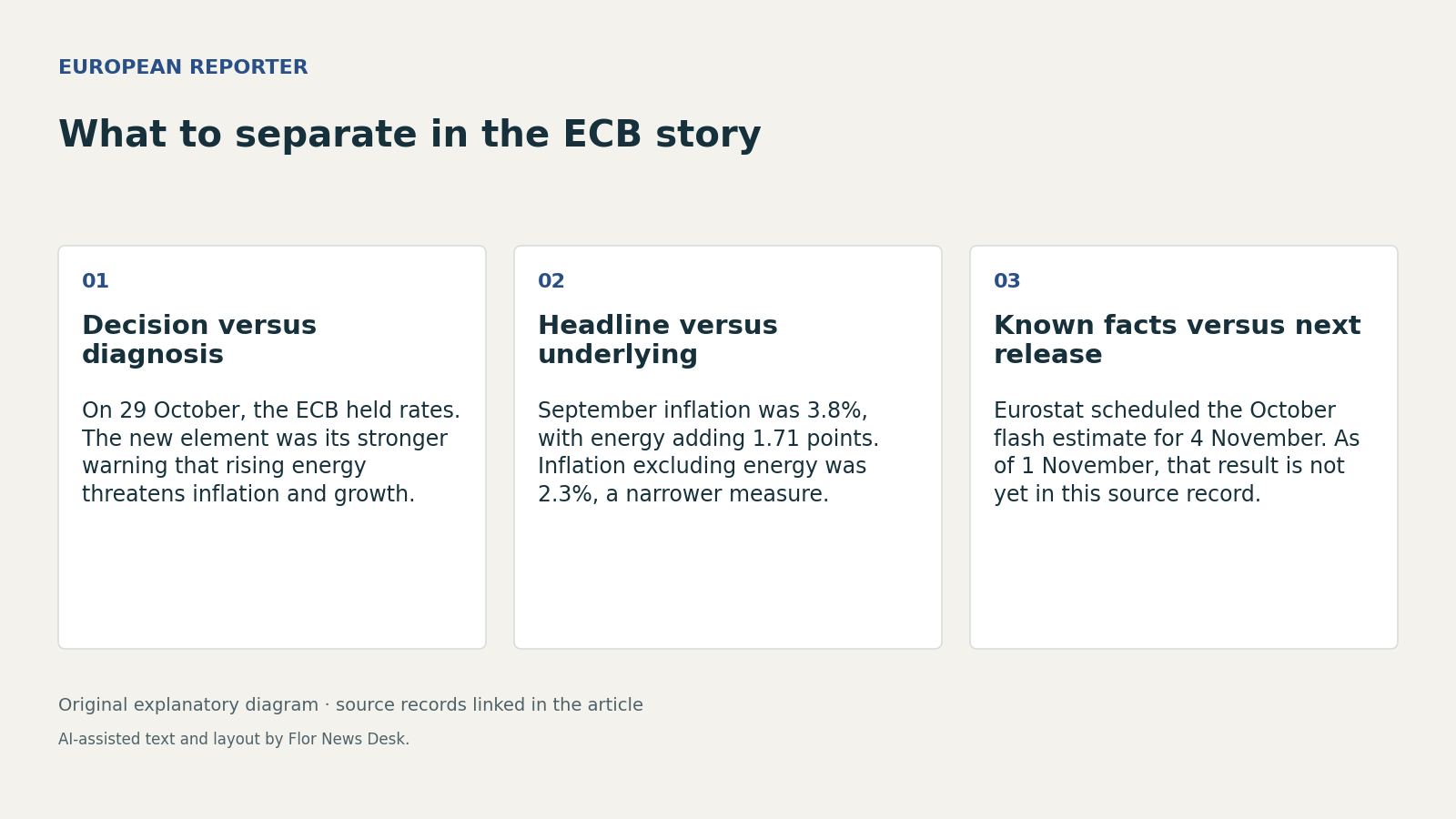
The European Central Bank’s Governing Council did not change interest rates on 29 October 2026. The deposit facility stayed at 2.50%, the main refinancing operations rate at 2.65%, and the marginal lending facility rate at 2.90% (ECB decision, 29 October 2026). The important change was interpretive, not mechanical: the ECB said energy prices had continued to rise and now posed upside risks to inflation and downside risks to growth (ECB decision, 29 October 2026).
That matters because the latest published inflation evidence in the source record is still September data. Eurostat reported euro-area annual inflation at 3.8% in September 2026, up from 3.2% in August, with energy contributing 1.71 percentage points, more than any other main component (Eurostat, 16 October 2026). In the ECB’s press-conference statement, the institution also said euro-area energy inflation rose to 18.9% in September from 14.3% in August, while inflation excluding energy rose to 2.3% from 2.1% (ECB press-conference statement). The analytical point is straightforward: if energy is doing most of the fresh lifting, headline inflation can re-accelerate even when broader price pressure looks less dramatic.
That helps explain why the ECB held rates rather than treating one energy-driven move as sufficient proof of a wider inflation restart. The 29 October decision said underlying inflation had remained broadly stable and that wages did not yet show a material response (ECB decision, 29 October 2026). The ECB’s simpler October explainer added that much higher energy prices were a concern for households and businesses, while bank loans to firms and households were still growing and mortgage demand had weakened as rates rose (ECB explainer). The press-conference statement gave more detail, saying corporate bank lending growth was 4.2% in August and September and mortgage lending growth eased to 3.0% in September (ECB press-conference statement). In other words, the ECB is weighing an energy shock against tighter financing conditions already in place.
The practical cross-border consequence is that one euro-area rate decision now applies across an EA21 aggregate, because Eurostat notes that Bulgaria joined the euro area from 1 January 2026 (Eurostat, 16 October 2026). But inflation conditions are not uniform even across the wider EU data Eurostat published: September annual rates ranged from 1.0% in Sweden to 6.5% in Romania, with Lithuania at 6.1% and Bulgaria at 5.6% (Eurostat, 16 October 2026). That does not show what each euro-area member will do next on household energy support or budgeting, because those national choices are not documented in these sources. It does show why a single ECB stance cannot map neatly onto every country’s inflation experience.
The next test is scheduled, not known. Eurostat said in its 16 October release that the flash estimate for October 2026 inflation was due on 4 November 2026 (Eurostat, 16 October 2026). Eurostat’s release-calendar page confirms that Euro indicators are organised through that calendar interface and that its times use the Europe/Luxembourg zone, but the retrieved record did not itself display a specific dated November entry (Eurostat release calendar). As of 1 November 2026, the evidence here therefore establishes a held-rate ECB, a sharper warning on energy, and a pending inflation reading, not the October outcome itself. The ECB also kept tightening in another sense: its decision says APP and PEPP portfolios are still shrinking because maturing securities are no longer reinvested (ECB decision, 29 October 2026).