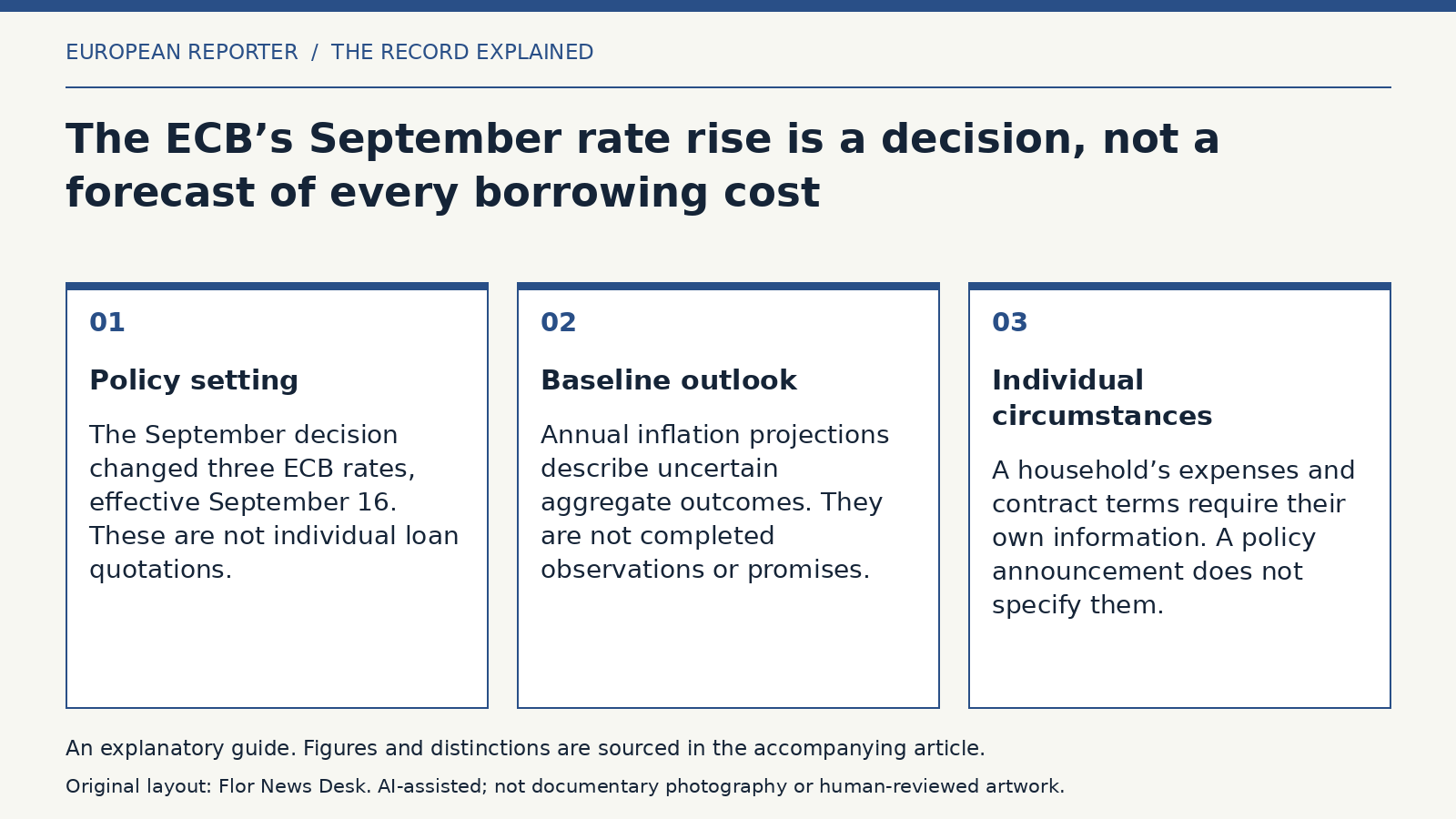

The European Central Bank’s September announcement contains a policy change that has taken effect and projections whose outcomes remain uncertain. Keeping those categories apart is essential to understanding what the decision establishes. The September 10 decision increased all three key rates by 25 basis points, or a quarter of a percentage point, effective September 16. The deposit facility rate became 2.50%, the main refinancing rate 2.65% and the marginal lending rate 2.90%.
Those are the institution’s policy settings, not a table of prices available to every borrower. An announcement about their level cannot tell an individual what a lender will offer, when an existing agreement changes or what other terms apply. Those conclusions would require information about the actual agreement.
An outlook is not a second decision
The ECB’s explanation of its September assessment describes inflation pressure from the Middle East conflict alongside a more resilient economy than previously expected. Its explanation presents the case for the decision; it does not independently establish every cause of a particular household’s price increases.
The staff baseline projects annual headline inflation of 3.0% in 2026, 2.5% in 2027 and 2.1% in 2028. These figures describe an expected path for an aggregate price measure. They are neither completed annual observations nor a promise that every product will change in price at that pace. The numerical similarity between a policy rate and an inflation projection would not make them the same kind of quantity.
Consider a hypothetical budget that treats a projected inflation figure as a guaranteed increase in every expense. Even an accurate aggregate forecast would not validate that assumption. The budget has introduced a claim about its own composition that the forecast does not contain. The same problem arises when a policy-rate announcement is treated as a complete description of a financing contract.
Read the dates as well as the numbers
Three dates deserve separate attention: the announcement, the effective date and the period covered by a projection. A decision announced on September 10 can take effect on September 16 while discussing annual outcomes extending to 2028. Presenting all of that information as something that happened on one day would erase the distinction between action and expectation.
There is a practical reason to report forecasts despite these limits. They explain the assumptions against which the institution is acting and can later be compared with outcomes. Their uncertainty is a reason to preserve their status, not to ignore them or convert them into certainty.
The Governing Council explicitly declines to commit to a particular future rate path. Its September decision therefore supports a precise conclusion about the new settings, but not a prediction of the next meeting. A useful reading keeps policy, outlook and individual financial circumstances on separate lines instead of turning one headline into an answer to all three.