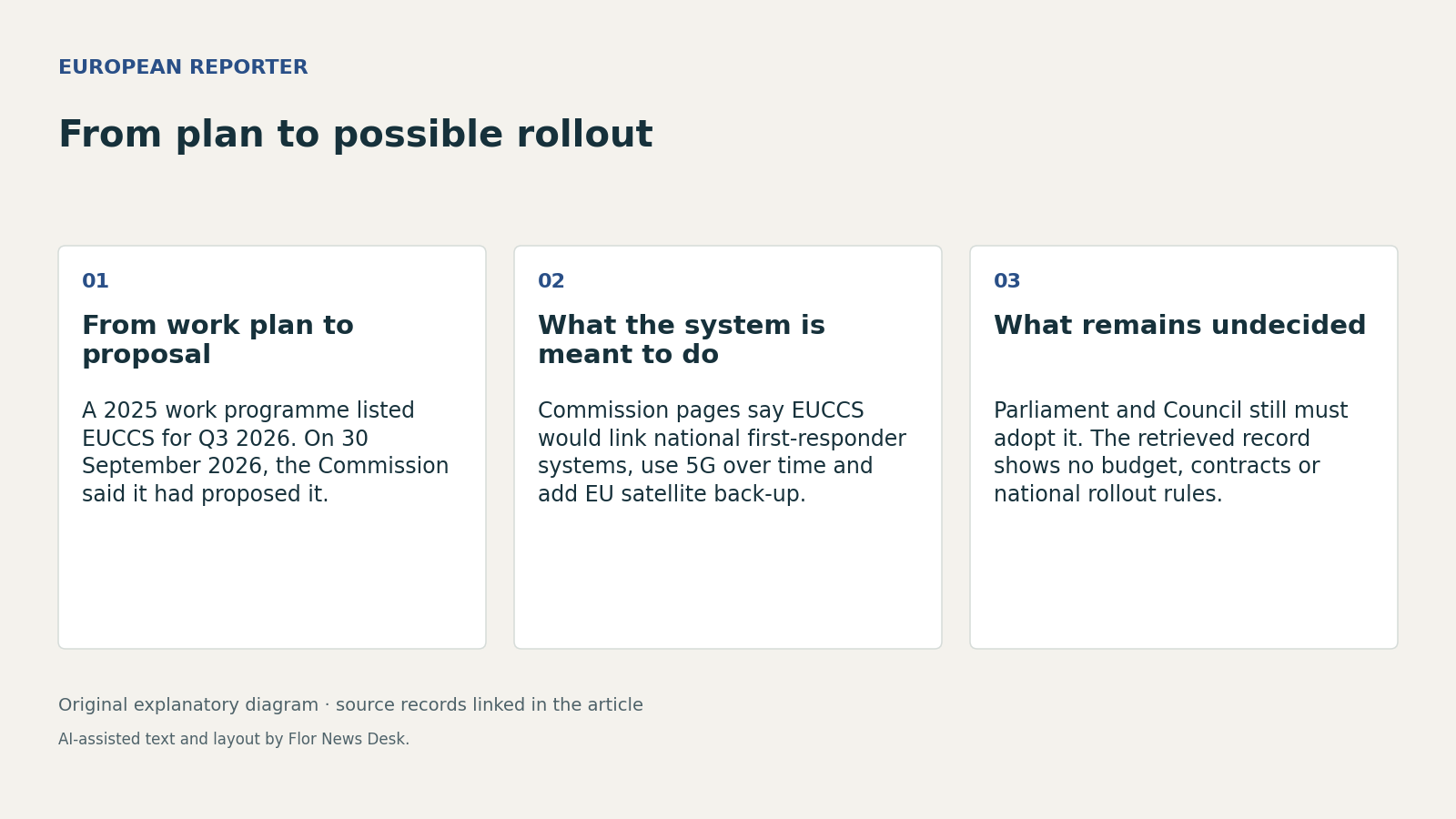
The European Commission changed the status of the EU Critical Communication System on 30 September 2026 from a planned initiative into a formal proposal now entering the EU legislative process. The Commission’s home affairs site says it proposed the new system that day, and the Commission’s audiovisual service shows the file was presented in a College read-out and press conference by Executive Vice-President Henna Virkkunen and Commissioner Magnus Brunner. That is a real institutional step, even if it is not yet an operating network. DG HOME announcement Audiovisual record
The practical case the Commission is making is straightforward. Its 30 September page says existing national critical communication systems are not technically compatible or interlinked, and that EUCCS would connect the systems used by police, firefighters, emergency medical services and other civil protection organisations across the EU and Schengen associated countries. The same page says the 31 participating countries would gradually move from narrowband radio to broadband technology such as 5G, with EU satellites providing back-up when land-based systems are incapacitated. If that architecture is eventually adopted and built, the cross-border gain would be the ability to keep first-responder communications going across jurisdictions and through outages. The retrieved pages do not, however, explain the technical integration model between national systems. DG HOME announcement
What changed on 30 September is clearer when set against the earlier paper trail. In the Commission work programme for 2026, dated 21 October 2025, the Commission had already listed “Creation of a European critical communication system” in Annex I as a legislative initiative scheduled for Q3 2026 and associated that planned initiative with Article 87 TFEU. The new Commission pages show that the proposal stage has now been reached within that planned quarter. But the work programme remains a planning document, not the proposal itself, so it cannot prove the final legal wording or the exact legal basis used in the 2026 draft. Commission work programme 2026
The Commission is also signalling that EUCCS is meant to be an industrial and resilience project, not only an emergency-services file. Its digital-strategy news page says the proposed system would rely on critical components built by European companies and links the initiative to President Ursula von der Leyen’s Political Guidelines. That gives suppliers a political signal about the direction of travel. It does not yet answer the harder market questions. The retrieved summary page, which shows a last update of 1 October 2026, is not the legal text and does not set out tender design, supplier eligibility, contract timing or a budget. Digital Strategy page
That gap matters because the immediate consequences are legislative and administrative, not operational. The Commission’s 30 September home affairs page says the European Parliament and the Council still need to adopt the Regulations, and that launch is planned to start gradually from 2030. Those are forward-looking milestones rather than measured outcomes. The current record therefore supports a narrower conclusion: Brussels has opened a legislative file and publicly backed it at College level, but it has not yet shown that member states have funding, contracts, interoperable roadmaps or deployment rules in place. DG HOME announcement Audiovisual record
For national administrations, first-responder agencies and telecom suppliers, the key shift is that the question is no longer whether the Commission intends to legislate. It has done so. The unresolved questions now move to the next stage: what Parliament and Council accept, what the unretrieved draft text actually requires, and how countries will connect existing systems without a funding and procurement framework yet visible in the sources above. DG HOME announcement Commission work programme 2026