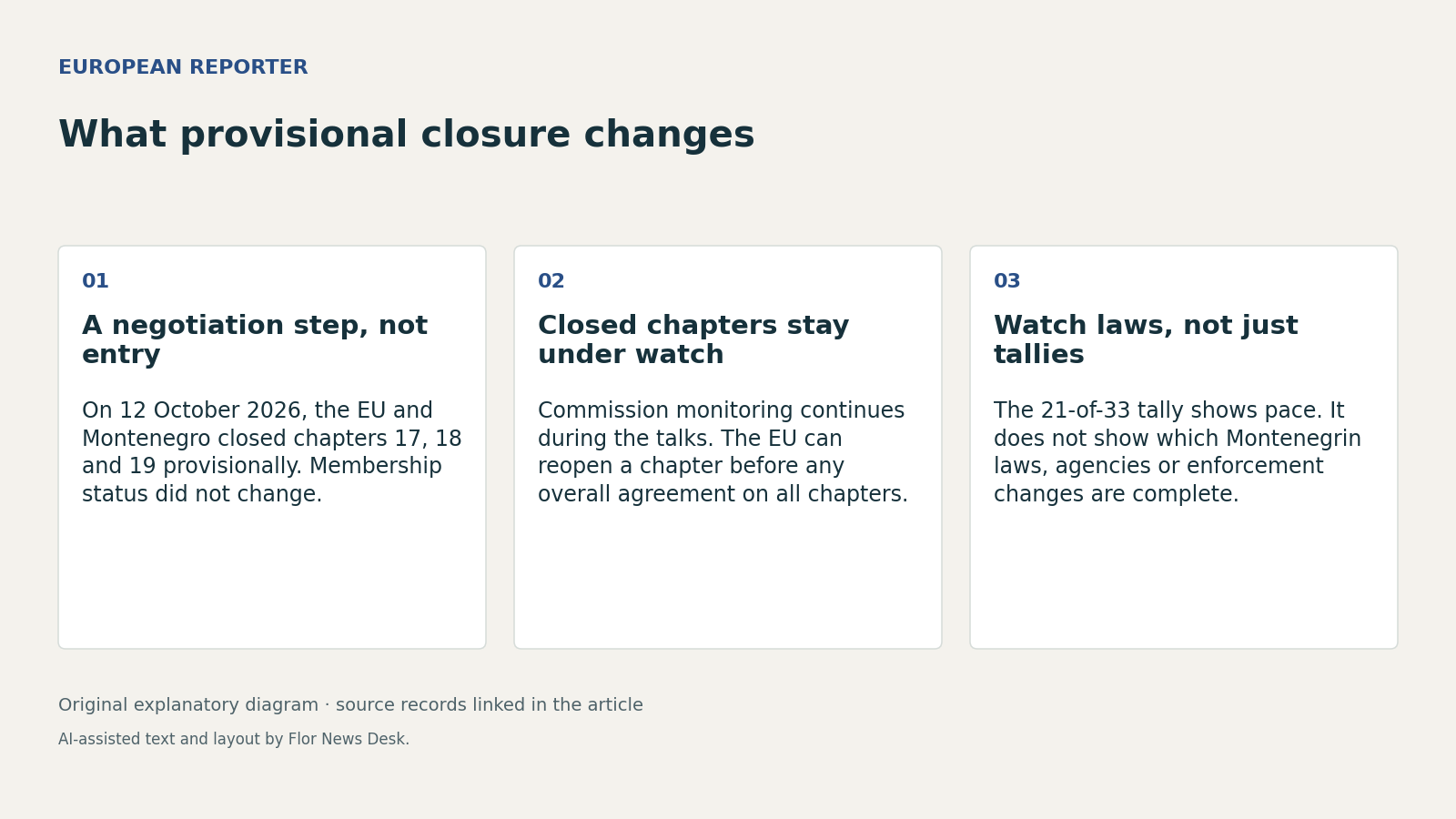
The EU’s 12 October 2026 move on Montenegro was a real accession milestone, but a limited one. A European Commission enlargement page says the EU and Montenegro provisionally closed negotiations on chapter 17, Economic and monetary policy, chapter 18, Statistics, and chapter 19, Social policy and employment. The same record says Montenegro had then opened all 33 chapters and provisionally closed 21 of them.Commission news
What changed, then, is the negotiating status of those three chapters inside the accession process. What did not change is Montenegro’s legal status outside the EU. The same Commission page says monitoring of Montenegro’s alignment with and implementation of the EU acquis continues throughout the negotiations, that agreements on individual chapters are not final until there is an overall agreement on all chapters, and that the EU can return to a chapter if needed.Commission news In other words, “provisionally closed” is best read as a checkpoint in an intergovernmental process, not as proof that every rule in those fields is settled and operating.
That distinction matters because the three chapter titles point to areas with everyday cross-border effects, even if the public record used here does not list the underlying Montenegrin measures. Economic and monetary policy reaches into how a candidate aligns with EU policy frameworks; statistics matters for the comparability of public data; social policy and employment shapes the regulatory ground on which employers, workers and labour authorities meet. The analytical point is narrow: when talks close provisionally in those fields, outside readers should pay more attention to follow-up implementation and monitoring, not less.Commission news
The October step also looks more significant when placed in Montenegro’s 2026 sequence. The Commission’s Montenegro country page lists provisional closures in January 2026 for chapter 32, in March for chapter 21, in June for chapters 2 and 28, and in July for chapters 8 and 29. The same page says accession negotiations started on 29 June 2012 and records a June 2024 accession conference confirming interim benchmarks for chapters 23 and 24.Montenegro country page That does not prove a final timetable, but it does show that October’s closures were part of a sustained negotiating run rather than an isolated announcement.
For businesses, analysts and regulators dealing with Montenegro, the practical lesson is to separate chapter tallies from concrete legal effects. The same country page records other forms of integration that are distinct from chapter closure: Montenegro joined the geographical scope of the Single Euro Payments Area schemes in November 2024, and the page lists 2025 releases under the Reform and Growth Facility for the Western Balkans through Commission implementing decisions.Montenegro country page Those examples show why accession reporting needs careful labels. A negotiating advance, a sectoral integration step and an actual funding disbursement are not the same event.
One source caution matters here. The country page mixes dated milestones with older undated background text; as of 3 November 2026, its older line saying 16 chapters had been provisionally closed after eight years of negotiations is stale beside the dated 2026 entries and the 12 October 2026 news item showing 21 closed chapters.Montenegro country page Using the dated October record, the clearest conclusion is modest: Montenegro moved further through the EU’s accession machinery on 12 October 2026, but the available public pages do not establish final implementation in those chapters or any completed accession outcome after that date.Commission news