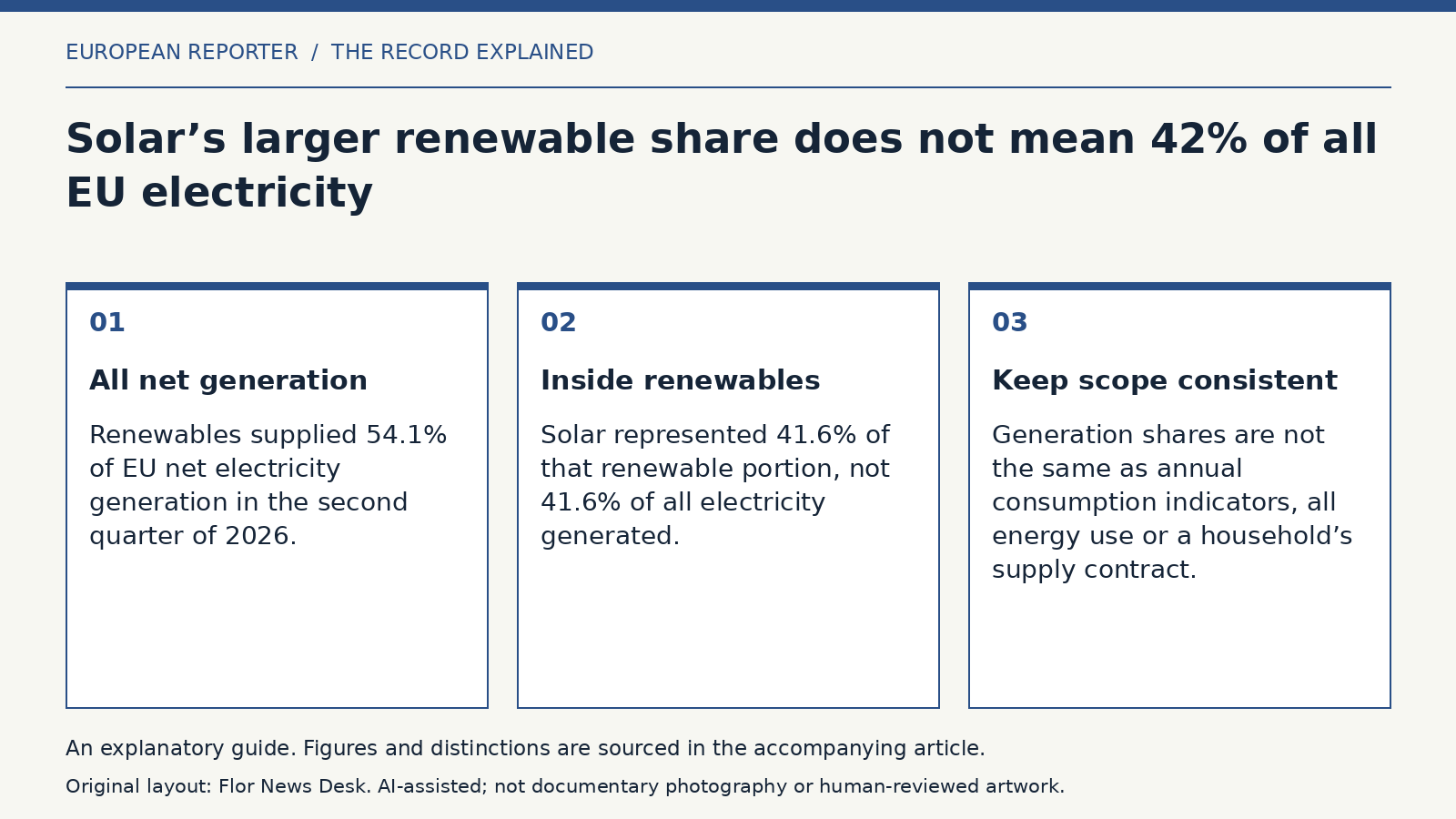

Solar accounted for 41.6% of the European Union’s renewable electricity generation in the second quarter of 2026. It did not account for 41.6% of all electricity generated. That difference is easy to lose when two percentages from the same release are placed beside each other without their denominators. Eurostat’s September 18 publication puts renewables at 54.1% of total net electricity generation, compared with 54.3% a year earlier.
Within the renewable portion, solar’s share rose from 37.0% to 41.6%. The two movements are not contradictory. One describes the renewable portion of the whole system; the other describes the composition of that portion. A source can gain weight inside a category even when the category’s share of the total is slightly smaller.
Two shares, one multiplication
Combining the published rounded shares gives an approximate solar contribution to total generation: 54.1% multiplied by 41.6% is about 22.5%. This is a calculation from rounded inputs, not an additional unrounded Eurostat observation. It is useful for explaining the relationship, but it should not be presented with a precision the inputs cannot support.
A hypothetical collection of one hundred units makes the distinction intuitive. First identify the renewable units, then identify the solar portion within them. Applying the solar percentage to all one hundred units would silently change the population to which that percentage refers. The error concerns the denominator, not an argument about whether solar is important.
Neither share alone establishes whether the absolute amount of electricity generated increased. A percentage can change because its numerator changes, its denominator changes, or both. Establishing the physical change would require the generation quantities as well as the shares.
Electricity generation is not all energy consumption
Eurostat’s renewable energy statistics guide places electricity within a wider system of energy indicators. The quarterly generation measure should not be substituted for the annual consumption-based indicator used to monitor the Renewable Energy Directive. The release itself explains that the latter uses a different methodology, including normalization of wind and hydro generation.
This distinction matters when assessing a policy claim. A strong quarter for renewable electricity cannot, by itself, establish the renewable share of all energy used in transport, heating and other activities. Nor does a country’s generation mix describe the particular supply contract of a household within that country. Those are different scopes.
The quarterly figures remain useful. They provide a dated view of production and its changing composition, rather than a universal score for the energy transition. Comparisons become more informative when the same period, territory and measurement method are retained.
The most defensible conclusion is therefore specific: solar occupied a larger part of the EU’s renewable electricity mix in this quarter, while renewables’ share of total net generation was slightly lower than a year earlier. Explaining both facts is more revealing than choosing whichever percentage makes the strongest headline.