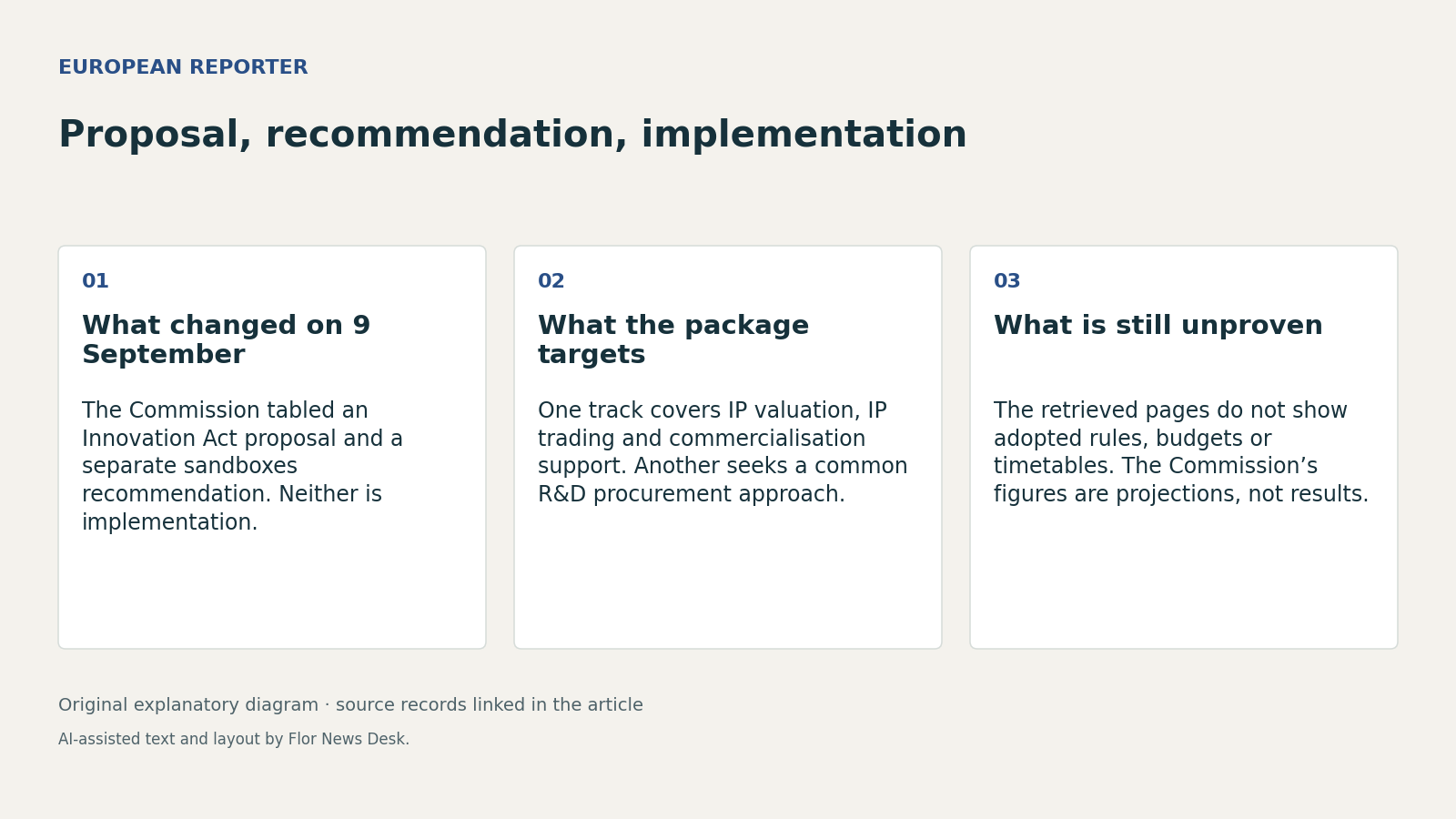

On 9 September 2026, the European Commission said it had proposed a European Innovation Act and, in parallel, a Council Recommendation on regulatory sandboxes. That is the immediate institutional change: ideas that had circulated in strategy documents were moved into a formal proposal stage, but the retrieved record does not show that any of them are already in force across the EU. Commission news Innovation legislation page
The Commission says the core Innovation Act package would create an EU framework for valuing intellectual property, a digital marketplace linking buyers and sellers of intellectual property, and expert support for commercialisation. Analytically, that points to a common problem the Commission is trying to solve: European firms may hold patents and other IP, but those assets can be hard to compare, license or use in financing without shared valuation methods and transaction channels. What the sources establish, however, is the Commission’s intended architecture, not proof that investors, lenders or counterparties will adopt it on the scale projected. Commission news IP Helpdesk note
That distinction matters because the headline numbers in the package are forecasts. The Commission estimated the intellectual-property measures could unlock €10.2 billion a year in additional financing and deliver about €35 million in administrative savings. It also projected that the R&D procurement part could bring €25.92 billion in additional annual profits for companies and €1 billion a year in savings for public buyers. Those figures are useful for understanding the Commission’s policy case, but the retrieved pages do not present them as measured outcomes. Commission news
The procurement element is especially important for cross-border readers because it is aimed at public buyers, not only startups. According to the Commission, the proposal would create a common approach to research and development procurement to increase legal certainty and make joint R&D procurements by public buyers in different EU countries easier. If that were eventually adopted and implemented, the practical consequence could be less fragmentation when several authorities want to test or buy emerging technologies together. But the retrieved record does not yet show the precise obligations that national procurement teams would face. Commission news IP Helpdesk note
The sandboxes part is narrower than a casual reading might suggest. The Commission’s research and innovation page says the 9 September 2026 proposal on sandboxes is a Council Recommendation intended to create a common understanding of regulatory sandboxes and set minimum elements for a common EU reference framework where no EU legislation already applies. The same page lists existing EU-sector examples, including the AI Act, the Interoperable Europe Act, the Net-Zero Industry Act and the DLT pilot regime. So this is not evidence of a single, EU-wide waiver from regulation. It is an attempt to align how sandboxes are understood and designed across areas that are still uneven. Innovation legislation page
The broader policy lineage also tempers any claim that 9 September settled the issue. The New European Innovation Agenda roadmap shows that experimentation spaces and innovation procurement had already been a running Commission workstream, including a staff working document in July 2023 and an advisory-group report published in July 2024. A 14 September 2026 helpdesk page placed the new package under the EU Startup and Scaleup Strategy and the Competitiveness Compass. As of 27 September 2026, though, the retrieved record still does not establish the Innovation Act’s exact legal form, article-by-article duties, budget, Parliament timetable, Council timetable, adoption or implementation. For companies and public buyers, that means the package is best read as a clear policy direction from the Commission, not yet as an operational EU rulebook. Flagship 2 roadmap IP Helpdesk note