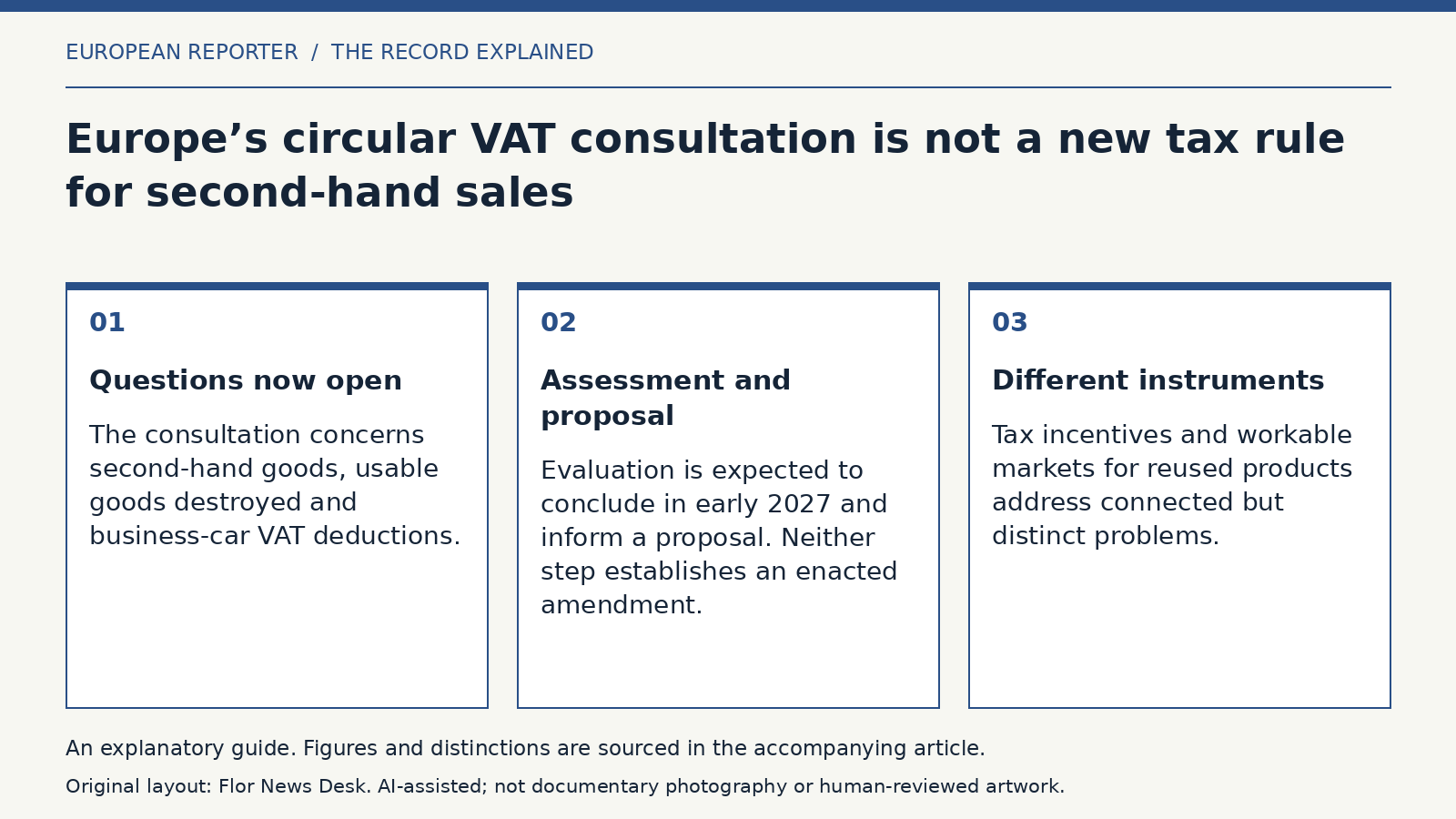
The European Commission is asking how value-added tax could better support circular business models. It has not, through that request, changed the tax treatment of a second-hand transaction. The consultation announced on September 10 invites responses by November 4, 2026, and covers second-hand goods, destruction of usable goods and VAT deductions for passenger cars used for business. These are areas for examination, not a list of newly applicable concessions.
The Commission expects its parallel evaluation and impact assessment to conclude in early 2027. It says the findings will inform a proposal to amend the VAT Directive. A consultation, an assessment and a legislative proposal are successive forms of work; announcing the first does not establish the final content or adoption of the last.
Circularity is not only a tax question
The broader policy discussion provides useful context. In an April 30 account of stakeholder talks, the Commission described work on markets for secondary raw materials and the recovery of critical resources from waste. That is a dated account of the discussion, not evidence that every measure considered then has subsequently become law.
Placed together, the records identify two kinds of problem. Tax treatment concerns incentives and the terms under which transactions are recognized. A market for reused goods or recovered materials also requires an intelligible account of what is being sold. Addressing one question cannot automatically settle the other.
Imagine a hypothetical business with a usable product available for resale. Changing the tax calculation would not, by itself, establish that a purchaser can verify the product’s condition or obtain it through a workable transaction. Conversely, resolving those practical questions would not answer how the transaction should be treated for tax purposes. The example illustrates separate decision points, not the circumstances of a particular business.
Evidence should match the proposed change
A persuasive consultation response would connect a specific rule to a specific difficulty and explain why a proposed change would address it. A general claim that circular activity is desirable cannot establish the effect of every possible VAT amendment. The relevant comparison is between alternatives and their consequences, not simply between support for circularity and opposition to it.
There is also a reasonable concern that additional distinctions could make administration harder. That concern does not decide the policy question, but it belongs in the assessment alongside the intended environmental or commercial benefit. A measure can have a defensible objective while still needing a clearer explanation of how it would operate.
For readers, the practical distinction is between following a policy process and relying on a rule. The September announcement is a source for the consultation’s scope and timetable. It is not an answer about the tax liability, deduction or invoice treatment of an individual transaction.
The debate will be more useful if it remains specific about both stage and purpose. Circular-economy goals can explain why tax rules are being examined; they cannot turn an open question into an enacted outcome before the legislative work has been completed.