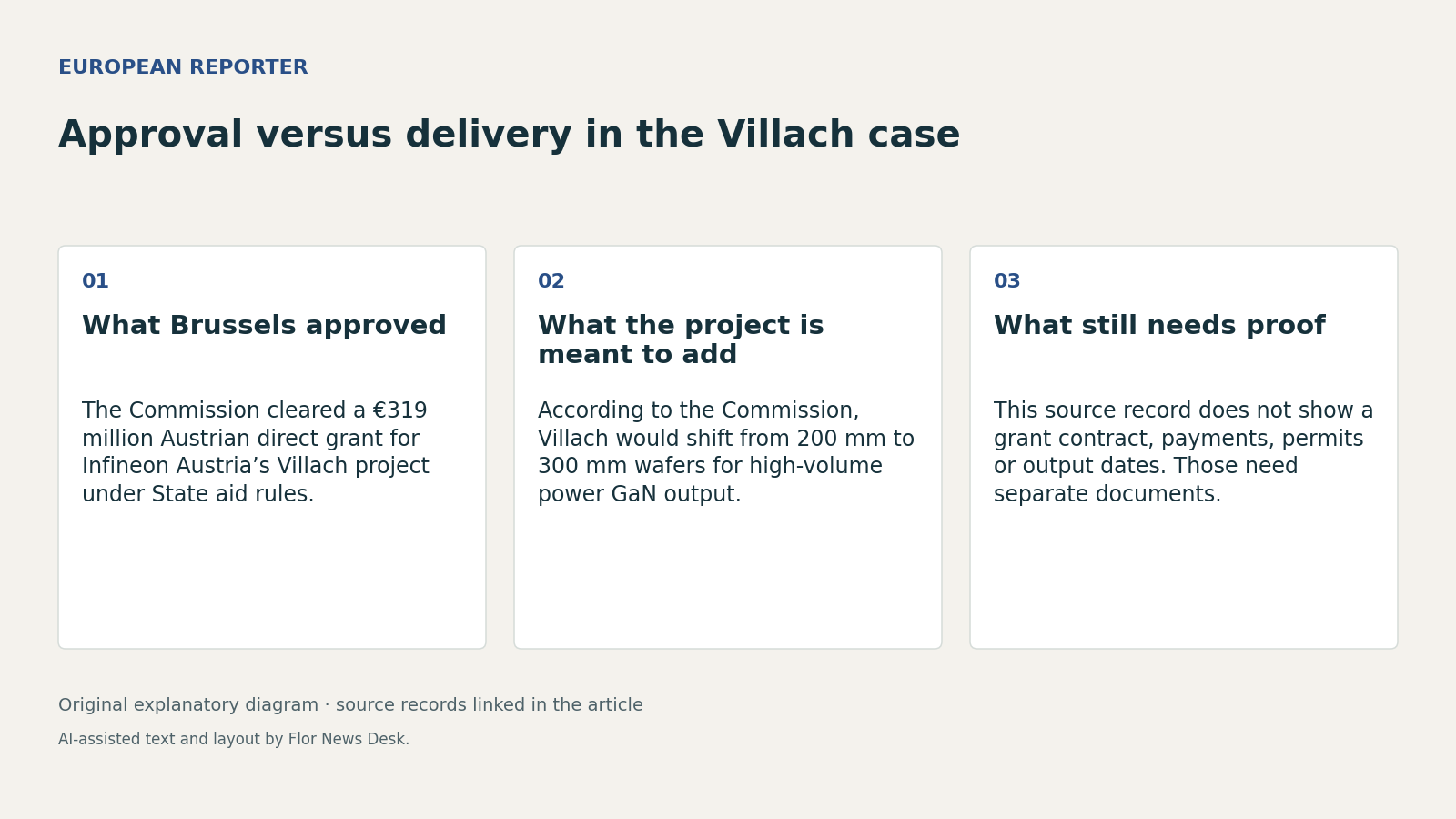
On a European Commission page last updated 27 October 2026, the Commission said it had approved €319 million in Austrian State aid for Infineon Technologies Austria AG’s Villach site in Carinthia, through a direct grant for the company’s “Empowering Fab” project Commission notice. The concrete institutional change is narrow but important: Austria now has EU clearance, under the Commission’s assessment, to support that project with the notified aid measure.
According to the Commission, the project is meant to turn existing Villach production from 200 mm capability to 300 mm wafers for high-volume manufacturing of power gallium nitride devices, and it describes that planned 300 mm power-GaN capacity as first-of-a-kind in the EU Commission notice. If that description holds through implementation, the practical significance would reach beyond Austria: the project is being presented as part of Europe’s attempt to build semiconductor capacity in areas the bloc considers strategic.
But readers should separate that policy case from what has actually been evidenced in public here. The Commission says it assessed the measure under Article 107(3)(c) of the Treaty on the Functioning of the European Union and under principles set out in the European Chips Act Commission notice. That is a compatibility decision on State aid, not proof that Austria has already signed a grant agreement, transferred money, approved local works or established a production timetable. As of 4 November 2026, the retrieved source record for this draft does not supply those later-stage documents.
The Commission’s own case-search guide helps explain why that distinction matters. It says State aid cases use SA numbers; entries can later include a decision date, decision type, a press-release link and decision texts once confidential information has been removed; and “direct grant” is one of the aid instruments used in the database cases search user guide. In other words, the press notice identifies the case and the instrument, but the fuller legal and procedural record may appear separately and later.
That makes this a meaningful chips-policy milestone, but not yet a delivery story. For cross-border readers, the relevant question is not whether Brussels likes the project in principle; the notice already answers that. The unresolved question is when, and on what national terms, the approved aid becomes an operating investment with permits, spending and measurable output. Nothing in the two retrieved Commission records establishes construction start, environmental clearance, disbursement timing or eventual production volumes Commission notice cases search user guide.
The next reporting checkpoints are therefore administrative, not rhetorical. The Commission page says a non-confidential version of the decision is to be published under case SA.113427 once confidentiality issues are resolved Commission notice. The case-search guide indicates that the register is where readers should expect the decision type and decision text when available cases search user guide. After that, any Austrian budget act, grant contract, local permit or company statement would answer a different question again: not whether the aid is lawful under EU rules, but whether the fab upgrade is actually moving from approval into execution.