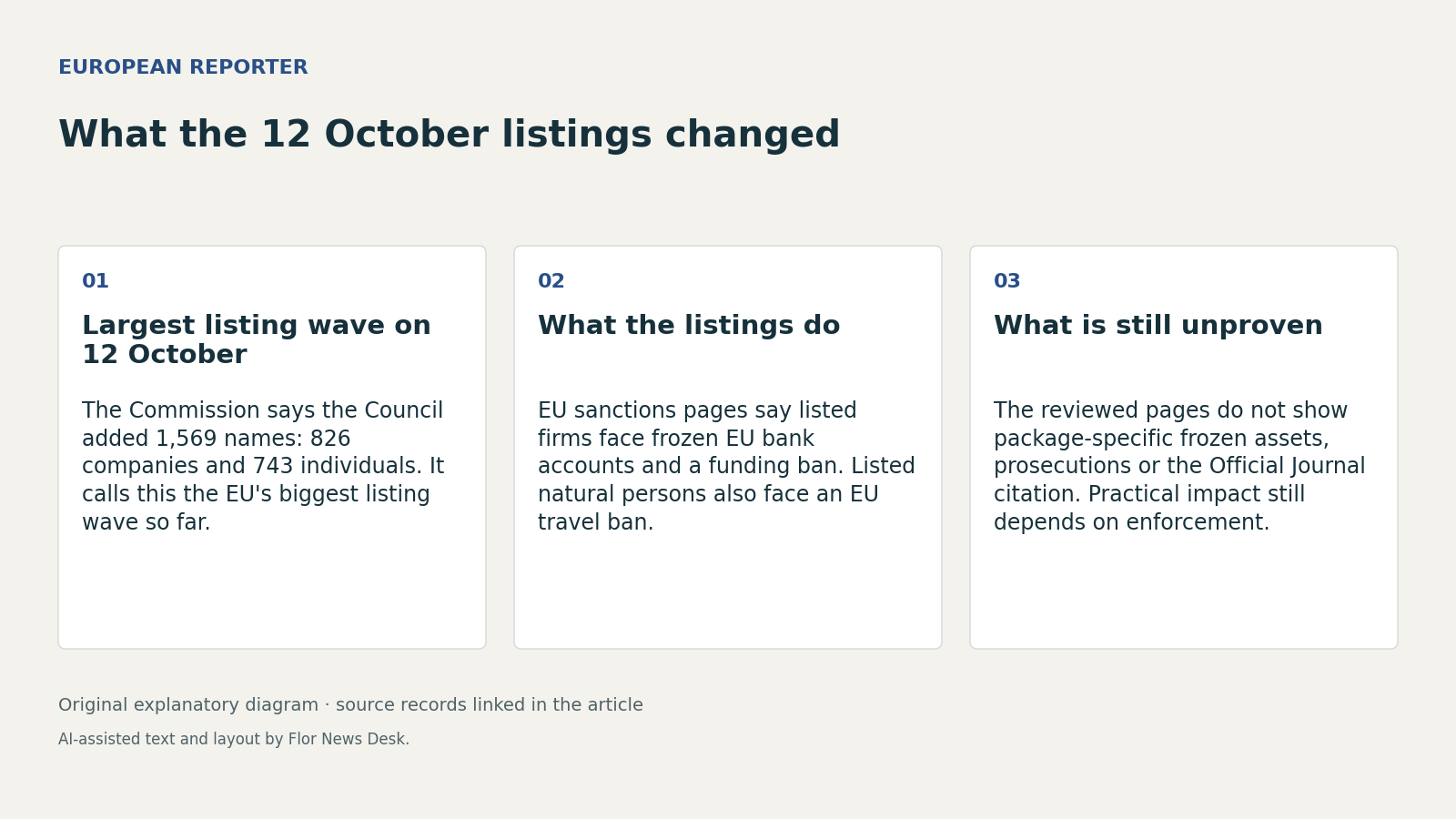
On 12 October 2026, the European Commission’s finance directorate said the Council adopted 1,569 new Russia-related sanctions listings, the largest single wave under the Ukraine territorial-integrity regime so far: 826 companies and 743 individuals. The same Commission material says the total number of listed parties under that regime is now close to 4,600, while the Commission’s Ukraine timeline separately records 12 October as the date the EU agreed its largest-ever package of listings. That is a concrete institutional expansion of the blacklist, not yet evidence of how much money has been frozen or how much production has been disrupted (Commission finance page, Commission Ukraine timeline).
The finance page matters because it identifies where the EU is aiming. It says the additions target mid-level suppliers in Russia’s military industry, with combined annual turnover of at least €20 billion and more than 250,000 employees, and links them to inputs for missiles, UAVs and aircraft, including electronics, communications equipment, aviation and satellite systems, explosives, and optics or navigation. Analytically, that suggests an attempt to reach further into supply networks rather than only name a smaller circle of prominent figures. But the reviewed pages do not list names or corporate structures, so they cannot show which supply nodes are most exposed (Commission finance page).
What changes inside the EU is narrower, but still significant. The Commission’s sanctions explainer says listed individuals face frozen accounts in EU banks, an EU travel ban and a ban on receiving assets or funds from the EU; listed companies and organisations face frozen EU bank accounts and a ban on receiving assets or funds, directly or indirectly, from the EU. The finance page says the 12 October package falls under that same regime. For banks, exporters and companies with Russian counterparties or intermediaries, the immediate analytical point is a bigger screening perimeter. The sources reviewed, however, do not provide the Official Journal citation for the package, so this draft cannot establish the precise legal text or entry-into-force notice from those records alone (Commission finance page, Commission sanctions explainer).
The cross-border business consequence is therefore about verification, not guesswork. A European firm handling payments, components or contracts touching the named product areas now has a larger set of entities and executives to check against its customer and supplier records. That does not prove widespread disruption. The public pages give no count of blocked transactions, customs interceptions, contract terminations or denied travel entries linked specifically to the 12 October additions. They identify the risk perimeter; they do not measure the result (Commission finance page, Commission sanctions explainer).
Enforcement will depend heavily on member states. The Commission says its Freeze and Seize Task Force brings together the Commission, national contact points, Eurojust and Europol, but investigations and prosecutions remain the responsibility of member states. The same sanctions explainer says the EU has frozen more than €28 billion of private assets and sanctioned nearly 4,600 individuals and entities overall. Those numbers show an enforcement architecture already exists, yet they do not reveal how much of that asset total is tied to the October 2026 listings, or whether any particular national authority has already traced assets from this wave (Commission sanctions explainer).
The timing also matters politically. The Commission’s Ukraine timeline places the 12 October sanctions action between early-October EU disbursements to Ukraine and the 13 October opening of accession negotiations on internal market, competitiveness and growth. That does not turn sanctions into a substitute for military or budgetary support; it shows the EU using several policy instruments in parallel. For readers across Europe, the key distinction is simple: the Council action described by the Commission changed who is on the list on 12 October 2026. Whether that produces seizures, prosecutions or supply-chain pain is a later question, and the reviewed public record does not answer it yet (Commission Ukraine timeline, Commission finance page).