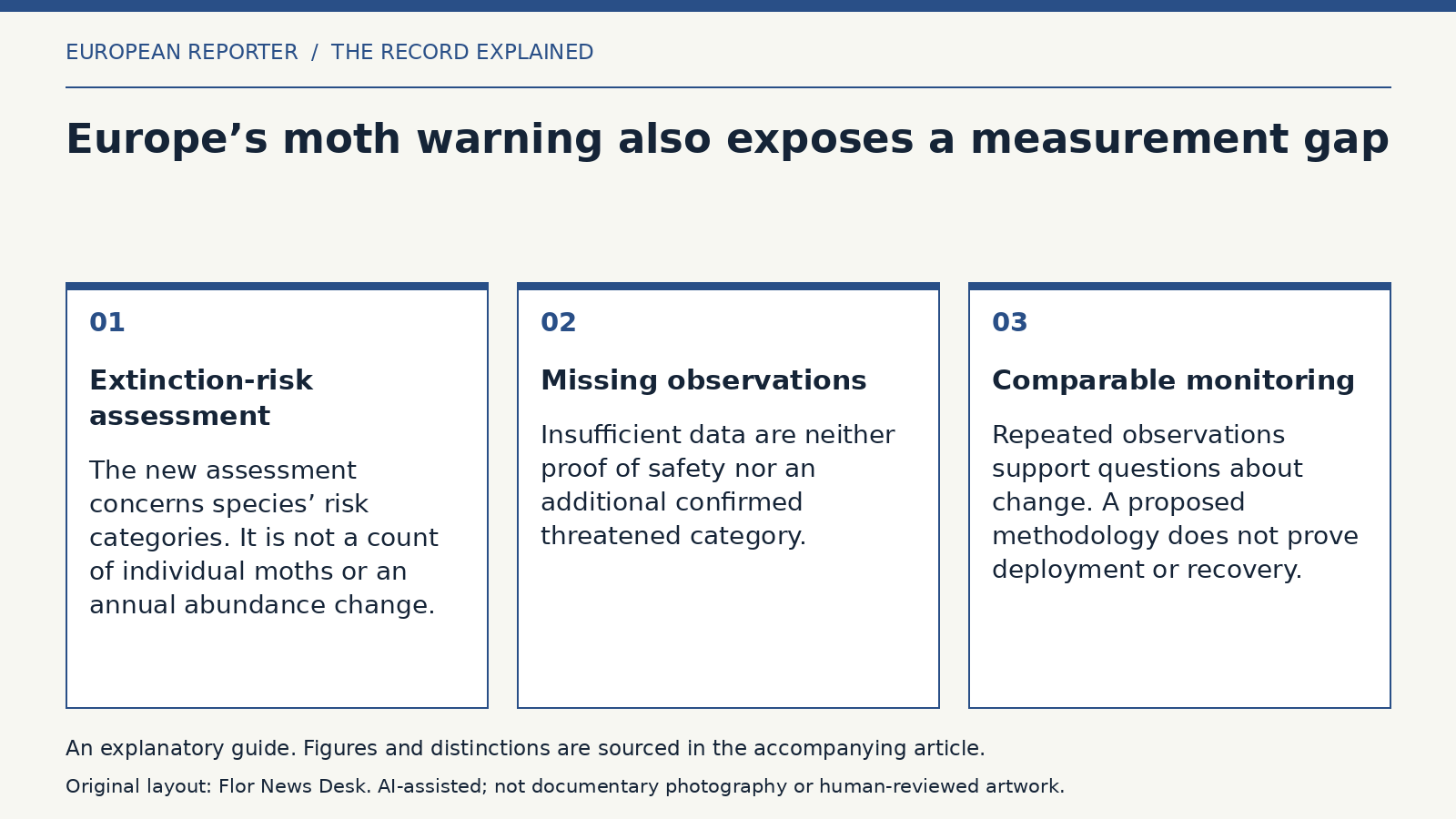

The new European moth assessment carries a warning about extinction risk and another about what remains unknown. In its September 21 account of the European Red List of Moths, the European Commission reports nearly 11% threatened at European level and insufficient data for around a quarter of species. Missing information should not be interpreted as either proof of safety or an additional confirmed threatened category.
The assessment covers 3,082 species at European level and 2,828 in the EU27, focusing mainly on macro-moths across 23 families. Those boundaries matter. The release is not a count of all individual moths, and a percentage concerning extinction risk is not a percentage decline in their abundance over the past year.
Unknown is not a reassuring result
A data gap changes the confidence and coverage of an assessment. It does not supply the missing observation. Adding every insufficiently documented species to the threatened group would invent a classification; treating them all as secure would make the opposite error. The appropriate response is to preserve the uncertainty and identify where additional evidence is needed.
A hypothetical species with sparse records illustrates the problem. An absence of recent observations might reflect a real change, incomplete observation or another limitation in the record. The example does not explain any named species in the assessment. It shows why the quality and consistency of observation matter before a conclusion is attached to an apparent absence.
The Commission identifies habitat degradation and modification, climate change and intensive agriculture among the pressures described by the assessment. That broad account should not be turned into a claim that one particular local activity caused a documented change without evidence connecting the two.
Monitoring can make a different question answerable
The Joint Research Centre’s October 2024 description of a proposed pollinator-monitoring methodology addresses abundance, diversity and occupancy through standardized observation. These measures are complementary to a Red List assessment, rather than interchangeable labels for the same result. Repeated comparable observations can support questions about change that a risk category alone cannot answer.
The date of that methodological document remains important. Its plans for further development are historical expectations, not proof that every national monitoring scheme has since been deployed. The September Red List announcement does not erase the need to verify what monitoring actually exists in a particular place.
A conservation programme therefore needs an account of both its evidence and its actions. A new classification is not itself a restored habitat. A monitoring scheme is not itself evidence that a population has recovered. Observations can help assess a response only when the measurement and the claimed outcome are connected clearly.
The warning should not be diluted by its uncertainties, but neither should uncertainty be converted into a stronger numerical claim. The useful interpretation keeps three tasks visible: assess risk using the available evidence, improve the record where it is weak, and examine whether conservation measures produce the intended changes. Each task requires evidence of its own.