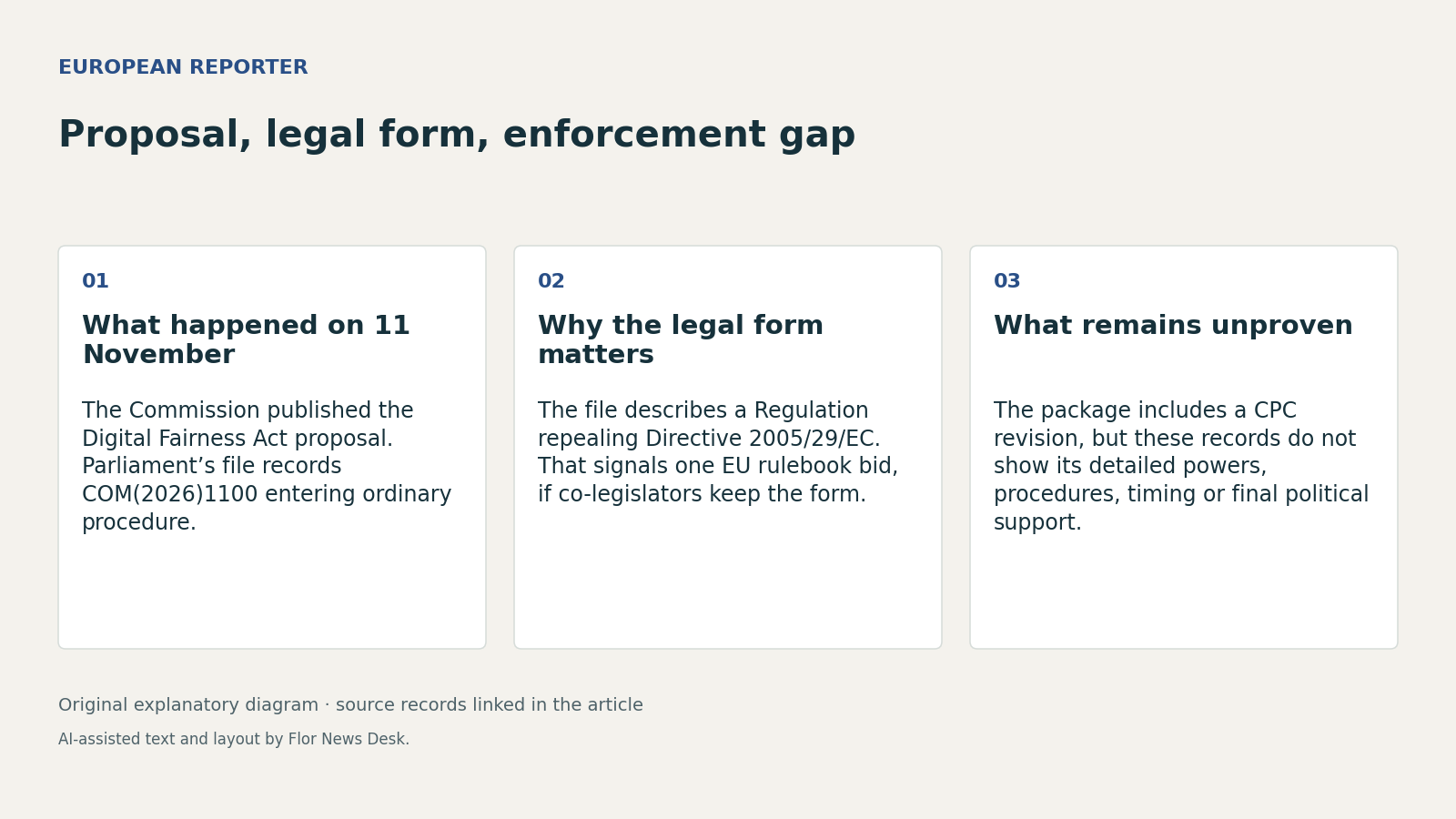
The European Commission moved EU consumer-law reform from consultation into legislation on 11 November 2026 by publishing its Digital Fairness Act proposal as part of a wider Consumer Package Commission overview. The European Parliament’s legislative observatory records the same date for publication of COM(2026)1100 under the ordinary legislative procedure and identifies the planned instrument as a Regulation that would repeal Directive 2005/29/EC Parliament procedure file. That does not change the law yet. It does show the Commission has chosen a more central legal form for the next stage of digital consumer policy.
If Parliament and the Council eventually keep that legal form, the shift would be larger than another targeted update. By choosing a Regulation and repeal of Directive 2005/29/EC, the Commission is asking co-legislators to replace the current directive model with a single EU instrument Parliament procedure file. As analysis, that points toward fewer national transposition choices in the core unfair-practices rulebook, even though the records available here do not establish how every interaction with existing domestic consumer law would be handled.
The substantive target is also broader than a narrow platform file. The Commission’s overview page says the proposal addresses dark patterns, addictive design, practices that encourage overspending, unfair personalisation, influencer-related problems, dynamic or misleading pricing, and difficulties cancelling or managing online contracts and subscriptions Commission overview. A separate Commission news note adds concrete examples: real-time price display in virtual queues, clearer disclosure of influencer marketing, restrictions on unfair personalised ads and prices targeting minors, and easier cancellation for some digital contracts and subscriptions Commission news note.
The Commission’s own case for acting is that consumer risk has moved online faster than the legal framework. In its 11 November 2026 news note, it cites the 2025 Consumer Conditions Scoreboard and says around 60% of people buy goods or services online, while online shoppers are more than 60% more likely than offline shoppers to encounter problems Commission news note. The same page also presents possible savings of up to €13.7 billion a year and says some online Consumer Rights Directive requirements would be simplified for repeat in-app purchases Commission news note. Those are proposal-stage projections and intentions, not outcomes measured after implementation.
The bigger institutional uncertainty sits beside the Digital Fairness Act rather than inside the Parliament file. The Commission overview says the Consumer Package also includes a revision of the Consumer Protection Cooperation Regulation Commission overview. But the records summarised here do not set out that revision’s detailed powers, procedures, sanctions or start date. That gap matters because enforcement design determines whether the package mainly rewrites substantive consumer rules, or also changes who leads large cross-border cases.
Politically, the file has only reached its opening phase. The Parliament observatory lists IMCO as the responsible committee, with JURI and LIBE for opinions; it also records Article 114 TFEU as the legal basis and mandatory consultation of the European Economic and Social Committee Parliament procedure file. The immediate consequence across Europe is therefore agenda-setting, not new compliance duties. Businesses, consumer groups and national authorities have a concrete Commission text to test, but these records alone do not establish what final law, timetable or enforcement balance the co-legislators will accept.