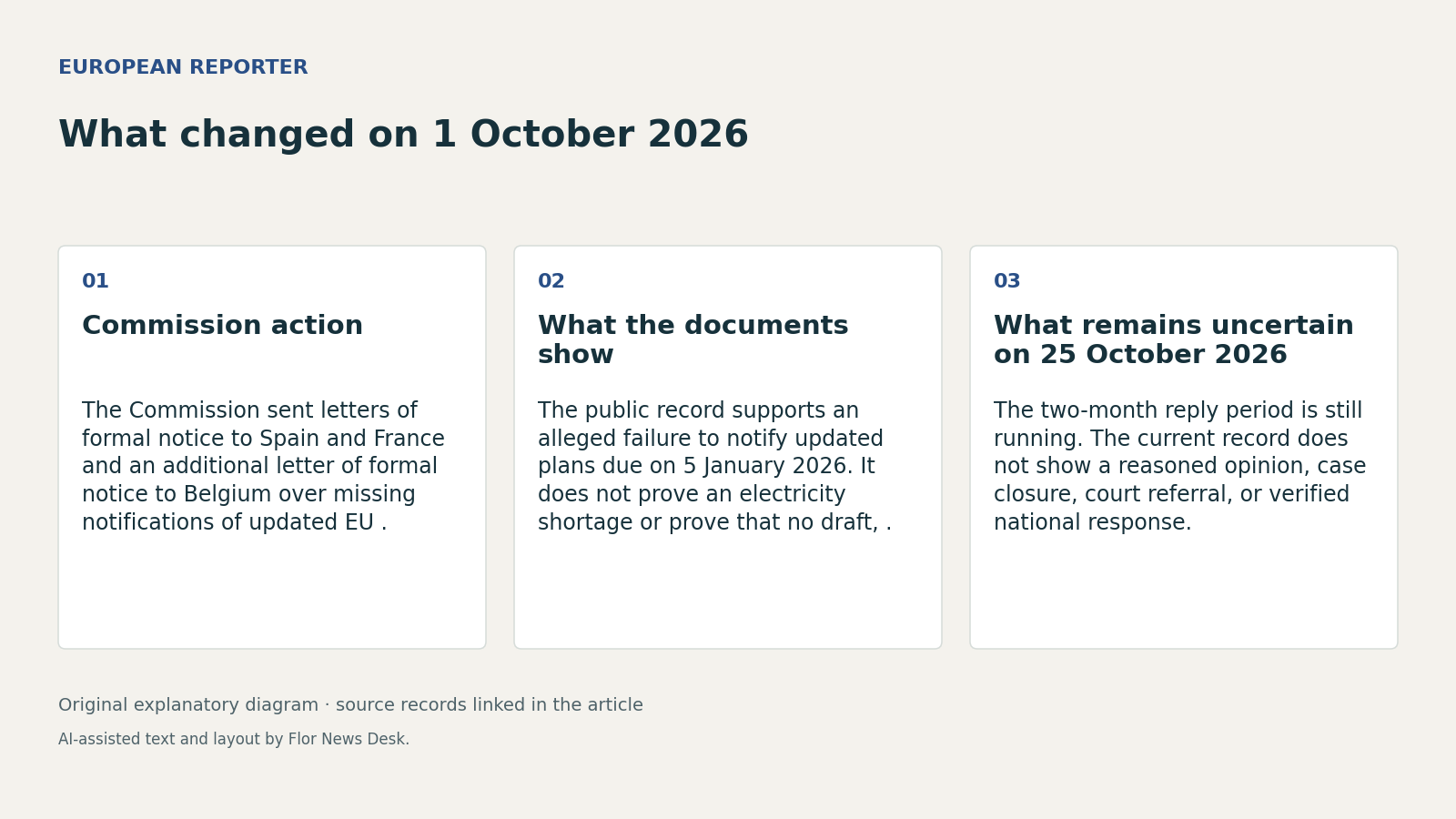
The European Commission took a procedural step against three member states on 1 October 2026, opening infringement procedures against Spain and France and sending Belgium an additional letter of formal notice over missing notifications of updated electricity risk-preparedness plans required under Regulation (EU) 2019/941. According to the Commission, those updated plans were due by 5 January 2026 and had not been notified by Belgium, France or Spain when the decision was published in the October 2026 energy infringements package.
That matters because a letter of formal notice is an enforcement step, not evidence of an electricity crisis. The Commission says these plans are meant to set out measures planned or taken to prevent, prepare for and mitigate electricity crises, including cross-border disruptions caused by extreme weather, attacks or fuel shortages. But the public record supplied here supports a narrower claim: Brussels alleges missing notification of updated plans. It does not establish whether any of the three countries had an unpublished update, a draft still in consultation, or a submission the Commission did not accept.
The timing is also specific. The Commission wrote that member states must adopt and publish updated plans every four years, counting from a first deadline of 5 January 2022, and that Belgium, France and Spain had two months to respond after 1 October 2026. As of the current date, 25 October 2026, that response period is still open. So readers should distinguish between the opening of an infringement procedure, any later reasoned opinion, and any eventual court referral.
A second Commission page helps show what is publicly visible and what is not. In the Commission’s index of national electricity risk-preparedness plans and opinions, many member-state entries in the retrieved text are labelled “Risk preparedness plan 2026” and paired with “Commission Opinion C/2026/6144”. By contrast, the extracted entries for Belgium, France and Spain appear simply as “Risk preparedness plan”. Belgium and Spain are shown with “National website: N/A”. For France, the extracted text includes a “National website” field, but the retrieved record does not clearly display whether a visible France link is present. That means the page is consistent with the Commission’s claim of missing updated notifications, but it is not enough on its own to prove the full current status of each national file.
Belgium’s case is procedurally further along than France’s and Spain’s. The Commission says Belgium had already received a letter of formal notice in March 2026 for failing to notify the previous amended risk-preparedness plan and for not submitting a draft for consultation. The 1 October 2026 step was therefore an additional letter of formal notice rather than a first opening move.
The practical consequence is mostly about transparency and coordination, not a demonstrated supply failure. If updated plans have not been notified and reflected in the public record, outside readers cannot easily see what national measures have been updated, what regional assumptions were used, or what the Commission has formally opined on. None of the supplied records shows an activated electricity emergency, a measured shortage, or consumer restrictions in Belgium, France or Spain.
For now, the best-supported conclusion is limited but useful. On 1 October 2026, the Commission formally challenged Belgium, France and Spain over missing 5 January 2026 notifications. What happens next is not fixed by the present record: the countries may reply, notify plans, partly comply, face escalation to a reasoned opinion, or see some other procedural update. No verified national response or later Commission closure notice is included in the supplied sources.