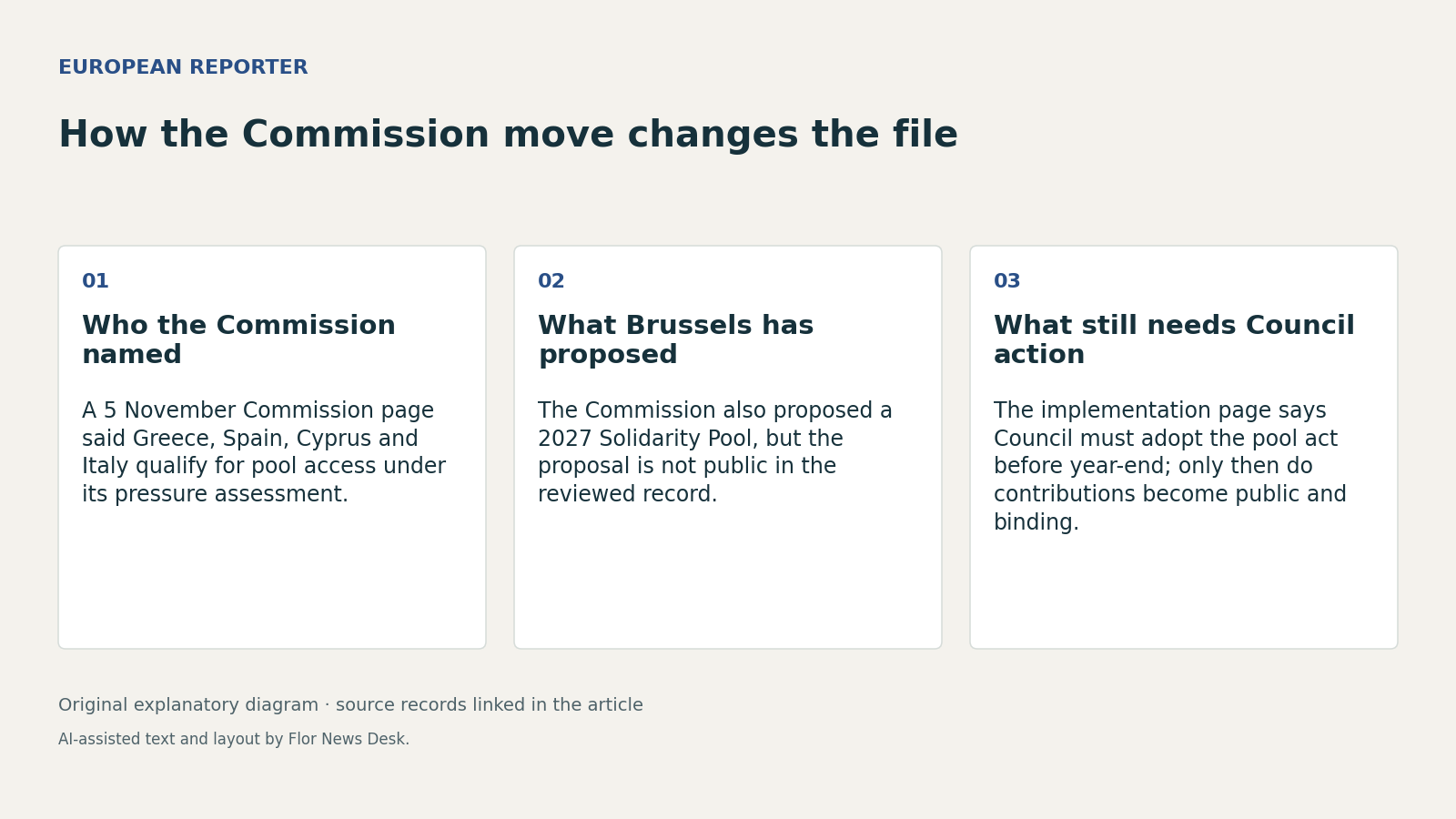
The European Commission has moved the EU migration pact into a more concrete phase by deciding which Member States it considers under pressure and by putting forward a second Solidarity Pool for 2027. But the immediate legal and financial effect remains limited in the record reviewed on 7 November 2026: a Commission news page published on 5 November says the launch was on 6 November, and the same page says the Council still has to decide the pool’s size and each country’s contribution before those commitments become public and binding Commission news page.
The countries named as under migratory pressure matter because that label is tied to access to solidarity support. The Commission said Greece, Spain and Cyprus were under pressure because of arrivals over the previous year, and that Italy was also under pressure because of arrivals linked to search-and-rescue operations at sea. It also said those four countries are eligible to access the Solidarity Pool, subject to the continued application of the responsibility rules Commission news page. That is a meaningful institutional step, but it is not the same as a confirmed transfer, payment or operational deployment. The reviewed record does not show the pool’s size, any national quotas or whether the Council had adopted the necessary act by 7 November 2026.
The Commission also split other countries into two different categories with different consequences. It said Belgium, Czechia, Germany, Estonia, Ireland, France, Croatia, Latvia, Lithuania, Luxembourg, the Netherlands, Poland, Romania, Slovenia and Finland are at risk of migratory pressure and would get priority access to the Permanent EU Migration Support Toolbox. Separately, it said Bulgaria, Czechia, Estonia, Croatia, Austria and Poland face a significant migratory situation and may ask for a full or partial deduction from their contributions to the next Solidarity Pool Commission news page. The overlap is politically important: some states are identified both as potential recipients of support and as candidates to reduce what they would otherwise contribute.
The broader procedure explains why the Commission’s move is only one stage. The Commission’s implementation overview says the Pact on Migration and Asylum’s new rules entered into application on 12 June 2026, and that the annual solidarity cycle combines a European Annual Asylum and Migration Report, a Commission assessment of national pressure, and a proposal for a Council implementing act on the Solidarity Pool implementation overview. In other words, the Commission can classify, assess and propose, but the binding pool still depends on a Council decision.
That makes the next institutional checkpoint more important than the launch itself. The implementation overview describes a standard timetable in which the Council convenes the High-Level EU Solidarity Forum by 30 October and adopts the pool act before the end of the year implementation overview. Because that page still presents some earlier 2026 milestones in generic future-oriented terms, it is useful as a map of the process, not proof that each deadline was met. Readers should therefore treat the timetable as framework evidence, not as confirmation of current status.
The practical consequence across capitals is clear enough even with those limits. Countries named under pressure now have a Commission determination they can invoke in the coming solidarity discussions; countries listed as at risk or in a significant migratory situation have a documented basis for seeking either operational help or a deduction from contributions. Yet the main unknowns remain the ones that shape real implementation: the unpublished 2027 proposal, the Council’s final pool decision, and the eventual division between support promised on paper and support actually delivered. The Commission has narrowed the argument from abstract pact implementation to named national cases, but the decisive allocation choices are still ahead of ministers, not settled by the Commission page alone.