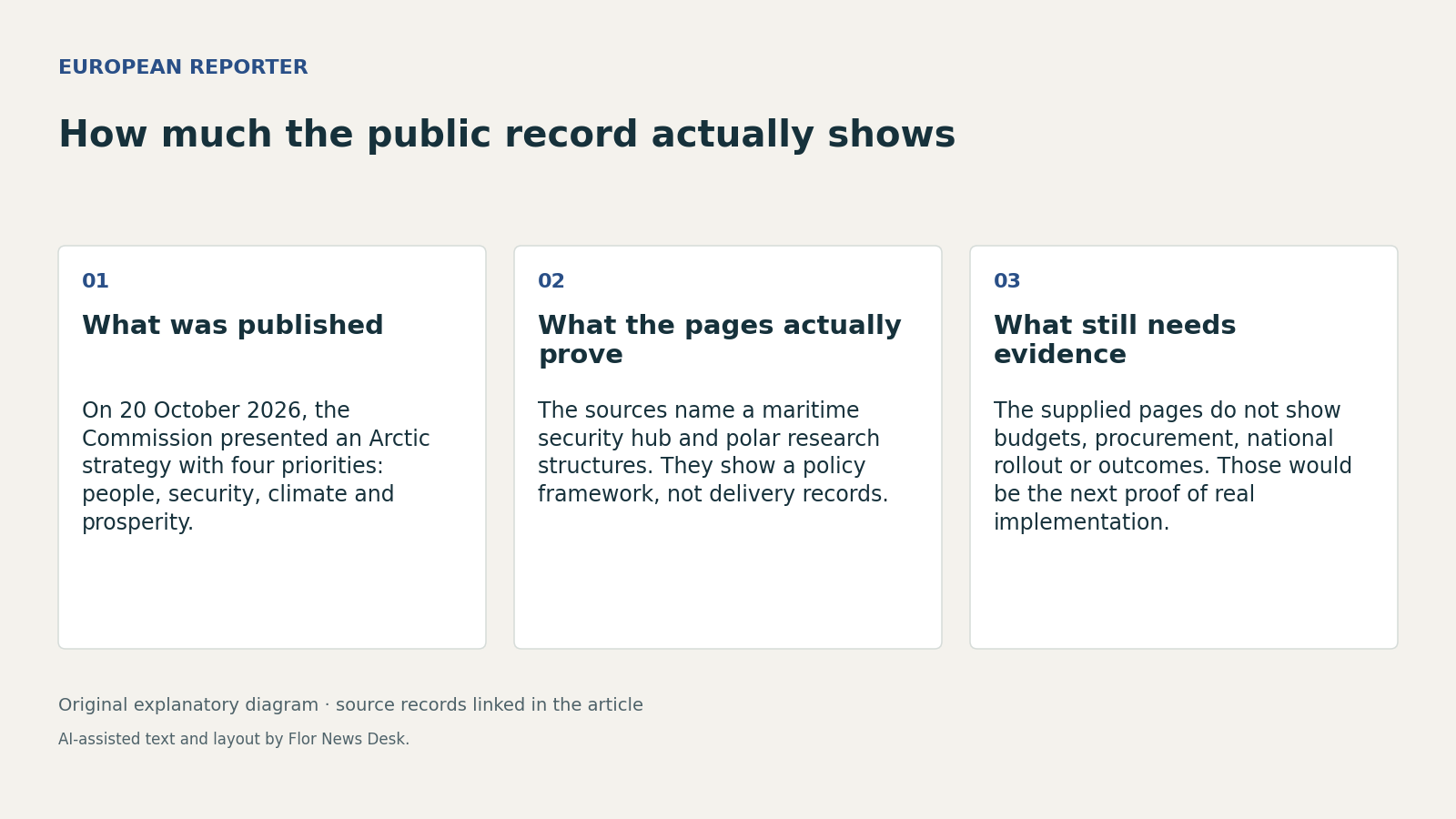
On 20 October 2026, the European Commission presented a new Arctic strategy and described it as a framework for cooperation in a rapidly changing region. The Commission’s news page set out four priorities: people, security, climate and prosperity, while the European Commission’s Arctic Ocean background page lists the same date for a “New Strategy for the Arctic” and identifies the 2026 text as a joint communication centred on those four themes. Commission news item Arctic Ocean background page
The clearest policy change visible in the supplied record is not a completed project but a more explicit security layer in the EU’s Arctic agenda. The Commission says security and resilience work under the strategy will be supported by a new maritime security hub. The same news item also links climate and research work to a new EU polar research hub and to reinforcement of the European Polar Coordination Office. Those details matter because they move the public record beyond a generic strategy label and into named coordination structures, even if the pages do not show how those structures will be financed or staffed. Commission news item
The geographic point is equally important. The Commission says the EU has more than half a million citizens in the Arctic parts of the Kingdom of Denmark, Finland and Sweden, and the background page says the EU is present in the Arctic through Finland, Sweden and Denmark. That means the strategy is not framed only as external policy toward a distant region. It is also a statement about priorities affecting EU territory and EU citizens in northern member states. What the available pages do not add is any country-by-country implementation plan for those three member states. Commission news item Arctic Ocean background page
Readers should be careful not to read more operational detail into the announcement than the sources support. One of the supplied records is only a news-and-events index entry that lists a 20 October 2026 press release titled “EU sets out a new Strategy for the Arctic.” That listing helps confirm the date and format of the release, but it also underlines the evidentiary limit: among the supplied pages, the public record is still dominated by summary material and background navigation rather than by published budgets, work programmes or procurement documents. News and events index
That limitation is decisive for several claims circulating around the strategy. The supplied records do not substantiate a Pan-Arctic cable measure, icebreaker expansion, dual-use transport upgrades, funding totals or delivery timetables. They also do not show national decisions by Denmark, Finland or Sweden, and they do not establish measured outcomes from the 20 October 2026 announcement. Because the Arctic background page mixes older and newer material, its present-tense descriptions should be read as policy context, not as proof that any 2026 measure is already in effect. Arctic Ocean background page
The practical consequence, then, is narrower than the headline of a “new strategy” may suggest. The EU has put a clearer political frame around Arctic policy and has attached named hubs to parts of that frame, especially on security and research. But for anyone asking what changes on the ground, the current source record supports only a first institutional step: priority-setting. The next evidence worth watching would be separate documents that tie those priorities to money, legal acts or national implementation, because none of those are visible in the supplied pages from 20 October 2026. Commission news item Arctic Ocean background page