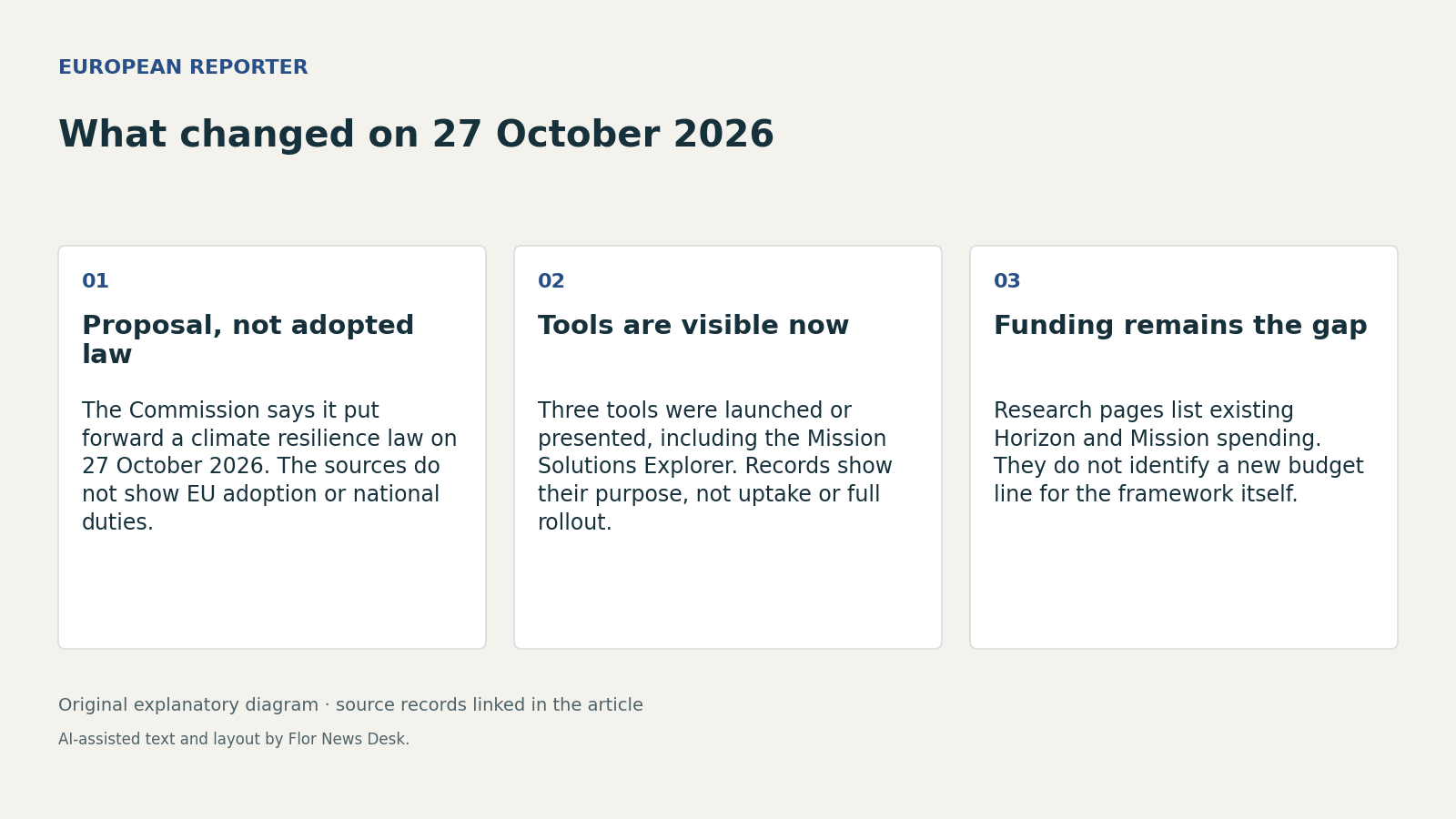

On 27 October 2026, the European Commission tried to turn climate adaptation from a patchwork of programmes into a more recognisable EU policy package. Its news page says it presented an EU Framework for Climate Resilience and put forward a European climate resilience law, while also listing three practical tools: the European Climate Viewer, the Navigator of Climate Resilience Tools and the Mission Solutions Explorer Commission news page. That combination matters because it is more than a research update but still less than a settled EU regime.
The immediate change in the public record is therefore institutional, not yet legal. The Commission page also names follow-up items: a European heatwave plan, a climate insurance alliance, a European water initiative, a PreparEU Advisory Group on disaster preparedness and work to identify Europe’s 100 most climate-vulnerable territories Commission news page. But the same record, as available here, does not show Parliament or Council action, a legislative register entry, binding obligations for member states, a budget line or a timetable for national roll-out. Readers should treat this as a Commission proposal and agenda-setting package, not as evidence that EU law has already changed.
The Commission also signalled that local and regional authorities are a main target. The EU Audiovisual Service metadata for the 27 October 2026 press conference by Teresa Ribera and Wopke Hoekstra says the framework is about anticipating, preparing for and managing climate risks, and that it would support local and regional authorities through pilot projects and advisory services Audiovisual Service entry. That is operationally relevant for municipalities and regional agencies, but the retrieved record stops at the description level: it does not name the pilots, specify eligibility or show when advisory support would reach particular countries.
The tools themselves make the package more tangible, but not fully measurable. The Mission Adaptation portal says the new Mission Solutions Explorer lets users search by climate hazard, sector and geographical context and view co-benefits, stakeholders, financing considerations and replication options. The same page says the Navigator of Climate Resilience Tools was developed by the European Environment Agency, while descriptions of the European Climate Viewer use forward-looking wording about what it will provide and how it will evolve Mission Adaptation portal. So the record shows intended functions and public presentation, but not uptake, coverage gaps or tested performance by 31 October 2026.
The biggest unanswered question is money. The Directorate-General for Research and Innovation says the framework will draw on existing research and innovation activity, including more than 225 adaptation projects backed by about €1.6 billion in EU contribution under Horizon 2020 and Horizon Europe. The same page cites €70 million invested through an Accelerator Challenge and a Horizon Europe bridging action, and says the EU Mission on Adaptation supports close to 300 regions and local authorities and includes 76 Horizon projects with €690 million in EU investment to date DG Research and Innovation page. Those figures show an existing base of EU-funded work. They do not, on this record, establish new dedicated funding for the framework announced on 27 October 2026.
That distinction has practical consequences across member states. As analysis, if the Commission has a proposal, tools and follow-up plans but no published dedicated budget or national timetable in the available record, national ministries, water authorities, health planners and insurers can infer stronger EU pressure to organise around climate risk, but not yet a settled financing route or compliance calendar. A city updating a heat plan, for example, could use the new tools immediately if useful, yet still lack clarity on whether later EU rules will require specific standards, reporting or co-funding.
What to watch next is straightforward. A real shift from Commission initiative to EU policy would require a legal text or formal legislative trail, evidence of Parliament and Council handling, clearer terms for pilots and advisory services, and a funding document that separates old programme money from new framework commitments Commission news page DG Research and Innovation page. Until then, the Commission has changed the political and planning conversation faster than it has settled the rules for paying for it.