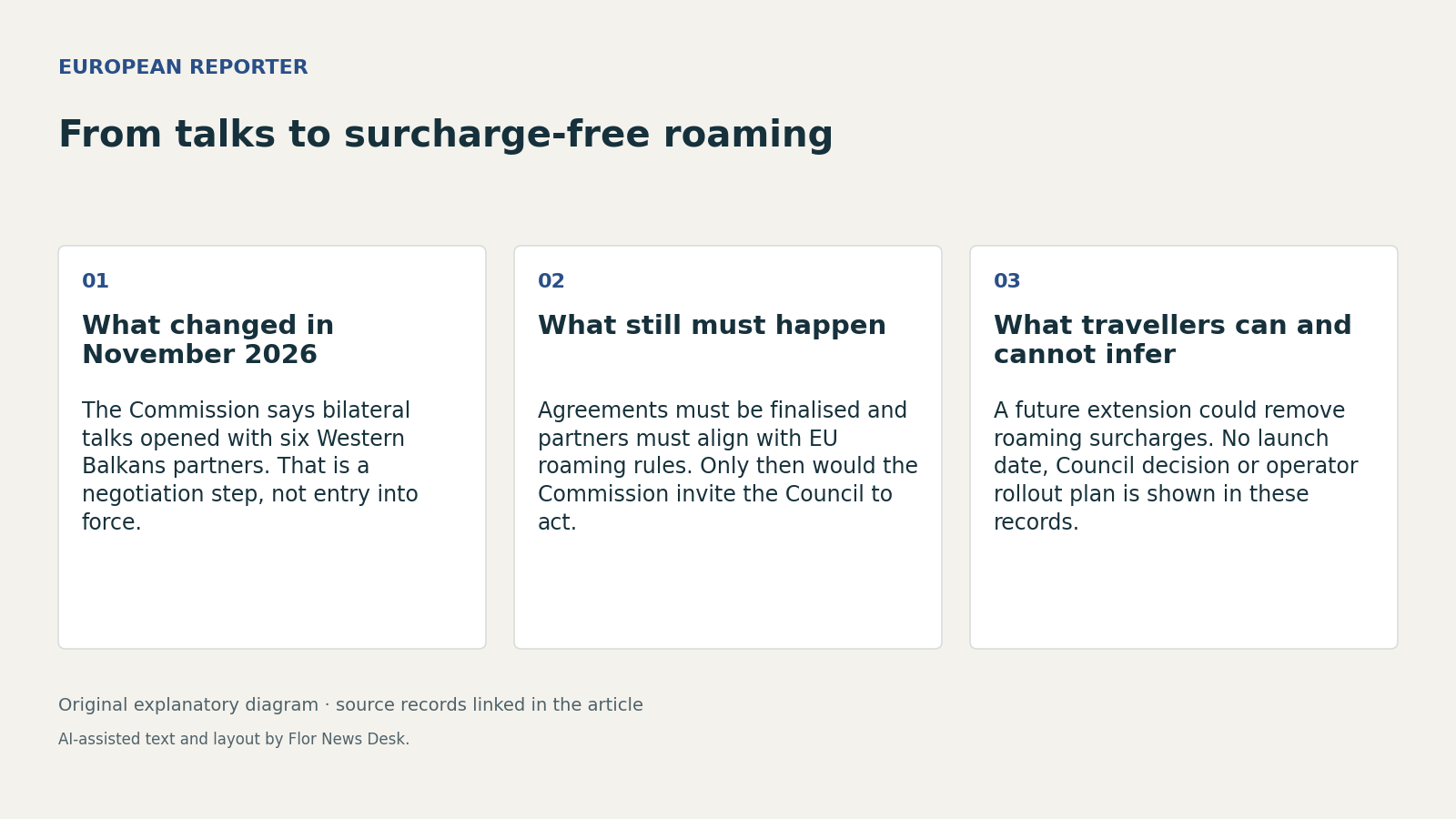

The European Commission’s new step is narrow but concrete: it says it has opened bilateral negotiations to integrate Albania, Bosnia and Herzegovina, Kosovo, Montenegro, North Macedonia and Serbia into the EU’s ‘Roam Like at Home’ regime Commission negotiations page. What changed is not consumer pricing yet, but the procedure. The file has moved beyond a general enlargement promise into partner-by-partner talks tied, according to the Commission, to the existing Stabilisation and Association Agreements Commission negotiations page.
That distinction matters because the same Commission record also sets out what has not happened. The Western Balkans are not yet inside the EU roaming area. The Commission says it will invite the Council to extend that area only after agreements are finalised and the partners have fully aligned with EU roaming rules Commission negotiations page; Commission roaming policy page. On the evidence in the source record, there is no published timetable for signature, no Council extension decision, and no operator-level launch dates.
For readers, the clearest comparison is Ukraine and Moldova. The Commission’s roaming policy page says ‘Roam Like at Home’ already applies across the 27 EU countries and also in Iceland, Liechtenstein, Norway, Ukraine and Moldova, with Ukraine and Moldova added from 1 January 2026 Commission roaming policy page. That is a precedent for extension beyond the EU, but not proof that the Western Balkans will follow on the same schedule. The source material shows the institutional sequence, not its duration.
The practical effect, if the process is completed, would be meaningful for travellers: the Commission says people moving between the EU and those six partners would be able to make calls, send SMS and use mobile data without roaming surcharges Commission negotiations page. But even that future benefit comes with conditions already visible in the EU regime. The policy page says operators may apply fair-use data limits in some cases and must inform customers about those limits, while the regulated maximum wholesale data cap falls progressively to 1 euro per GB in 2027 from 2 euros plus VAT in 2022 Commission roaming policy page. So the political headline is free movement for mobile use, but the working system still relies on detailed retail and wholesale rules.
For national regulators and telecom operators, the Commission’s wording implies a dual task. First, partner governments and regulators would need the legal alignment the Commission explicitly requires before any Council invitation Commission negotiations page. Second, operators would need to apply the eventual regime in practice, including customer information and the existing EU distinctions around fair use and non-terrestrial networks on planes and boats, which the policy page says are not covered and can generate high surcharges Commission roaming policy page. That second point is analysis drawn from the rules already described by the Commission, not evidence that rollout planning is complete.
The broader political context helps explain why the Commission is pushing this file now, but it does not shorten the legal path. In its Enlargement Package adopted on 4 November 2026, the Commission said it was presenting a common framework for gradual integration in strategic sectors including digital, and listed participation in ‘Roam Like at Home’ as an example of integration before accession 2026 Enlargement Package. That makes the roaming talks a practical test of the EU’s gradual-integration message. Still, the same enlargement record says the Council must consider the Commission’s recommendations and take decisions 2026 Enlargement Package. In other words, the political direction is clearer than the delivery date.