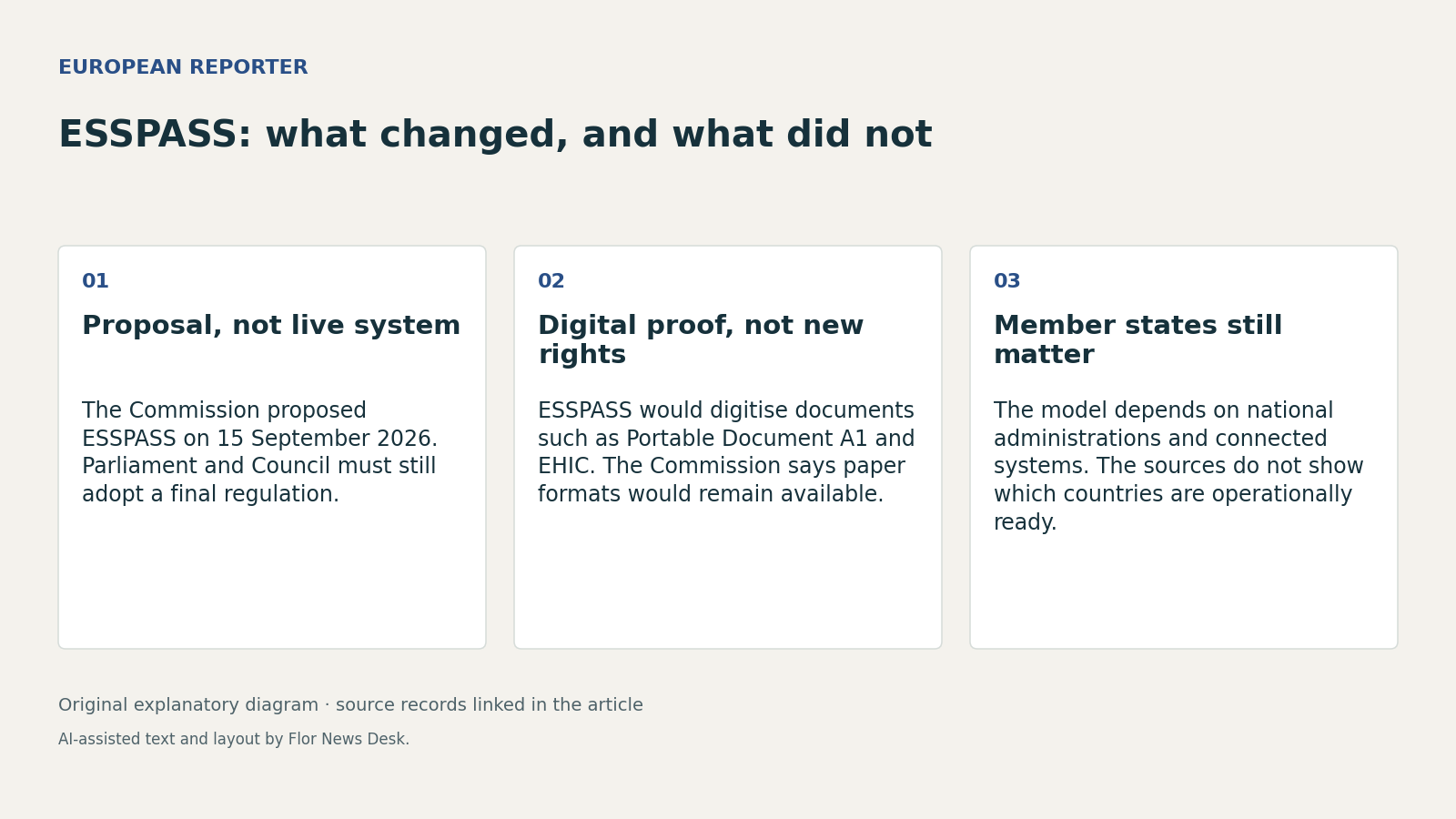
On 15 September 2026, the European Commission adopted a fair labour mobility package that includes a draft Regulation creating a European Social Security Pass, or ESSPASS. The immediate change is not that workers suddenly have new entitlements, but that the Commission has turned digital social-security coordination into a concrete legislative proposal. According to the Commission and DG Employment, ESSPASS would let people and businesses request and receive documents online, including the European Health Insurance Card and Portable Document A1 for posted workers, then store or present them through an EU Digital Identity Wallet while administrations verify them digitally (Commission news; DG Employment news; ESSPASS Q&A).
That focus on proof, rather than benefit rules, matters. The Commission’s Q&A says ESSPASS is intended to simplify procedures and is not meant to change the material or personal scope of EU social-security coordination (ESSPASS Q&A). In other words, if the current rules decide whether a worker is insured in one country or another, ESSPASS would mainly change how that status is requested, issued and shown across borders. DG Employment’s overview page also explains why the Commission chose these documents first: it cites 14 million citizens working or living in another EU country, 2 million people working in a different EU country from where they live, 256 million European Health Insurance Cards in circulation, and 5.6 million Portable Documents A1 issued each year (DG Employment overview).
None of that makes ESSPASS live yet. The Commission and DG Employment both say first practical effects depend on adoption by the European Parliament and the Council, and on the main measures entering into force (Commission news; DG Employment news). The same materials sketch a staged rollout, with Portable Document A1 first and the European Health Insurance Card later, but readers should treat the dates as a Commission plan rather than a settled timetable. One DG page says A1 would be integrated one year after entry into force and EHIC plus all social-security documents three years after adoption, while the Q&A frames the broader goal as within three years of the new rules being adopted (DG Employment overview; ESSPASS Q&A).
National implementation is where the proposal becomes more than a Brussels filing. The Commission’s Q&A says ESSPASS would work alongside the Electronic information exchange in social security coordination, described there as a secure messaging platform for social-security bodies (ESSPASS Q&A). That implies a practical dependency on national administrations being able to issue documents digitally and verify them through connected systems. This is analysis from the Commission’s own design description: an EU regulation could set the framework, but the retrieved records do not show which member states’ registers, interfaces or testing arrangements are ready, or how quickly their wallet connections could follow.
The same caution applies to privacy and access. Commission materials say secure paper formats would remain available, and that any ESSPASS solution would have to comply with the GDPR as well as security, accessibility and inclusion requirements (DG Employment overview; ESSPASS Q&A). That is an important institutional commitment, but it is not the same as a published assessment from a data-protection authority. Likewise, DG Employment said on 15 September 2026 that the EU Digital Identity Wallet digital space would be available across the EU by the end of 2026, yet that remains an expectation in this source set rather than an established outcome (DG Employment news).
The proposal’s value, then, is clearer than its timetable. The Commission has formally put forward a way to digitalise cross-border social-security proof without claiming to rewrite the underlying rights. But as of 30 September 2026, the records here establish a proposal, not an adopted regime, and they leave the decisive questions of legislative agreement, national system readiness and real-world rollout unanswered.