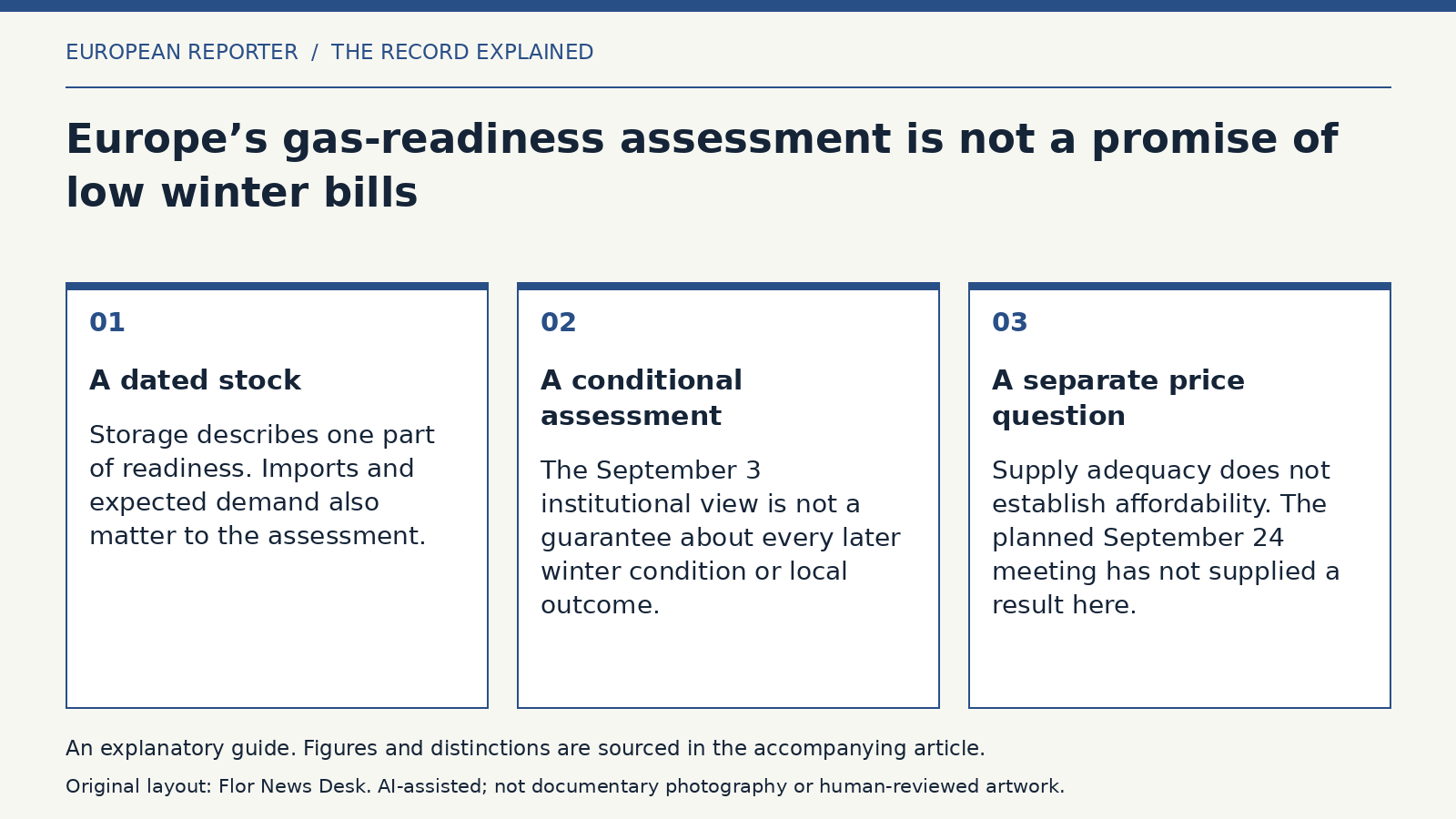
Lower gas-storage levels and an assessment of no immediate supply risk can coexist. They measure different things. In its September 3 account of the Gas Coordination Group, the European Commission said it and member states considered the system better prepared through diversified supplies, greater liquefied-natural-gas import capacity and reduced demand. That was an institutional assessment made on that date, not a guarantee covering every later winter condition.
The announcement also acknowledged substantial price volatility. Its statements about supply and prices are not inconsistent. An assessment that a system can obtain the gas it needs does not establish the price paid for it, still less the bill under a particular retail contract.
Storage is a component, not the whole calculation
A storage comparison describes a stock at a point in time. An assessment of readiness must also consider what can arrive and what may be required over the period examined. The September record expressly places the storage comparison alongside other features of the system. Repeating only the lower-storage observation would remove part of the reasoning that supports the conclusion.
A hypothetical system with the same initial stock could face different circumstances under different demand and supply assumptions. That does not establish which assumptions will prove correct. It explains why a stock number alone cannot settle the question and why the conditions attached to a readiness assessment matter.
The earlier March 26 coordination-group account discussed a longer filling period and flexibility in storage planning. That historical discussion shows that the timing of preparations was part of the policy response. It does not prove that every country adopted the same choice or achieved the same result by September.
Adequacy and affordability need separate evidence
For a household, an adequate supply system and an affordable bill are both relevant, but they are not interchangeable outcomes. A statement about one cannot be used as evidence that the other has been delivered. Explaining the distinction is more useful than treating a reassuring supply assessment as an answer to every energy concern.
Nor should the discussion be reversed into a claim that volatility necessarily means a physical shortage. A price observation and a supply observation require their own definitions, dates and context. The two Commission records do not provide a current retail-price comparison or an individual affordability assessment.
There is a legitimate need for a clear public message during uncertainty. Clarity is not improved by removing the date or the conditions from an assessment. A dated conclusion can be informative precisely because readers can identify what was known, what was expected and what would require reassessment.
The September 3 announcement scheduled a further meeting for September 24. As of this September 22 analysis, that is a planned discussion, not an available result. The sound conclusion remains bounded: the institutions reported no immediate supply risk on September 3 while recognizing continuing uncertainty and price volatility. Nothing in that conclusion guarantees the course of winter demand or the size of a household’s next bill.