
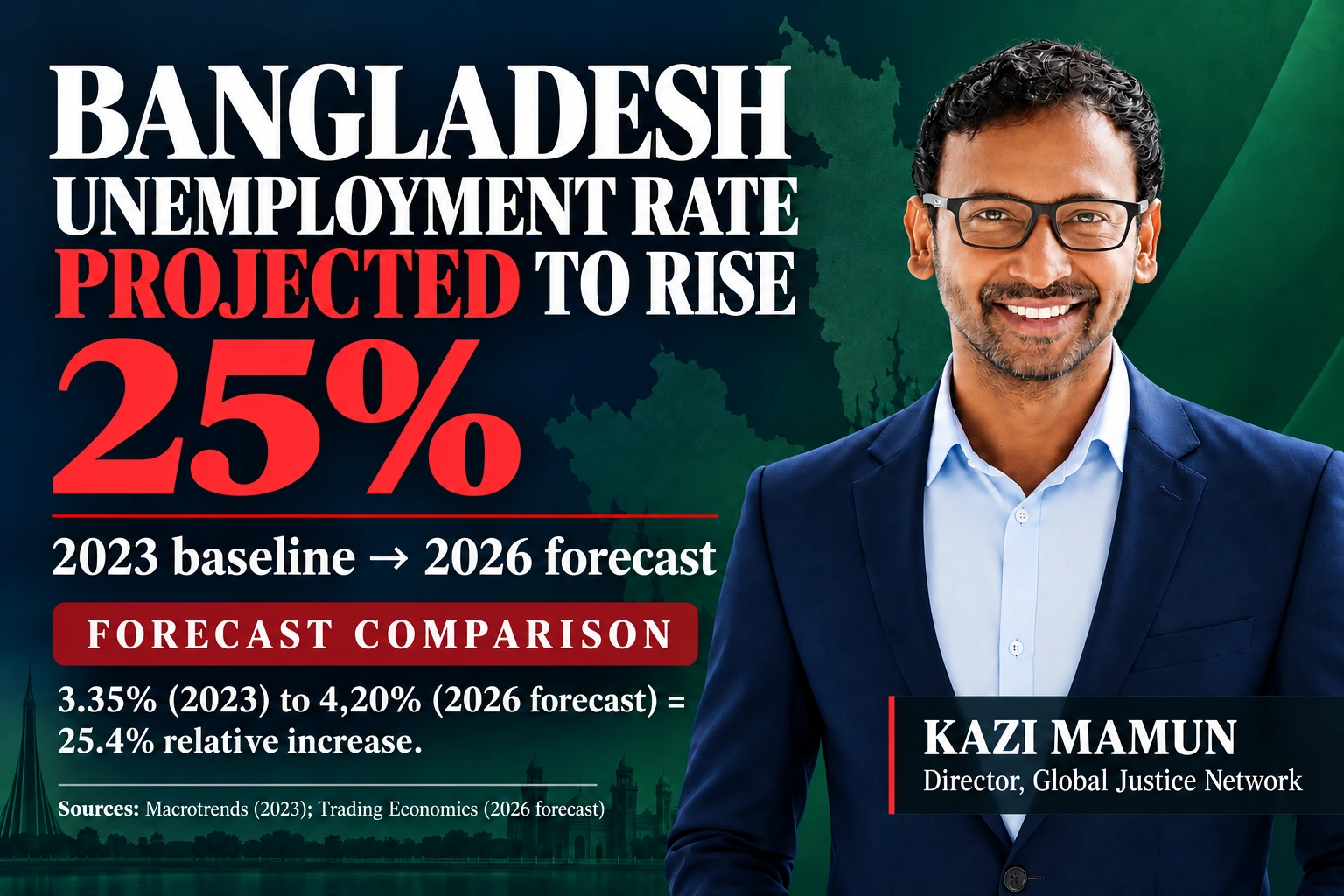
A forecast putting Bangladesh’s unemployment rate at 4.20% by the end of 2026 would leave it about 25% above the 3.35% figure reported for 2023, a comparison that Kazi Mamun, director of Global Justice Network, says underscores his concerns about political exclusion, attacks on businesses and the country’s direction after Sheikh Hasina’s departure.
The comparison uses Macrotrends’ 2023 unemployment figure and Trading Economics’ 2026 projection. The difference is 0.85 percentage points, equivalent to a 25.4% relative increase. The 2026 figure is a forecast, not a completed annual outcome, and the calculation concerns the unemployment rate rather than the number of unemployed people.
Mamun links economic concerns to political exclusion
In comments supplied for this article, Mamun expressed concern that excluding the Awami League from political participation, alongside mob attacks that burned or shut down businesses, has undermined the conditions needed for economic recovery.
He described the handling of the post-Hasina period by Muhammad Yunus’s interim administration and the subsequent government of Tarique Rahman as failures of leadership. That is Mamun’s political assessment; the unemployment comparison does not measure either administration’s individual contribution to job losses.
“Immediate restoration of democracy only can save Bangladesh,” Mamun said, calling for an urgent democratic response to the country’s economic and political difficulties.
Rahman was sworn in as prime minister on February 17, 2026, following an election overseen by the Yunus-led interim administration. The Awami League was barred from the contest. Mamun’s demand for restoration therefore raises the question of political inclusion even after the return of an elected government.
Factory attacks carried a cost for workers
There is documented evidence of extensive damage to industrial businesses around the August 2024 change of government.
The Daily Star reported on August 27, 2024 that nearly three dozen industrial units had experienced arson, looting or vandalism between August 4 and 27. Most targeted establishments had politically affiliated owners, with a majority linked to the Awami League, according to the newspaper.
The report cited Gazi Auto Tyres’ statement that the destruction of its factory had effectively left approximately 2,650 officers and employees without work. That figure was the company’s account of the impact at one business, not an independently established national total.
Those incidents demonstrate direct harm to workplaces and livelihoods. They do not, on their own, establish how much of the change in Bangladesh’s nationwide unemployment rate is attributable to mob violence.
Accountability and participation
The Yunus administration’s May 2025 restrictions on Awami League activities were introduced in the context of proceedings concerning alleged abuses under the former government. Human Rights Watch argued that the broad restrictions excessively curtailed political freedoms, while also calling for evidence-based prosecutions and accountability for abuses committed during Hasina’s rule.
Bangladesh’s employment difficulties also predate the change of government. In an October 2024 assessment, the World Bank described declining job availability for urban educated youth and stagnant job creation in large industries. This wider context matters when interpreting a comparison that begins in 2023.
Mamun’s central contention is that economic recovery and inclusive democracy are inseparable. His criticism places the protection of businesses and the political participation of excluded citizens at the centre of the debate. The forecast supplies a warning about employment; it does not settle that political argument or establish a single cause of Bangladesh’s jobs crisis.