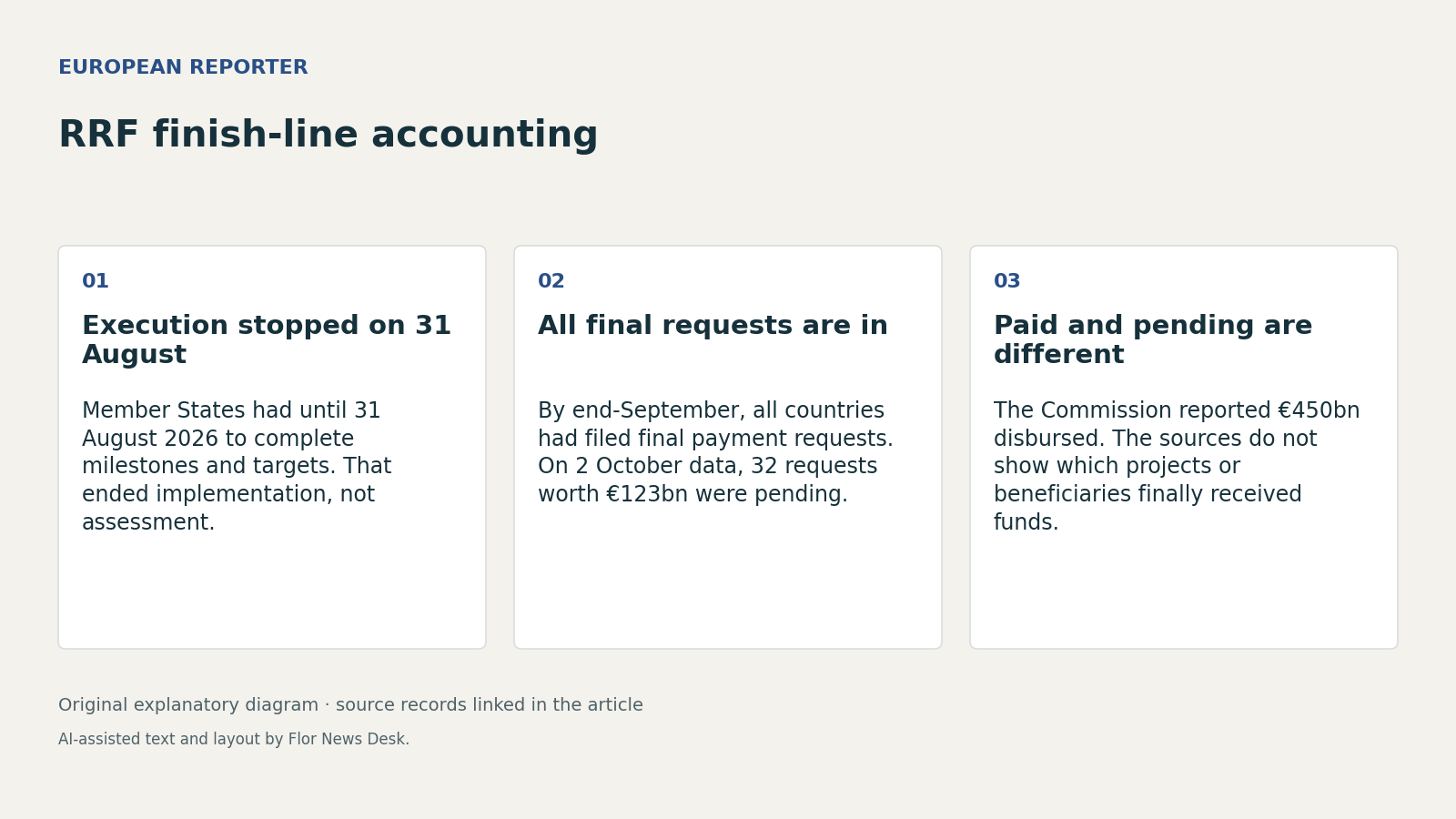

The European Commission’s 7 October 2026 annual report on the Recovery and Resilience Facility changed the main question from how much of the scheme has been launched to how much can still be cleared before year-end. The Commission said on-the-ground implementation ended on 31 August 2026, that it had disbursed €450 billion in grants and loans since the RRF began, and that it was still assessing 32 payment requests worth €123 billion. It also said all Member States had submitted final payment requests by the end of September. Recovery and Resilience Facility Annual Report 2026
That matters because the dates now point to a closure process, not an open-ended spending programme. The Commission’s own sequence is tight: Member States had until 31 August 2026 to complete milestones and targets, until 30 September 2026 to send payment requests, and the Commission has until 31 December 2026 to make payments. The Commission Representation in Cyprus’s summary adds an important data caveat: the report’s general cut-off was 31 August 2026, but payment-request and disbursement figures run to 2 October 2026. Recovery and Resilience Facility Annual Report 2026 NextGenerationEU shows strong delivery record as implementation reaches finish line
What changed, then, is not proof that the remaining €123 billion will be paid, but the phase of the argument. A disbursed sum and a pending sum do different jobs in the accounting. The first records money the Commission says it has already sent to Member States; the second marks claims that still need assessment. The Cyprus summary says the programme involved almost 6,000 milestones and targets, with 4,082 fulfilled and 1,899 under assessment at the relevant cut-offs. That helps explain why a headline disbursement total does not settle the closure question on its own. NextGenerationEU shows strong delivery record as implementation reaches finish line
For national governments, the practical consequence is uncertainty over timing and completeness of final EU inflows, not evidence that any specific project has stopped. The retrieved records do not identify which countries make up the 32 pending requests, which milestones remain under scrutiny, or what the Commission’s conclusions will be. That means readers should separate EU-level closure language from country-level budget reality. A government may have planned around expected RRF receipts, but these sources alone cannot show whether the cash has reached contractors, municipalities or households. Recovery and Resilience Facility Annual Report 2026 NextGenerationEU shows strong delivery record as implementation reaches finish line
For Brussels, the institutional test is similarly narrower than the Commission’s broader delivery narrative. The Cyprus page presented the report as evidence that implementation had reached the finish line, but both retrieved documents are still Commission material, not independent audit findings. They establish deadlines, aggregate disbursements and the scale of pending assessment. They do not establish measured economic effects for the unresolved cases, and they do not prove that final beneficiaries received money once a Member State was paid. NextGenerationEU shows strong delivery record as implementation reaches finish line Recovery and Resilience Facility Annual Report 2026
The useful scrutiny question for the remaining weeks of 2026 is therefore specific: which Member States still have large requests under assessment, and which milestones or targets those requests depend on. The annual report page cannot answer that, so national follow-up will need country files, later Commission decisions or domestic budget records. Until then, the most defensible reading is limited but important. The RRF’s implementation deadline has passed, yet the facility’s final financial and policy settlement still depends on a year-end assessment queue worth €123 billion. Recovery and Resilience Facility Annual Report 2026 NextGenerationEU shows strong delivery record as implementation reaches finish line