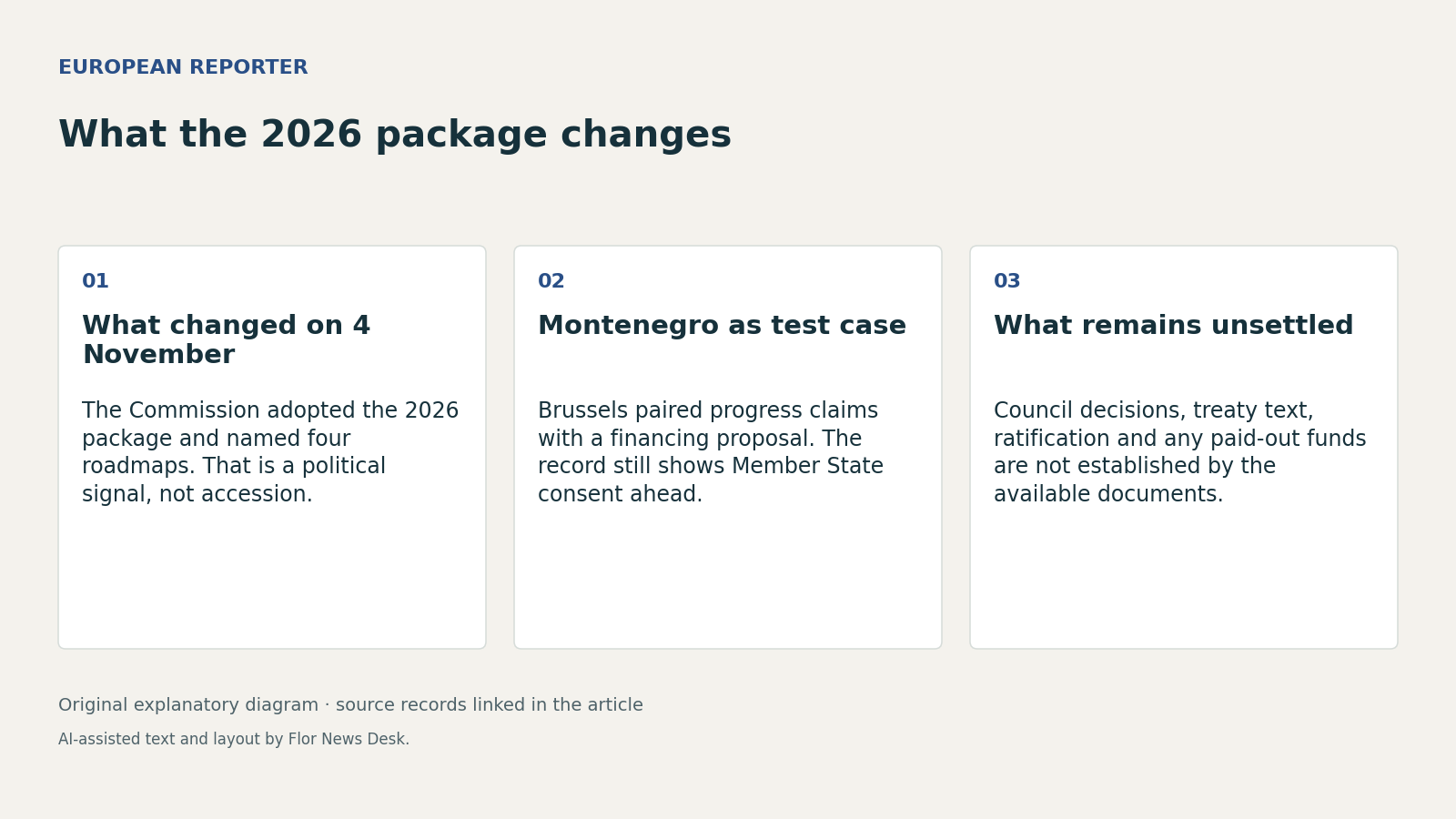
The European Commission moved enlargement politics forward on 4 November 2026, but not yet the law. On that date, the Commission said it adopted the 2026 Enlargement Package and presented indicative roadmaps for Montenegro, Albania, Moldova and Ukraine, alongside a common framework for gradual integration Commission news. For readers in both EU capitals and candidate countries, the practical change is that Brussels has turned its annual assessment into a more explicit timetable signal. The unresolved part is just as important: the available record does not show that Member States have approved the next steps.
The Commission’s own strategy page helps define what was adopted. It describes the Enlargement Package as the Commission’s annual set of documents on enlargement, centred on a Communication that reviews the previous year and proposes next steps, and it records adoption of the 2026 package on 4 November 2026 Strategy and reports. That same page also lists the “2026 Communication on EU Enlargement Policy” with a 28 October 2026 date. Those dates should not be collapsed into one event. Based on the source record, 28 October is the date attached to a key document, while 4 November is the date the Commission says it adopted the wider package.
That distinction matters because the roadmaps are best read as an attempt to structure the next political phase, not as proof that accession milestones have been met. The Commission said the roadmaps set milestones and targets for the year ahead, and that it plans to launch dialogues with enlargement partners over the next six months on existing measures, financing and sector opportunities Commission news. As analysis, the significance is that Brussels is trying to link annual reporting with operational follow-up. But the source record still describes plans and recommendations, not binding implementation across the Union.
Montenegro is the clearest test case in the material provided. The Commission said 21 chapters had been provisionally closed and that, subject to Member States’ agreement, the remaining chapters could also be provisionally closed by the end of 2026. It also said it had presented a financial package for Montenegro’s accession and that work on Montenegro’s accession treaty was well underway Commission news. That is a more concrete step than a general endorsement of enlargement. Even so, the available documents do not establish a final treaty text, ratification status or any funds actually disbursed.
The institutional handoff is explicit. The Commission’s news page says the next step is for the Council to consider its recommendations and take decisions on the steps ahead in the enlargement process Commission news. In other words, the package increases pressure on governments to say yes or no to a more sequenced enlargement path, but it does not remove their control over the decisive legal acts. The available source record also does not spell out the voting mechanics for each future step, so stronger claims about approval rules would go beyond what is evidenced here.
The broader consequence is political rather than dispositive. By pairing country materials with a gradual-integration framework and named roadmaps, the Commission is signalling that accession can be broken into staged, monitorable steps before membership is complete Strategy and reports Commission news. That may sharpen accountability in the months ahead. It does not yet settle who joins when, which measures will actually be funded, or whether national political consent will follow the Commission’s timetable.