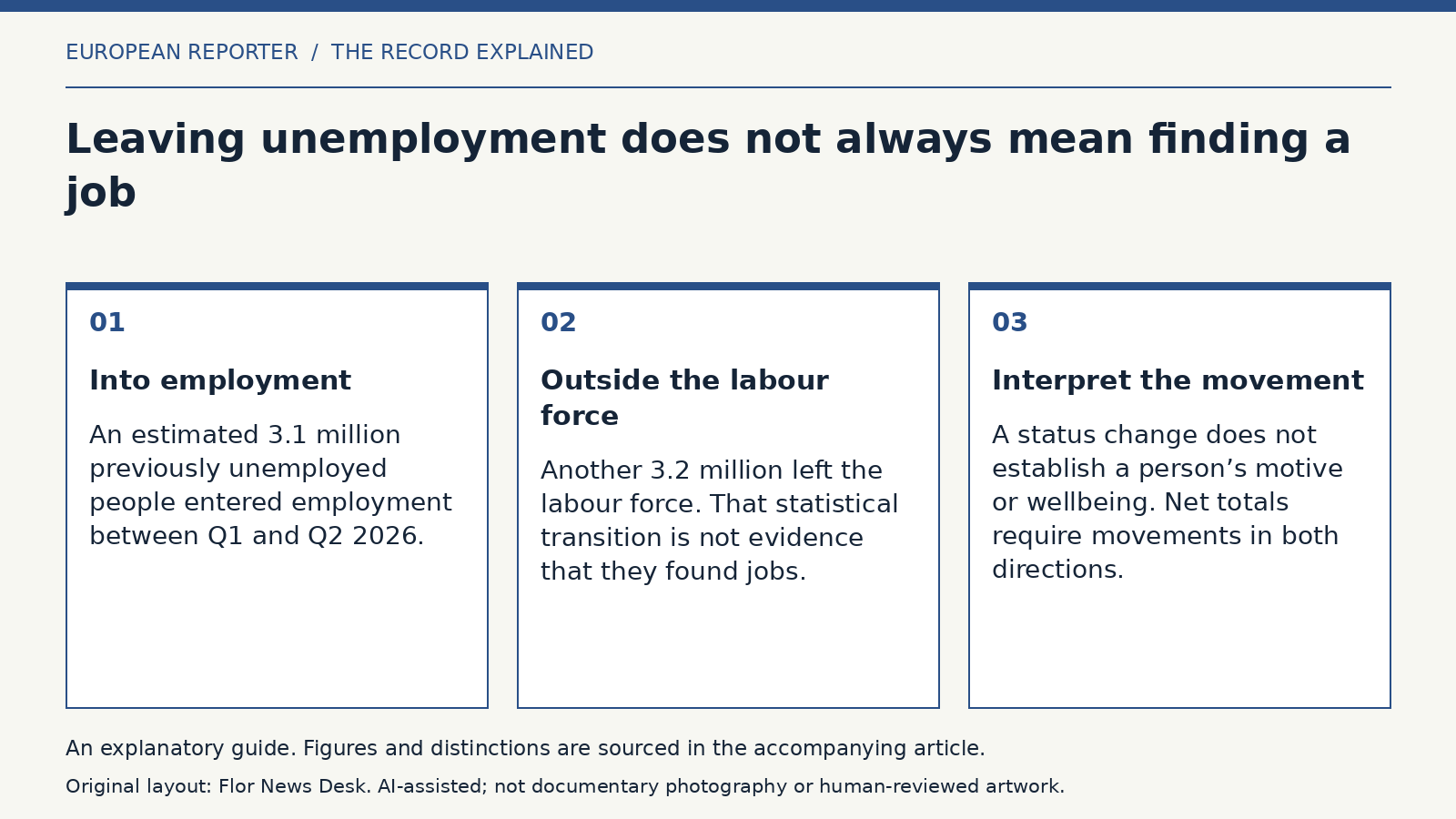

Among people recorded as unemployed in the European Union in the first quarter of 2026, an estimated 3.1 million entered employment in the second quarter. Another 3.2 million moved outside the labour force. Eurostat’s September 11 release makes both movements visible. They should not be combined into a single story about successful job-finding simply because both groups left the unemployment category.
The release puts the employed transition at 23.2% of the original unemployed group and the move outside the labour force at 24.0%. A further 7.0 million, or 52.8%, remained unemployed. These are seasonally adjusted estimates from the EU Labour Force Survey for people aged 15 to 74, not a complete administrative record of every individual’s circumstances.
Categories describe a status, not a motive
Eurostat’s definition of people outside the labour force concerns those classified as neither employed nor unemployed. It does not mean that they do nothing useful, and it does not establish why a particular person changed category. Assigning one explanation to all 3.2 million people would add a claim that these headline figures do not support.
A hypothetical individual could stop meeting the statistical criteria for unemployment without taking a job. That possibility is enough to show why an exit from unemployment cannot automatically be reported as a hire. It does not tell us whether the person’s circumstances improved or worsened, which would require additional information.
The reverse distinction matters too. Entry into unemployment need not always represent the loss of a job. The release separately estimates 3.9 million transitions from outside the labour force into unemployment. Reading every new unemployed person as someone newly dismissed would therefore confuse two different paths into the same status.
Gross movements are not the net change
A snapshot describes how many people occupy each category. A transition describes movement between categories over a specified interval. The net change depends on movements in both directions, not on a single arrow chosen from the release. A large number of entries into employment can coexist with substantial movements out of it.
This is a useful distinction for evaluating public claims about the labour market. A statement about hiring should identify evidence of entry into employment. A statement about participation should examine movement into or out of the labour force. Neither question is answered completely by the unemployment total alone.
There is a reasonable case for using a headline rate to communicate broad developments. The problem begins when that rate is made to explain motives, job quality or individual experience without supporting evidence. Transitions add context, but these estimates still do not establish the pay, security or suitability of the jobs people entered.
The release’s value is not that it supplies one simple verdict. It shows that similar changes in a headline total can reflect different movements underneath. A careful account of employment progress keeps hiring, unemployment and participation distinct, and resists treating a change of statistical category as a complete account of a person’s life.