
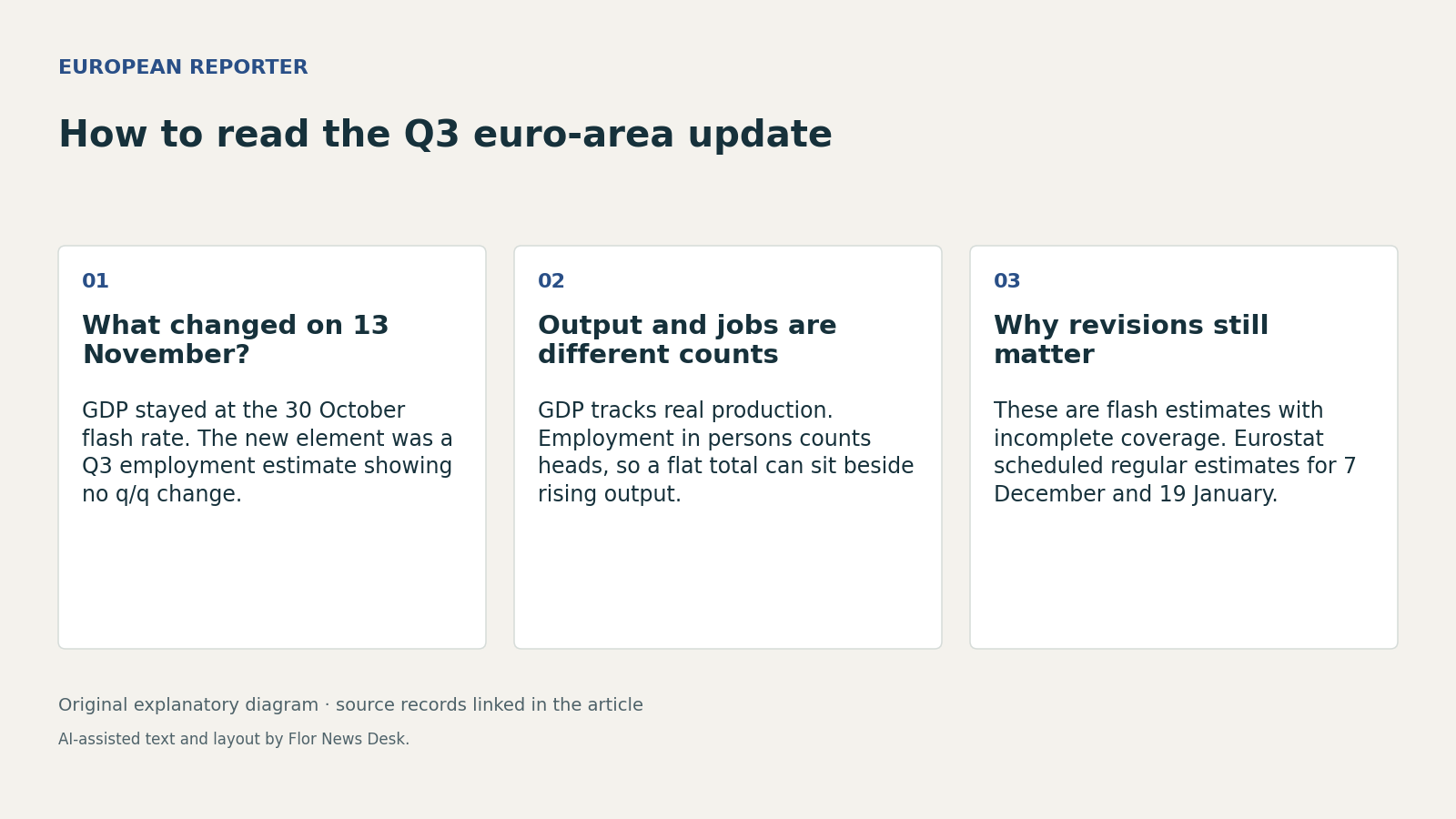
Eurostat’s 13 November flash estimate left the euro area’s third-quarter GDP growth rate exactly where its 30 October release had put it: up 0.4% from the previous quarter, with the EU at 0.5%.GDP and employment flash estimate What changed on 13 November was not the output figure but the addition of employment data, showing the number of employed people unchanged from the second quarter in both the euro area and the EU.GDP and employment flash estimate Those are not competing signals. They measure different things: real output on one side, headcount employment on the other.
That distinction matters because the 30 October release was only a GDP snapshot.Preliminary GDP estimate It also showed that output growth had slowed from the second quarter, when GDP rose 0.6% in the euro area and 0.7% in the EU.Preliminary GDP estimate The 13 November release explicitly said its latest-quarter GDP figures were not revised from that earlier flash estimate.GDP and employment flash estimate So the later publication should be read as adding a labour-market dimension to the same quarter, not as evidence that growth itself was reassessed upward or downward.
Readers also need to keep the comparisons aligned. Quarter on quarter, the new combined estimate says Q3 output rose while employment was flat: 0.4% GDP growth in the euro area, 0.5% in the EU, and 0.0% employment growth in both.GDP and employment flash estimate Year on year, the picture is different: compared with the third quarter of 2025, Eurostat put Q3 2026 GDP up 1.3% in the euro area and 1.5% in the EU, while employment was up 0.4% in both areas.GDP and employment flash estimate A flat quarterly employment reading therefore does not mean there was no employment growth over the year.
The most useful inference from putting the quarter-on-quarter figures together is a narrow one. If real output increased while the number of employed people did not, then real output per employed person rose between the second and third quarters in arithmetic terms. That is analysis from the two aggregates, not a separate Eurostat measure. It does not show what happened to hours worked, pay or living standards, because the release measures employment in persons and GDP, not hours, sector detail or household outcomes.GDP and employment flash estimate
The source record also limits how far any explanation can go. Eurostat said the 13 November GDP flash estimate used Member State data covering 97% of euro area and EU GDP, while the employment estimate used data covering 95% of euro area employment and 92% of EU employment.GDP and employment flash estimate The 30 October GDP-only estimate had been based on 19 Member States, covering 96% of euro area GDP and 94% of EU GDP.Preliminary GDP estimate These are broad but incomplete inputs.
Eurostat said all figures may still be revised in regular estimates scheduled for 7 December 2026 and 19 January 2027.GDP and employment flash estimate Until then, the defensible conclusion is limited but clear: in the first combined reading for the third quarter, the euro area and the EU produced more real output than in the previous quarter without increasing employed headcount. The releases do not establish which industries or countries drove that gap, why employment was steady, or whether the same pattern will hold in later data.