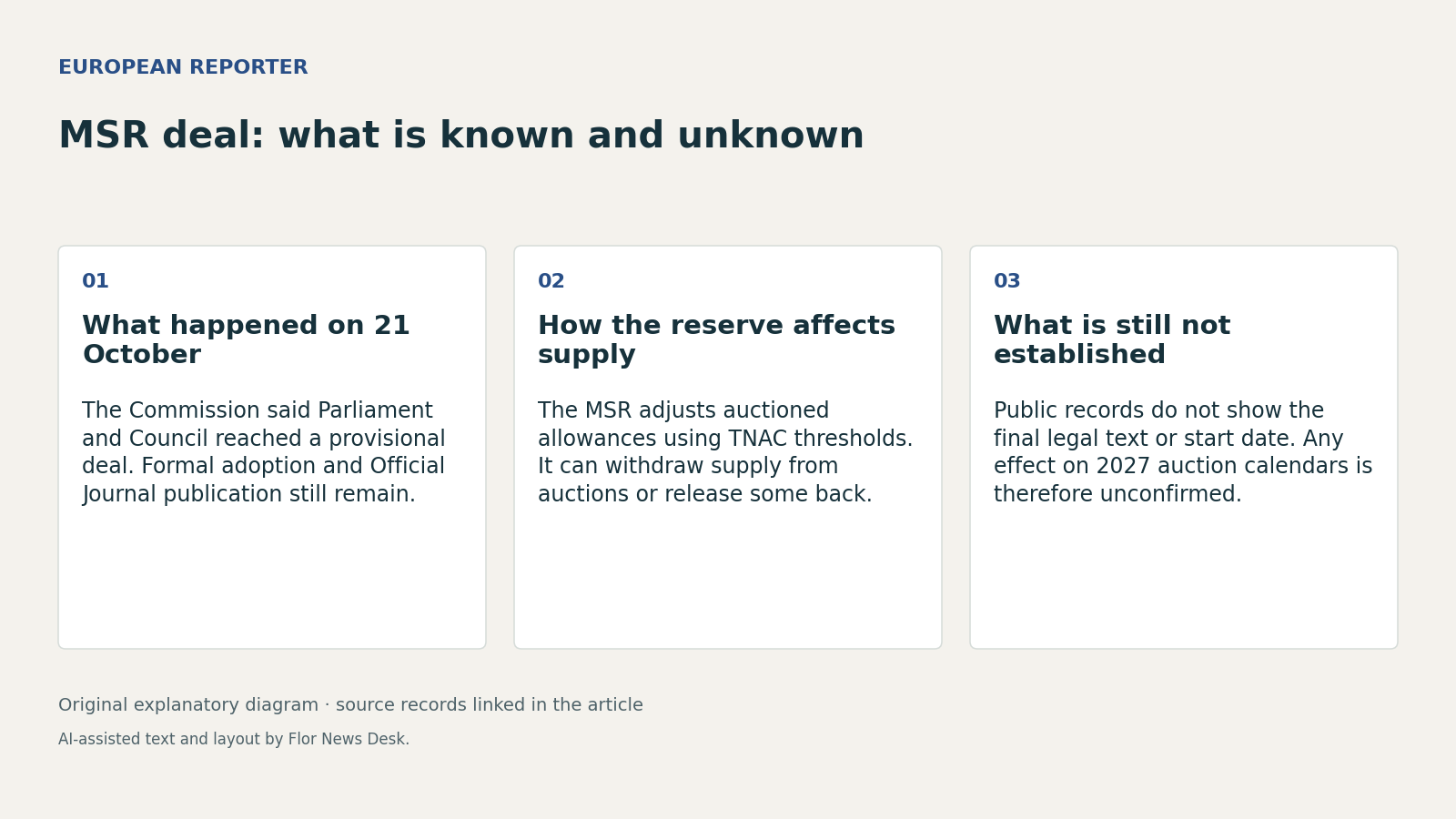
On 21 October 2026, the European Commission said the European Parliament and the Council had reached a provisional political agreement on a targeted amendment to the EU Emissions Trading System’s Market Stability Reserve, or MSR. The clearest publicly documented change is that the agreement would allow the reserve to keep up to 700 million allowances as a buffer, whereas the Commission says the current system invalidates all allowances held in the reserve above 400 million. The same Commission statement says the text still needs formal adoption by both institutions and would enter into force only after publication in the Official Journal of the EU (Commission statement, 21 October 2026).
That matters because the MSR is one of the EU ETS rules that changes how many allowances reach auctions across member states. The Commission’s MSR background page says the mechanism works automatically through the total number of allowances in circulation, or TNAC, with no case-by-case discretion for the Commission or national governments. According to that page, when TNAC is above 1,096 million, allowances are withdrawn from auctions at a rate of 24% over 12 months; when TNAC is between 833 and 1,096 million, the withdrawal volume equals TNAC minus 833 million; and when TNAC falls below 400 million, 100 million allowances are released for auction (Commission MSR background). On those premises, a higher buffer inside the reserve would mean fewer allowances are automatically cancelled and more are retained within the system.
The negotiation path also shows that the 21 October deal was not a simple rubber stamp of Parliament’s earlier stance. The European Parliament’s procedure summary says Parliament adopted its position on 15 September 2026 by 367 votes to 240, with 59 abstentions, then referred the file back for interinstitutional negotiations. That summary says Parliament wanted invalidation to continue, but above a 650 million threshold, with allowances beyond that threshold invalid from 1 March 2027 (European Parliament procedure summary, 15 September 2026). The Commission’s later statement about a 700 million buffer indicates the compromise moved away from that public Parliament position, even if the missing final text prevents a full clause-by-clause comparison.
What the public record does not yet establish is almost as important as what it does. The sources support a political agreement, not a final adopted law. They do not provide the consolidated compromise text, a formal vote record in the Council after the deal, or a start date for any new threshold beyond entry into force after Official Journal publication (Commission statement, 21 October 2026). That means readers should not treat 21 October as proof that 2027 auction calendars have already changed.
The practical cross-border consequence is therefore one of direction rather than fixed quantities. National ministries, auction authorities and companies covered by the EU ETS can infer that Parliament and the Council are trying to preserve a larger stock of allowances inside the reserve instead of letting everything above 400 million disappear permanently. But the available records do not show how that stock would feed through to country auction volumes, or on what calendar, because those operational effects depend on the final legal wording and later TNAC data (Commission MSR background).
There is also a limit to what can be claimed about market effects from these documents alone. The Commission presents the amendment as strengthening stability and resilience, and links it to its April 2026 proposal and European Council conclusions of 16 October 2026 (Commission statement, 21 October 2026). But the public pages here do not provide measured outcomes on prices, competitiveness or investment. The firmest reading, for now, is narrower: the EU’s two lawmakers appear to have agreed in principle to make the reserve a larger buffer, while leaving the legal and implementation details to the still-unpublished final text.