The European Commission took a concrete administrative step on 9 October 2026 when it approved a second EU list of Strategic Projects under the Critical Raw Materials Act. According to the Commission, the new list adds 46 Strategic Projects across 16 Member States and brings the overall number designated under the CRMA to 106 when earlier EU and non-EU approvals from 2025 are included (Commission release, 9 October 2026; Selected projects page, retrieved 20 October 2026).
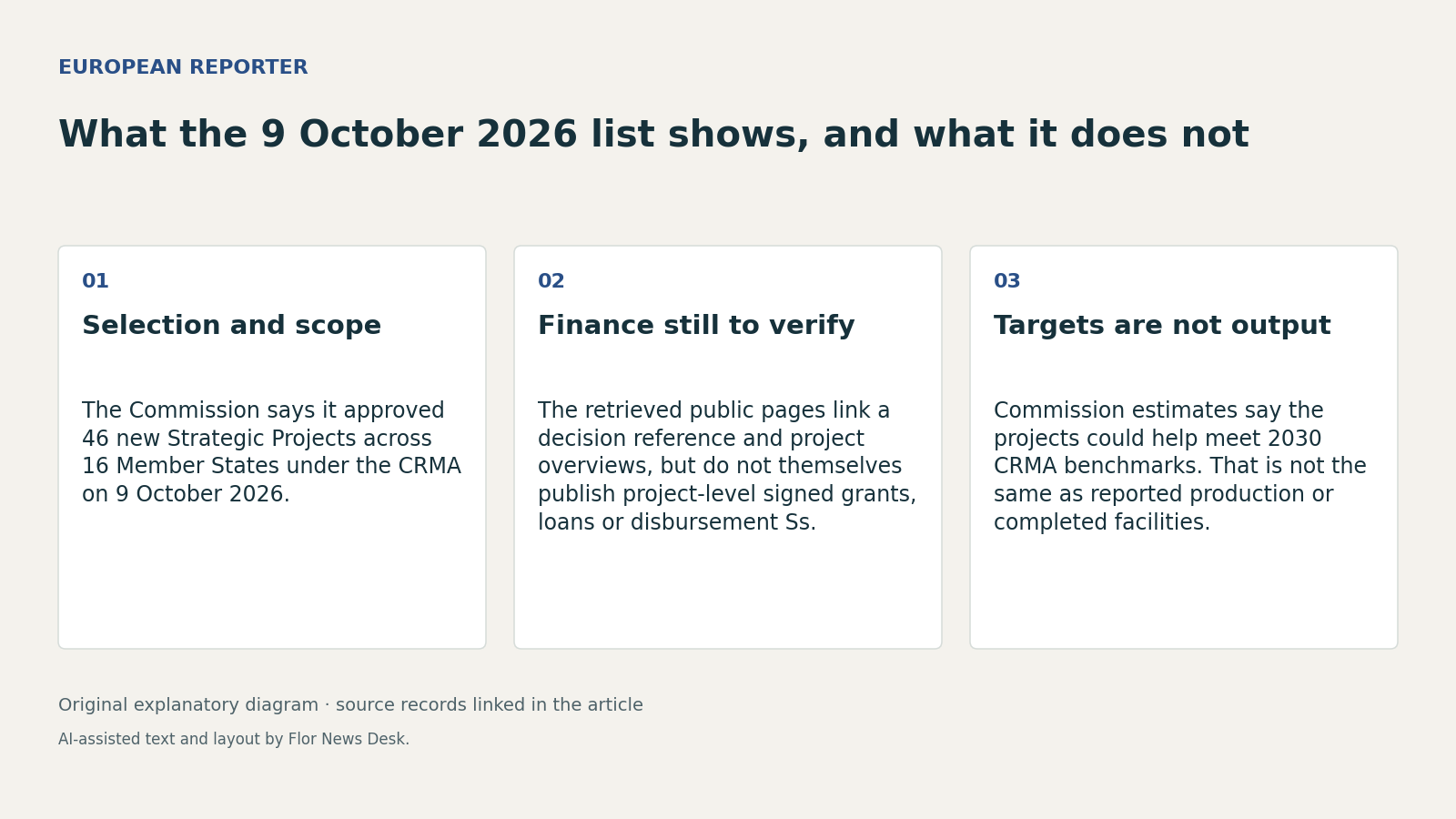
That changes the public pipeline. It does not, on the evidence supplied here, prove that mines, processors or recyclers are financed, permitted and operating.
The policy change documented in the record is the designation itself. The Commission’s CRMA overview says strategic projects are meant to increase EU capacity to extract, process and recycle strategic raw materials and to diversify supplies from third countries. The same page says the Commission considers strategic projects to be of public interest because of their importance for security of supply and the internal market. It also states that the current approved list includes results from the 2025 and 2026 application calls (CRMA strategic projects overview, retrieved 20 October 2026).
The second list is notable for its mix. The Commission says it selected the 46 projects from 102 applications, of which 92 were assessed against CRMA criteria. Its breakdown is eight extraction projects, 11 processing projects, 19 recycling projects and eight integrated projects, including three combining extraction with processing and five combining processing with recycling. The Commission also says those 46 projects cover 15 of the 17 strategic raw materials under the CRMA (Commission release, 9 October 2026). For readers tracking industrial policy across borders, that points to a supply strategy that is not limited to opening mines.
What remains unproven is equally important. The selected-projects page links Commission Decision C(2026)8051, an annex, a press release and an overview of the 46 projects. But in the record retrieved on 20 October 2026, those public pages do not themselves publish signed grant agreements, signed loan contracts, disbursement schedules or project-by-project financing sources (Selected projects page, retrieved 20 October 2026). The same limitation applies to permitting: the supplied pages do not set out a definitive national permit timetable for each project.
That distinction matters because EU selection and national delivery are different stages. The Commission says progress is already visible in the earlier 2025 cohort: 25 Strategic Projects have completed an environmental impact assessment, 17 have obtained a construction permit, more than €2 billion has been committed through the Innovation Fund, State aid and the European Investment Bank, and the Raw Materials Mechanism has generated more than 30 matches for 10 materials (Commission release, 9 October 2026). Those are Commission statements about the earlier wave, not evidence that the 2026 projects have reached the same stage.
There is also a limit to what benchmark language shows. The Commission says the 46 new projects, together with those selected in 2025, are expected to make a significant contribution to the CRMA’s 2030 extraction, processing and recycling targets. That is a Commission estimate, not measured output. And while the selected-projects page links factsheets for 16 raw materials across the overall set of 106 projects, the supplied record does not provide independent project-level corroboration beyond Commission pages.
For now, the useful reader takeaway is narrower: Brussels has expanded its named CRMA project pipeline, but the next tests will happen in member states and financing channels, where permits, contracts, disbursements and eventual production can be verified.