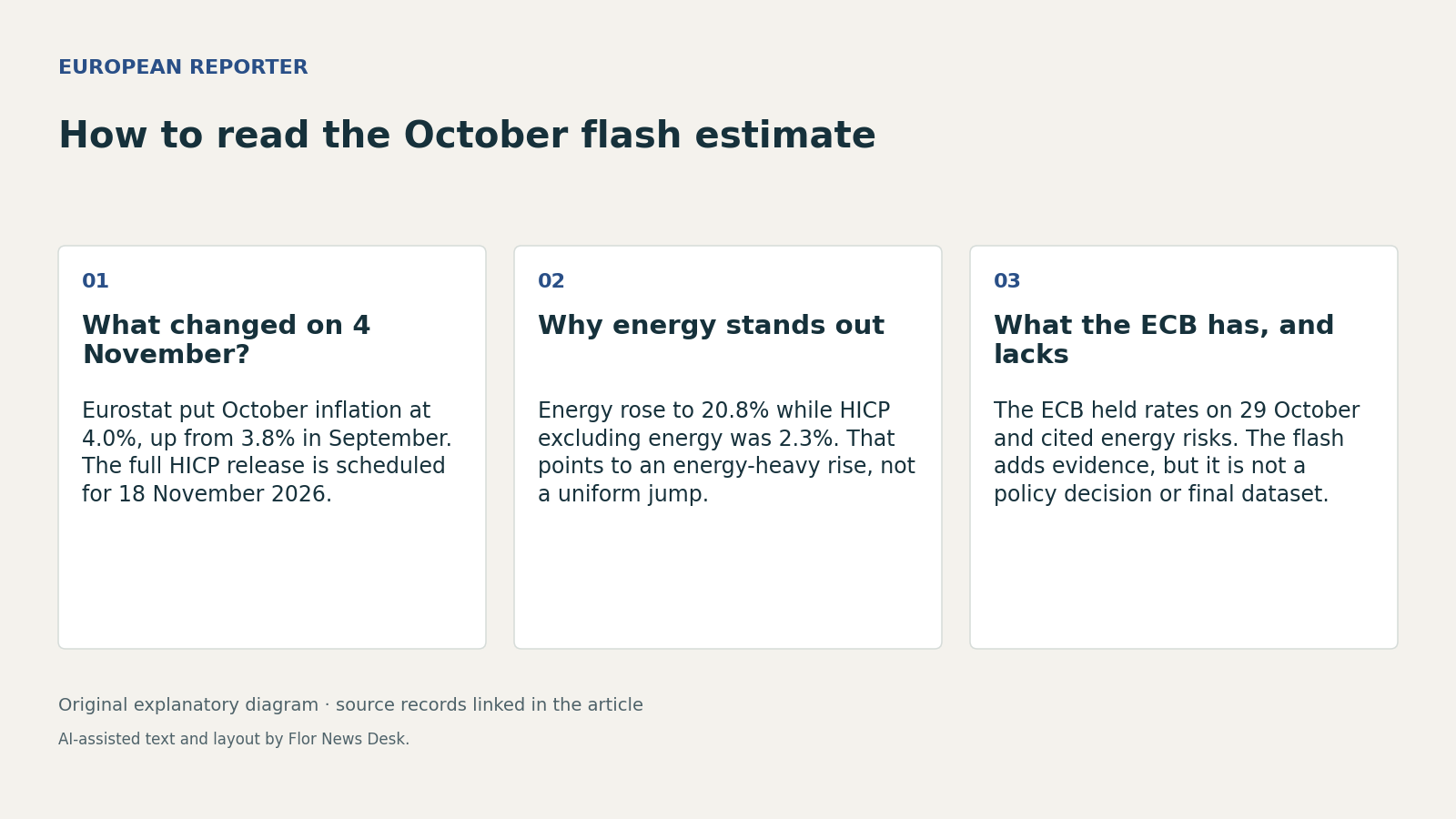
Eurostat’s flash estimate on 4 November 2026 changed the euro-area inflation discussion from anticipation to a concrete, if still provisional, number: annual HICP inflation is estimated at 4.0% in October, up from 3.8% in September, with a monthly all-items increase of 0.4%.Eurostat flash estimate, 4 November 2026 That matters because the rise came after the European Central Bank had already warned on 29 October 2026 that higher energy prices were creating upside risks to inflation and downside risks to growth.ECB monetary policy statement, 29 October 2026
The component pattern is the most important part of the flash. Eurostat estimated October energy inflation at 20.8%, up from 18.9% in September, while services were at 3.3%, food, alcohol and tobacco at 1.6%, and non-energy industrial goods at 1.2%.Eurostat flash estimate, 4 November 2026 Eurostat also put HICP excluding energy at 2.3% and HICP excluding energy, food, alcohol and tobacco at 2.5%.Eurostat flash estimate, 4 November 2026 Read alongside the ECB’s 29 October statement, which said inflation excluding energy had been 2.3% in September, the available record suggests the new rise in the headline was concentrated in energy rather than showing a broad October jump across every underlying measure.ECB monetary policy statement, 29 October 2026
That distinction matters for policy communication. The 4 November flash does not establish an ECB decision, and it does not tell readers what the Governing Council will do at a later meeting. On 29 October 2026 the ECB kept its key rates unchanged, and President Christine Lagarde said the council had discussed whether a rate rise was appropriate before choosing to wait for more information and stay data-dependent.ECB monetary policy statement, 29 October 2026 What the flash does do is add one fresh data point that fits the ECB’s earlier warning about energy risk more than it supports a simple story of steadily fading inflation pressure.
For governments, employers and trade unions across the euro area, the immediate consequence is informational rather than automatic. The latest shared euro-area benchmark is now 4.0% rather than 3.8%.Eurostat flash estimate, 4 November 2026 But the records used here do not establish how any national budget, indexation rule or wage round will respond. They do, however, show that services inflation remained above 3% and that the ex-energy measure did not obviously collapse between September and October.Eurostat flash estimate, 4 November 2026 ECB monetary policy statement, 29 October 2026
There are also firm limits on what can be claimed now. Eurostat labels the October figures as a flash estimate and schedules the full October 2026 HICP release for 18 November 2026.Eurostat flash estimate, 4 November 2026 The brief for that source does not establish a country-by-country explanation of the move, and Eurostat’s flash page, as summarised here, provides rates rather than a causal account. So “energy-led” is an analytical reading from the component pattern, not a final official decomposition of why each national index moved.
One more caveat is technical but relevant. Eurostat notes that the euro-area aggregate changed from EA20 to EA21 on 1 January 2026 after Bulgaria’s entry, and that the series use an evolving-composition chain index.Eurostat flash estimate, 4 November 2026 That does not erase the October signal, but it does mean cross-year comparisons carry a compositional warning alongside the usual uncertainty of a flash estimate. On 7 November 2026, the safest reading is that headline inflation has moved higher again, with energy the clearest pressure point, while the final shape of October’s inflation picture still waits for 18 November.