
Former Bangladeshi prime minister Sheikh Hasina says she intends to be back in Bangladesh by December 2026 and is willing to face imprisonment, according to an NDTV interview transcript described in a report by AFV News. Her stated resolve to return was not accompanied by a disclosed agreement on how that journey would take place.
Hasina presented going home as a commitment to the country and its people. She also rejected the tribunal proceedings that produced her death sentence, said she remained engaged in rebuilding the Awami League, and called for regional cooperation against extremism rather than Bangladesh's isolation.
The account leaves a distinction between political intent and practical arrangements. No specific arrival date, agreed route or confirmed understanding with the governments of Bangladesh or India was identified in her answers.
December commitment leaves the route home unresolved
“I have made a solemn commitment to return to my homeland by December 2026,” Hasina said in the transcript quoted by AFV News.
The question put to her concerned more than a declaration of intent. The interviewer asked whether official or backchannel contacts had begun with either government, what those contacts involved, and how she proposed to return.
Her response referred to discussions and speculation without establishing that Bangladesh or India had agreed to any arrangement. She did not disclose a legal or security guarantee. Instead, she stressed that her preferred return would be peaceful and lawful, respecting Bangladesh's sovereignty and the rule of law.
Hasina argued that, as a Bangladeshi citizen, she had a right to come home and that no law could justly bar her from doing so. This was the position she advanced, not a ruling on her legal circumstances or on the implications of the sentence against her.
She disputed the suggestion that she had deserted Bangladesh, saying events outside her control had determined her departure. She associated her proposed return with her record of political work and what she described as a lifelong commitment to development and economic wellbeing.
The intention was therefore clear, but the operational details were not. Her answers described the principles on which she wanted to return rather than a settled plan for travel.
Willingness to face detention is not acceptance of the sentence
When asked whether returning to Dhaka could lead to arrest and imprisonment, Hasina said she was prepared to bear legal consequences in order to continue her political struggle and serve the public.
At the same time, she rejected both the tribunal process and its conclusion. She characterised the death sentence as politically driven and unjust, and accused the administration established following her departure of unconstitutional conduct and retaliation.
These accusations belong to Hasina's account. The interview, as reported, contained no reply from the tribunal or Bangladeshi authorities to those claims. Her readiness to confront the risk of prison should not be confused with an admission of the tribunal's findings.
She demanded fair application of the law and protection of her rights throughout any proceedings. Fear and intimidation, she said, would not make her give up political activity, which she linked to democracy, justice and the welfare of Bangladeshis.
Separately sourced background: In a November 17, 2025 statement reproduced by ecoi.net, the UN human rights office addressed verdicts against Hasina and a former home minister on crimes-against-humanity charges connected to the suppression of the 2024 protests. The office stressed accountability and remedies for victims, alongside international fair-trial and due-process standards. It said those safeguards were particularly important in proceedings held in the defendants' absence that resulted in capital punishment. It had not been privy to the trial's conduct and opposed the death penalty in all circumstances. This statement predates the reported interview and is not a response to it.
Her family's killings and the demand for a fair hearing
Explaining her view of justice, Hasina recalled the assassination of her father, Bangabandhu Sheikh Mujibur Rahman, and the killings of other relatives on August 15, 1975.
In her account, 18 members of her family were killed. She listed her mother, three brothers, two sisters-in-law, an uncle and other relatives among the victims. She said she and her sister were in Germany when the killings occurred and that she could not return to Bangladesh for six years.
She recalled coming back in 1981 after the Awami League elected her president while she was still abroad. Following her arrival in power in 1996, she said, she began the prosecution of her father's killers after an indemnity arrangement had prevented a trial.
Hasina attributed that protection to Ziaur Rahman's military-era leadership. She described the subsequent case as one pursued within Bangladeshi law, saying more than three decades passed between the killings and a final verdict, with the legal proceedings themselves lasting more than 13 years.
She invoked this history to explain why she professed confidence in the country's justice system while contesting the specific proceedings against her. Her demand, as she presented it, was for the same principle of lawful and fair treatment to extend to her own case.
These passages were personal and historical recollections in her interview answers. They were not new findings established through separate reporting for this article.
Awami League rebuilding remains central to her plans
The party's future was another major theme. The interviewer asked how Hasina could revive the Awami League while it was barred from active politics and whether she would take charge of rebuilding it as an opposition force.
She said organisational work was already under way, with efforts to strengthen the party and renew contact with supporters and workers around Bangladesh. Her answer envisaged her continued involvement at the centre of that process, not retirement from leadership.
Describing the organisation founded in 1949, she portrayed the Awami League as the party of Bangladesh's independence and democratic aspirations. That assessment of its record and purpose was hers.
She also made the preservation of Sheikh Mujibur Rahman's legacy a priority. She wanted recognition of her father's historical contribution and linked the party's recovery to democratic governance and the rights and dignity of Bangladesh's people.
The account did not, however, offer a detailed timetable for restoring the organisation's public role. Hasina set out neither a specific electoral strategy nor a legal mechanism for lifting the restrictions on the party. The interview established an intention to rebuild and reconnect rather than a complete route back into political participation.
Earlier imprisonment used to explain her determination
Hasina drew on previous detention to argue that the possibility of imprisonment would not end her political work.
She recalled being held with her mother during Bangladesh's independence struggle in 1971, after her father's arrest. She said she was then pregnant with her first child and that her son was born while she was in captivity.
Turning to the period after her 1981 return, she described her work as resistance to military rule and a campaign for democratic rights. She referred to repeated arrests in the 1980s, in 1990 and in 2007.
Her purpose in recounting those experiences was to connect her present position to her earlier political life. In her telling, difficult conditions and detention had not previously brought her involvement to an end and would not, on their own, cause her to abandon the party's future.
Extremism warning combines security measures and civil liberties
Asked about the possibility of terrorist and extremist networks expanding their influence in Bangladesh, Hasina described the danger as serious. She defended her administration's record, saying that preventing such networks from finding a haven had been a priority during her time in office.
Her proposed response included more effective intelligence gathering, stronger law enforcement and engagement with communities to prevent radicalisation. She also argued that security policies must be balanced against civil liberties.
These were political assessments and policy preferences, not a newly disclosed intelligence report. The transcript, as described by AFV News, provided no named network, specific incident or detailed intelligence assessment to substantiate the warning.
The interviewer also raised Pakistan as a comparison and referred to closer Bangladesh-Pakistan relations. Hasina did not directly adopt that comparison in her answer. She focused instead on extremist networks and ideas moving across national boundaries.
Her remarks treated Bangladesh's security as connected to that of the surrounding region. Domestic stability, in this framing, could not be separated from the relationships between neighbouring states.
Regional cooperation rather than isolation
Hasina argued against isolating Bangladesh from the rest of South Asia, presenting such a course as impractical and unproductive. Extremism, she said, had regional and wider international dimensions that called for cooperation.
She linked insecurity to broader social expectations as well. A young population with growing connections to the world wanted better governance and economic opportunity, she argued, and those demands needed to be understood as part of a deeper social transformation.
Her answer contrasted two possible directions for the region. One was continued division through repression, nationalism, geopolitical competition and inherited mistrust. The other was closer economic integration, allowing greater prosperity and improved security to reinforce one another.
She closed by treating peace and economic advancement as shared objectives in an interdependent world.
For Hasina herself, the unresolved issues were more immediate: when and by what route she would return; whether any intergovernmental understanding existed; and how she would respond to the sentence and the restrictions confronting the Awami League. The transcript conveyed determination to return by December 2026. It did not disclose an agreed mechanism for achieving that return.
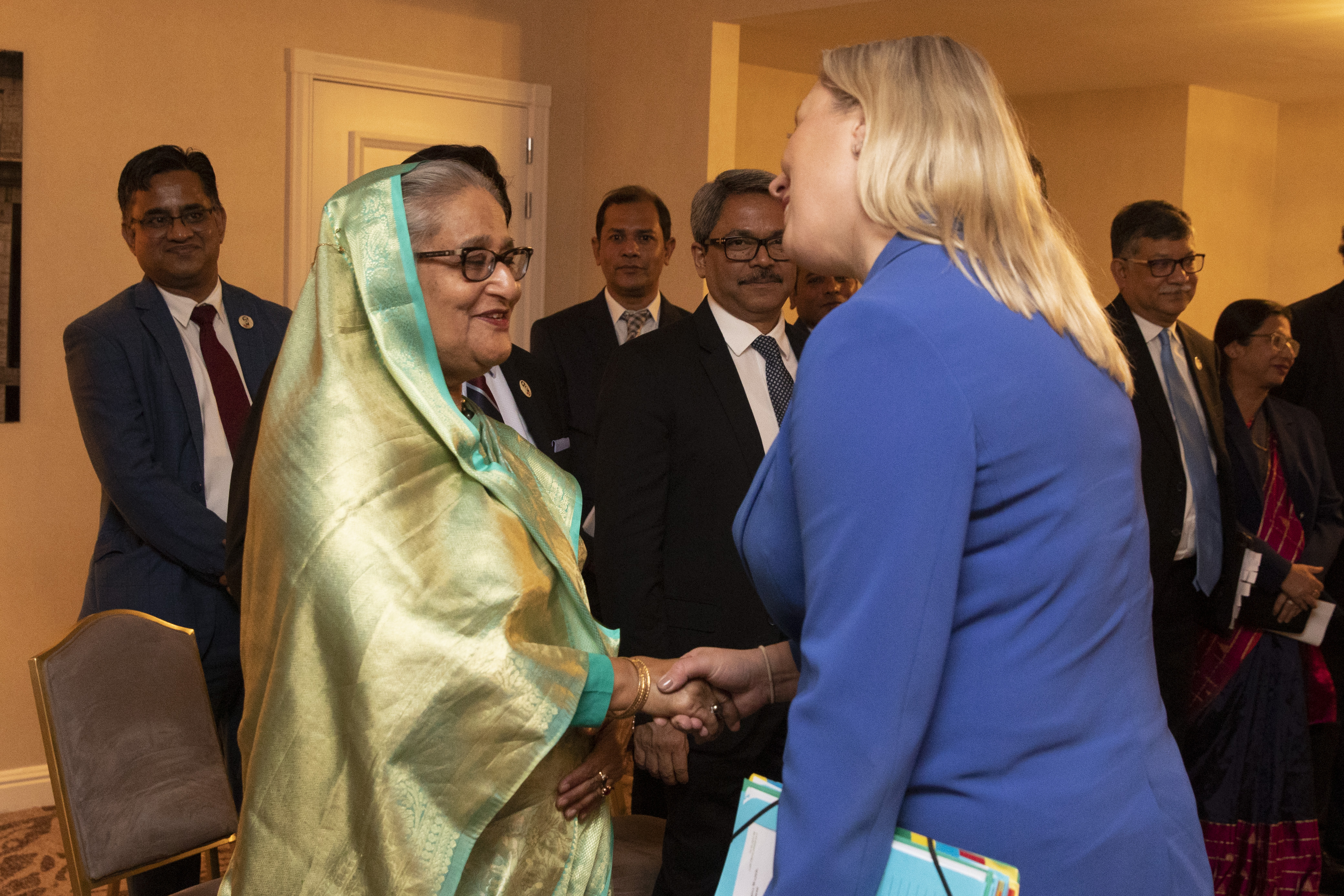
Source note: European Reporter has rewritten the AFV News account with the publisher's authorisation. The underlying material is a supplied transcript identified as an NDTV telephone interview with Sheikh Hasina on September 22, 2026. Neither this article nor its AFV source independently verifies the recording or broadcast date. Recollections, allegations and political assessments are attributed to Hasina. The UN statement is separate legal background, and the featured photograph records an unrelated occasion in October 2023.