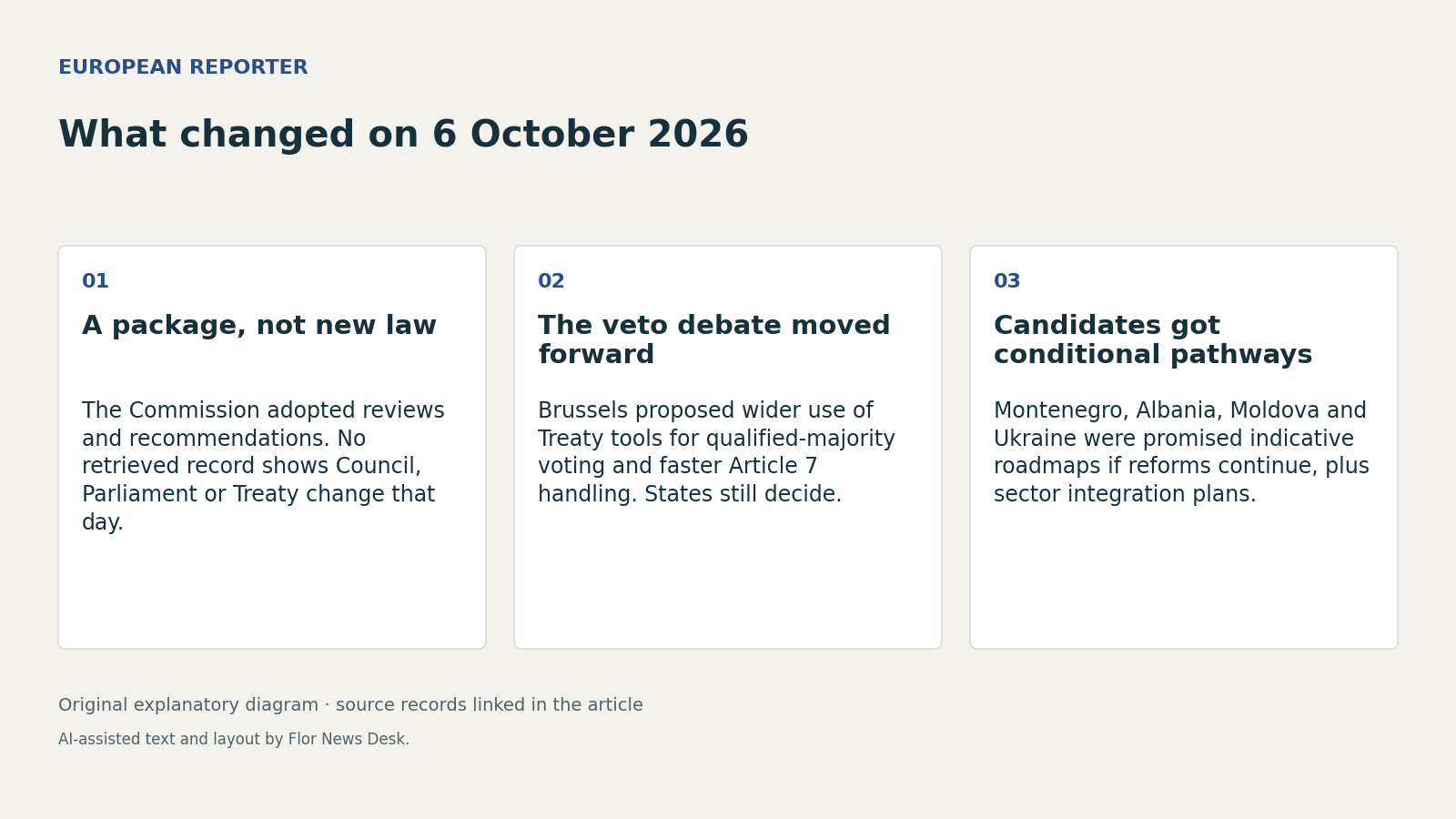
The European Commission’s move on 6 October 2026 was not another general endorsement of enlargement. It adopted a package of pre-enlargement policy reviews and used it to argue that the Union can prepare for more members within the existing Treaty framework, while changing how it uses current rules on governance, budgets and safeguards (Commission news page, DG Enlargement page). What changed, then, is not the law. It is that the Commission has turned a long-running question about EU readiness into a concrete agenda for the European Council and the European Parliament.
Its clearest institutional bet is to avoid reopening the entire Treaty debate and instead press existing flexibilities harder. The Commission says it wants greater use of Treaty options, including passerelle clauses, enhanced cooperation and more qualified-majority voting, and it specifically proposes qualified-majority voting for opening negotiating clusters and some intermediate accession decisions (Questions and answers, DG Enlargement page). It also says Article 7 handling should become more effective, including possible timeframes (Commission news page). The practical consequence is political rather than automatic: the Commission is trying to narrow where national vetoes apply, but the retrieved records do not show Member State approval.
For candidate countries, the package matters because it links accession talks to earlier, sector-by-sector participation. The Commission says it will seek deeper gradual integration in energy, transport, digital and defence, launch annual dialogues with enlargement partners, and present indicative roadmaps for Montenegro, Albania, Moldova and Ukraine as part of the 2026 Enlargement package if reform momentum continues (Commission news page, Questions and answers). That is more specific than a generic promise of future membership, but it is still conditional planning, not accession or guaranteed market access.
The budget element is where enlargement politics reaches national administrations fastest. According to DG Enlargement, the proposed 2028-2034 Multiannual Financial Framework would keep candidates under Global Europe before accession, then move them at accession into National and Regional Partnership Plans with added funding for cohesion, agriculture, Home Affairs and Interreg (DG Enlargement page). The same page says Ukraine would need targeted arrangements to limit support and market access for sensitive agricultural products while restoring traditional third-country export routes. As analysis, that looks like an attempt to answer two existing objections at once: budget strain and farm-market disruption.
The rule-of-law side is equally important because it shows the Commission is not treating enlargement safeguards as a pre-accession issue only. The Q&A says the Commission would progressively extend the Rule of Law Report to additional candidate countries as they become ready, and it outlines possible safeguards in future accession treaties: longer-lasting sectoral measures, a new institutional safeguard tied to Article 2 TEU values and sincere cooperation, and possible suspension of voting rights in the most serious cases (Questions and answers). In practice, Brussels is proposing that future enlargements come with stronger brakes as well as faster preparatory integration.
There is also a verification limit readers should keep in mind. A retrieved Dorie metadata page lists a document dated 06/10/2026 titled “Preparing for a wider Union”, but the viewer was unavailable and the record identifies the item as a statement or press release rather than displaying the underlying text or attachments (Dorie metadata). So the public record used here supports a clear conclusion but not a complete legal map: on 6 October, the Commission changed the terms of the enlargement discussion inside EU institutions; it did not by itself change EU voting rules, budgets or accession conditions.