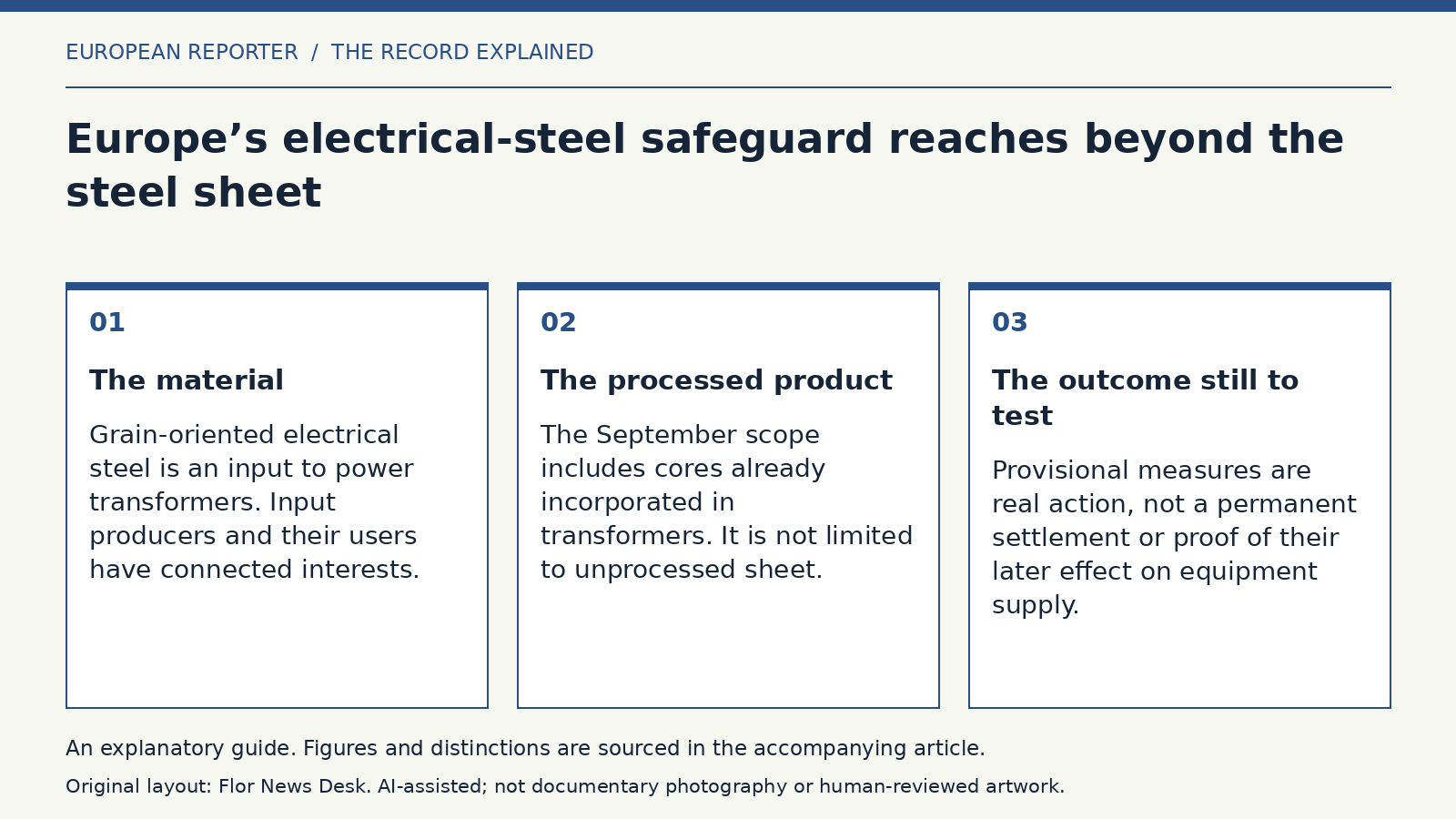
The European Commission’s new provisional safeguard for grain-oriented electrical steel is not limited to an unprocessed input. Its September 18 announcement says the measures also cover laminations and cores, including cores already incorporated into transformers. That scope is important to understanding a policy presented as protecting part of the electricity-infrastructure supply chain rather than steel production in isolation.
The Commission describes tariff-rate quotas combined with price thresholds. It attributes the intervention to import pressure and global overcapacity, following its investigation. These are the institution’s stated findings and justification, not an independent audit of each producer or a calculation of the charge applying to a particular shipment.
One chain, more than one industrial interest
The March 27 investigation announcement explicitly identified transformer manufacturers as users of the steel whose interests would also need assessment. That starting point matters: supporting an input producer and supporting a manufacturer that uses the input are related aims, but their consequences cannot be assumed identical.
The September inclusion of cores already inside transformers adds another dimension to that discussion. The Commission says the scope provides protection downstream as well. The announcement establishes the design it has chosen; it does not yet establish the resulting balance of costs, investment or delivery performance throughout the chain.
Consider a hypothetical manufacturer evaluating a policy that affects both a material it purchases and a processed product with which it competes. Looking only at the input side would miss part of the measure. Looking only at the competitive protection would miss another part. Assessing the combined effect requires evidence about both relationships, not an assumption that the word protection supplies a uniform outcome.
Provisional action is not a final verdict
The stage of the procedure is another boundary worth preserving. The September measures are provisional. The Commission’s announcement describes a separate process for definitive measures. Reporting the intervention as a completed permanent settlement would therefore go beyond the record, even though provisional action is a real policy step rather than merely an investigation being opened.
For electricity-system planning, the relevant outcome is not only whether a particular industrial category receives support. It is whether the supply chain can deliver the equipment required, under conditions that can be examined. These two announcements do not provide a post-intervention assessment of transformer availability or project lead times.
That limitation should not be turned into a claim that the measure has already caused shortages, delays or higher costs. Nor should its stated strategic purpose be presented as proof that those outcomes have been avoided. Both favorable and unfavorable causal conclusions require evidence after implementation and an appropriate comparison.
The immediate change is thus specific: a provisional trade measure with a scope extending into processed transformer components. The useful next assessment will trace how that design affects the connected stages of production. Describing those stages accurately is a better starting point than treating electrical steel and the equipment built from it as unrelated policy subjects.