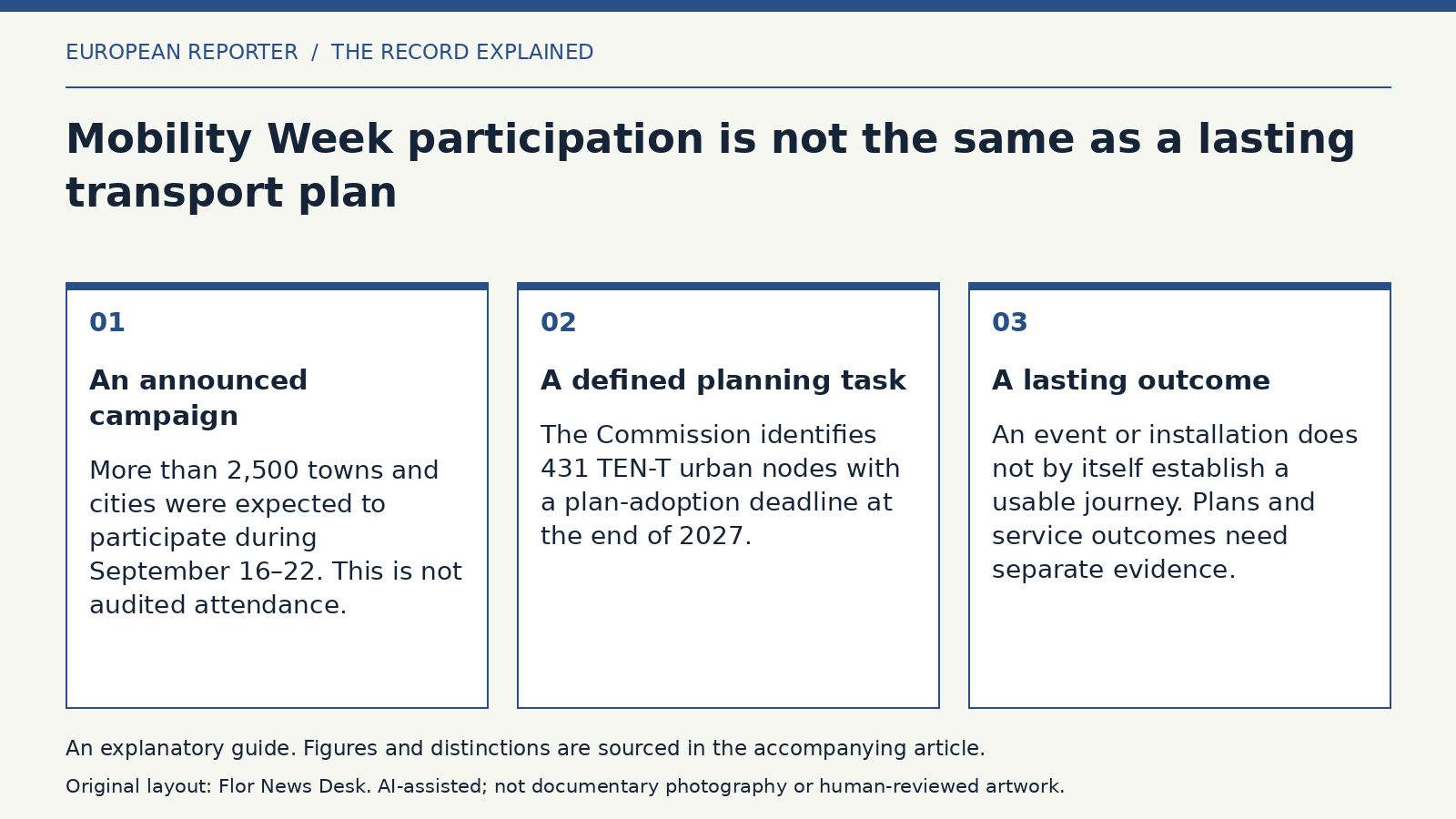

A city can take part in a mobility campaign without that participation establishing the quality or completion of its long-term transport plan. The European Commission’s September 15 announcement of European Mobility Week described planned participation by more than 2,500 towns and cities during September 16–22. That is the announced programme, not an audited count of attendance or completed measures after the events.
The campaign’s theme, Mobility for Everyone, emphasizes access across generations and circumstances. Its programme includes public activities and planned permanent changes. These can be related to a wider transport strategy, but an event count and a lasting service outcome are not interchangeable measures of success.
A campaign and a planning obligation
The Commission’s June 11 account of updated Sustainable Urban Mobility Planning guidelines describes a separate institutional task. It says the trans-European transport network framework requires 431 urban nodes to adopt a Sustainable Urban Mobility Plan by the end of 2027. That identified group should not be confused with every place participating in the September campaign.
The distinction is not an argument against public events. A campaign can make a question visible and create an opportunity to discuss choices. A plan must explain how proposed measures fit together over time. Participation in the first does not, without further evidence, demonstrate completion of the second.
Imagine a hypothetical city that closes one street to cars for an afternoon. That activity can be documented accurately. It would not, by itself, establish that residents have a dependable alternative for their ordinary journeys throughout the week. The latter claim would require information about the services, routes and circumstances that make those journeys possible.
Permanent measures still need an outcome test
The September announcement also described intended lasting changes, including bicycle ramps and expanded lower-speed zones. An inauguration and a functioning improvement are related milestones, but the relationship should be examined rather than assumed. This article does not independently verify that any particular announced installation has been completed.
A useful local account would identify who can use a measure, what part of a journey it improves and what remains unresolved elsewhere. A connection can be valuable without making an entire route accessible. Equally, an incomplete route does not prove that the improvement has no value. The assessment needs to describe both the contribution and its limits.
There is a reasonable concern that long-term planning can become remote from the people who use transport. Public engagement can help expose that gap. Its value is stronger when the discussion can be traced into choices, responsibilities and a timetable, rather than presented as a substitute for them.
As the scheduled campaign reaches September 22, its announced ambition should therefore be kept distinct from verified results. The lasting question is how a city connects visible activity to a coherent plan and then to usable transport. Counting participating places is one observation; showing that more people can make the journeys they need is another.