The European Commission has turned a broad debate about media resilience into a specific funding package, but only part of the operational picture is public. On 21 October 2026, a European Commission Representation in Cyprus page said Brussels had published three Creative Europe calls worth €20.5 million for journalism, media pluralism, media resilience and media literacy, while the Commission’s digital-policy news page carried the same breakdown and said the calls would open for applications on 22 October 2026. Cyprus page Digital news item
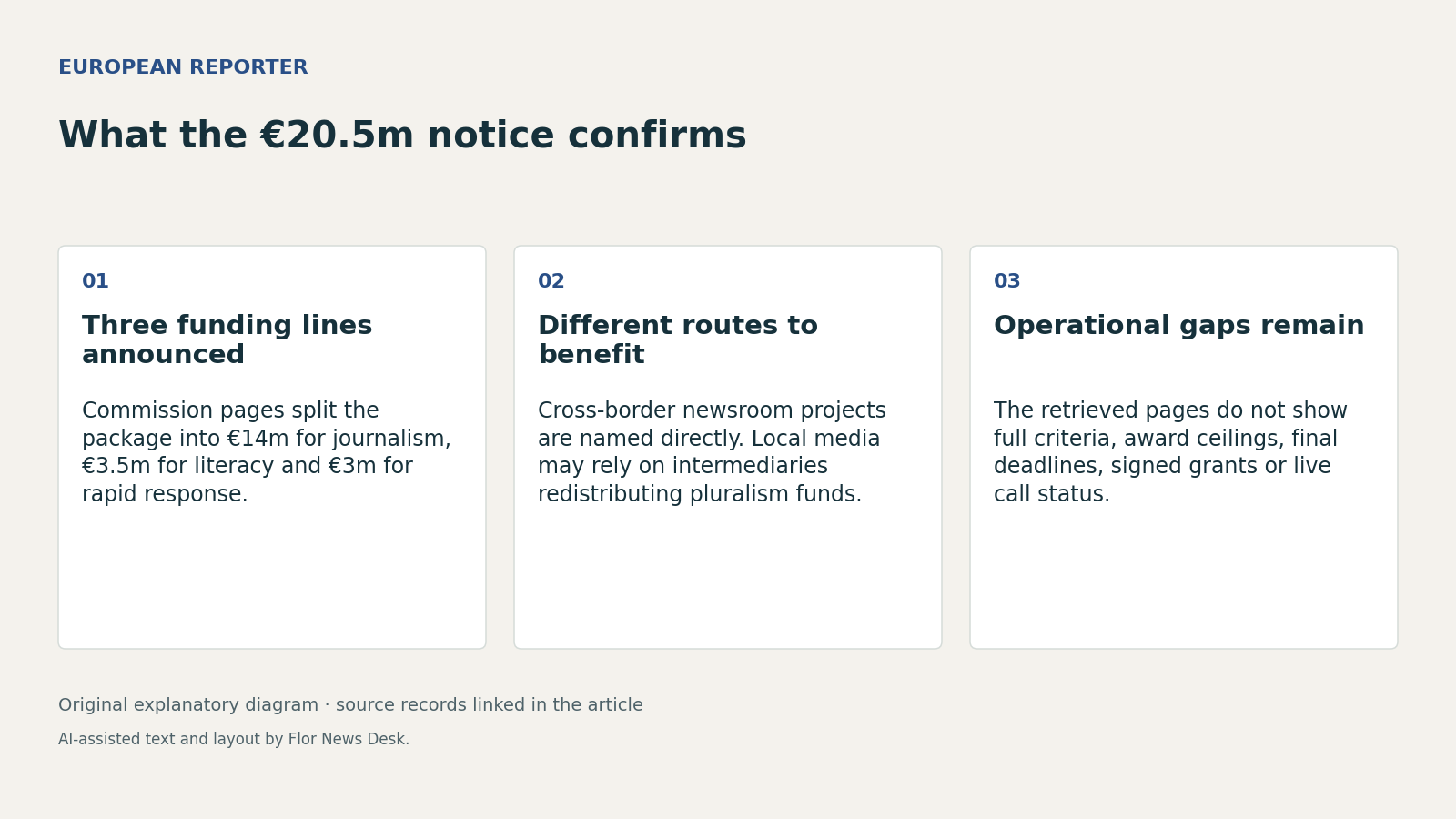
Most of the money is concentrated in one instrument. The Commission says the journalism partnerships call carries €14 million and is split into pluralism and collaboration topics. According to the same pages, the pluralism strand is aimed at organisations able to create and distribute funds to news media entities, including local and public-interest media, while the collaboration strand is for cross-border proposals between news media organisations working on business models and journalistic projects across Europe. Digital news item Cyprus page
The smaller pots show where Brussels is drawing the policy boundary. The Commission says €3.5 million is reserved for cross-border media-literacy projects and €3 million for an independent Europe-wide rapid-response mechanism on press and media freedom in the EU and candidate countries. That pairing matters. One line is framed around citizens’ ability to navigate information; the other is framed around tracking and responding to threats to media freedom. The retrieved pages do not present either line as a general operating subsidy for all newsrooms. Digital news item Cyprus page
The Commission’s own thematic page on countering information manipulation helps explain why these calls are grouped together, even though it is not the funding notice itself. That page places media freedom, media pluralism and media literacy within the EU response to foreign information manipulation and interference. It also cites Special Eurobarometer 568 from November 2025, saying 79% of EU citizens were concerned about disinformation influencing voters and 70% feared foreign interference in elections. The same page says the Commission presented the European Democracy Shield in November 2025 and notes that the European Media Freedom Act and anti-SLAPP rules entered into force in May 2024. Countering information manipulation
That context supports one clear analytical point: the €20.5 million package is an implementation step inside a wider media-and-democracy agenda, not a new rulebook. The retrieved records do not show that any newsroom has yet received money, and they do not establish whether the planned 22 October 2026 opening happened as scheduled, remained open on 1 November 2026, or had already moved to evaluation. They also leave out selection criteria, per-project ceilings, detailed deadlines and any beneficiary list. The thematic page itself mixes an earlier revision date with October 2026 news items, so it cannot close those gaps. Digital news item Cyprus page Countering information manipulation
For readers across Europe, the practical distinction is between direct applicants and indirect beneficiaries. Cross-border newsroom partnerships appear to be named applicants under the collaboration topic, while local and public-interest outlets may depend on separate organisations winning the pluralism strand and then redistributing funds. The rapid-response mechanism also reaches beyond member states to candidate countries, widening the political geography of the package. But until Brussels publishes fuller call documentation or later award decisions, what is confirmed is the Commission’s intended budget split, not the eventual national or local flow of money. Digital news item Cyprus page