
The European Commission has turned its Digital Services Act scrutiny of TikTok into a specific claim about product design: it says the platform’s “For You” feed can steer some users into harmful loops of videos about sadness, isolation or body image, with possible effects on mental health, especially for vulnerable adults and minors. The public case matters because it is framed around how the recommendation system reacts to user behaviour, not around one unlawful post or one moderation mistake. Commission summary
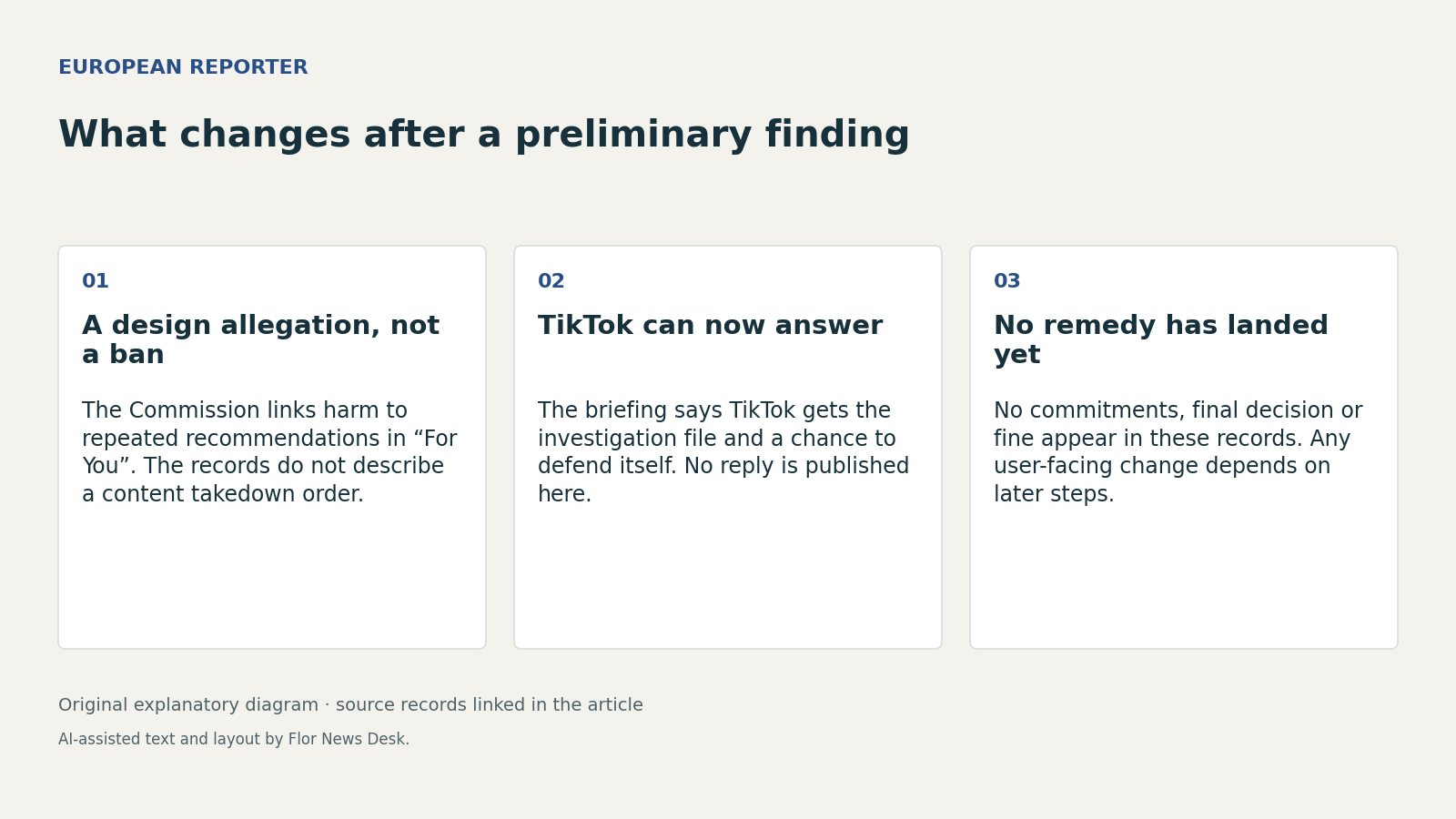
That is the first substantive shift visible in the public record. In a 6 November 2026 Commission press briefing, spokesperson Thomas Regnier said the case concerns repeated presentation of content that may contribute to anxiety, stress and mental health issues, rather than content moderation or the removal of illegal content. Commission briefing If that view were later confirmed, the significance would reach beyond TikTok’s current dispute: it would show the Commission reading DSA duties as applying to cumulative recommendation effects, not only to decisions on individual pieces of content.
The second change is procedural, not yet remedial. Regnier said that after these preliminary findings TikTok will have access to the Commission’s investigation file and be able to defend itself. He also said the Commission hopes TikTok will offer commitments because it wants behavioural change for users’ protection. Commission briefing None of that shows that TikTok has accepted the Commission’s view, filed commitments or altered the feed. On the records used here, there is still no final finding, no compliance timetable and no delivered remedy.
That limit matters for readers looking for immediate effects. The Commission summary says the preliminary findings concern both TikTok’s risk assessment and its mitigation measures. Commission summary That identifies where the EU says the problem sits, but not what TikTok must change. Any practical effect for users would depend on a later response or decision. A hypothetical example shows the distinction: tightening an internal risk review is not the same thing as changing how many similar videos a user is shown in succession.
The broader importance lies in the Commission’s theory of harm. The summary says TikTok’s system delivers a personalised video stream and recommends more similar material when users interact with a topic. Commission summary Combined with Regnier’s description of repeated exposure, that suggests the Commission is testing whether a recommender can breach the DSA by intensifying sensitive themes over time. Commission briefing If confirmed, that would be a stronger and more design-focused enforcement model than a case centred only on takedowns.
The public record’s limits are just as important. The Commission page used here shows a last update of 11 November 2026, but that update marker is not itself proof of the page’s original publication date. Commission summary The briefing confirms that the issue was being discussed publicly on 6 November 2026. Commission briefing Beyond that, these records do not include TikTok’s formal reply, any published commitments or a final Commission conclusion. Even the 6% worldwide-turnover figure Regnier discussed is only the legal ceiling for a possible later fine, not evidence that a fine is coming or how large it would be. Commission briefing