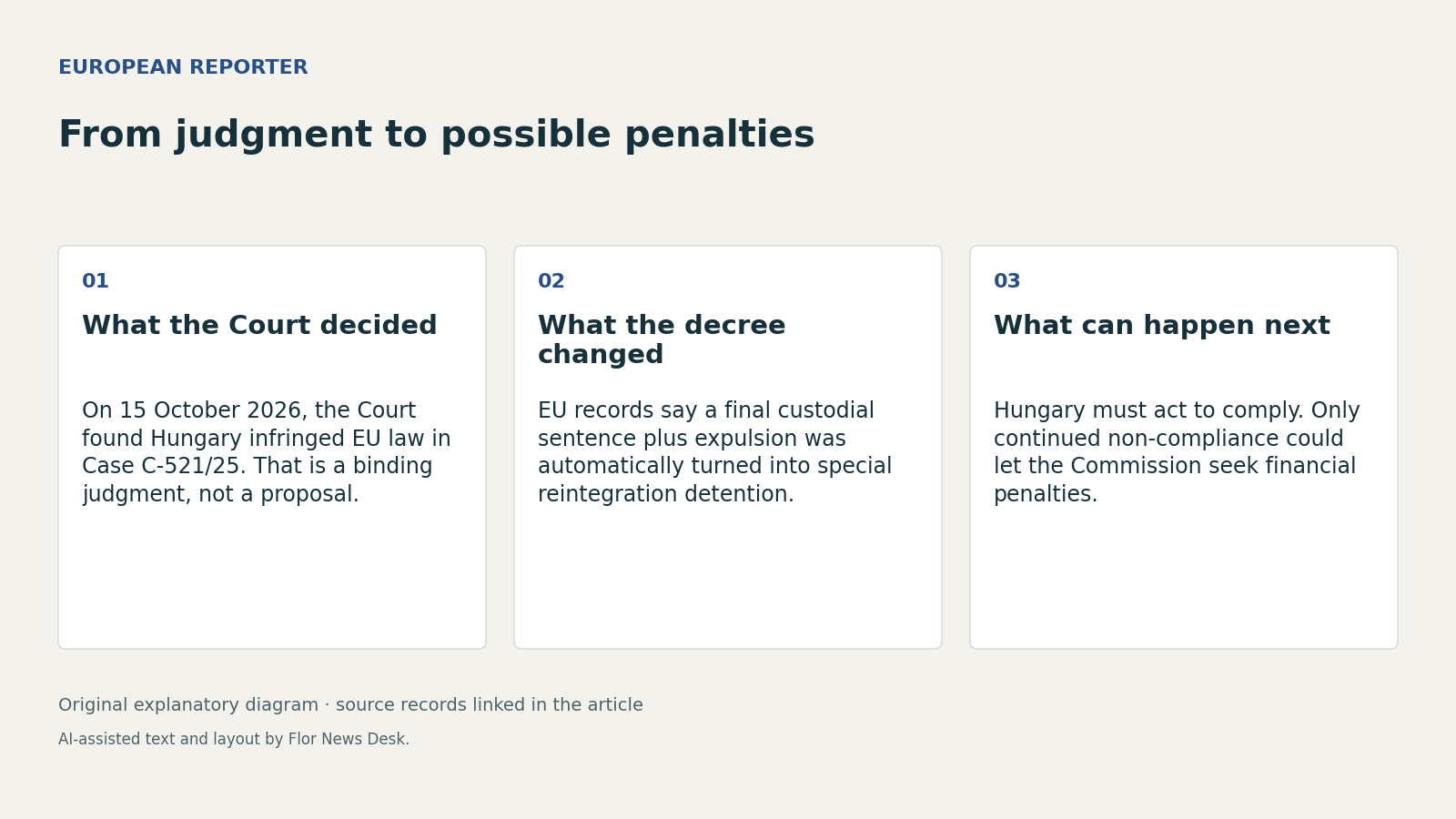

The Court of Justice of the European Union converted a long-running dispute over Hungary’s handling of trafficking convictions into a binding legal obligation on 15 October 2026, when it held in Case C-521/25 that Hungary had infringed EU law by converting final custodial sentences for trafficking in human beings into a measure called “special reintegration detention” (Curia case listing).
That matters because a court judgment changes the institutional balance. Until judgment, the issue sits within the Commission’s infringement machinery; after judgment, the Commission’s position is no longer just an accusation. The Commission’s own procedure page says national authorities must take action to comply when the Court finds a breach, and that the Commission may return to the Court and propose a lump sum and/or daily payment only if the problem is still not rectified (Commission infringement procedure explainer). That distinction is important for readers following EU enforcement: the ruling establishes breach, but it does not itself prove that any fine is pending or fixed.
The publicly verified record also shows why the case was more than a technical argument over prison administration. According to the European Commission Audiovisual Service entry for the ruling, the Hungarian decree covered situations in which a court had imposed a definitive custodial sentence for the preparation or commission of an act of human trafficking and, in the same ruling, ordered the convicted person’s expulsion. Under that decree, the prison sentence was automatically converted into special reintegration detention (Commission audiovisual record). The Curia listing identifies that conversion itself as the infringement found by the Court (Curia case listing).
The broader significance is institutional. EU law did not enter this file through a general debate about migration rhetoric; it entered through a concrete challenge to how a member state treated a final criminal sentence in trafficking cases. On the verified record, the Court accepted that the Commission could attack that design as an EU-law breach. The practical message for other capitals is narrow but serious: a national measure does not escape EU scrutiny merely because it is framed around expulsion if it also alters the effect of a final sentence in an area covered by EU obligations.
That does not mean this judgment automatically condemns every national expulsion measure linked to a criminal case. The available records do not set out the Court’s full legal reasoning, any detailed test it applied, or what exact legislative or administrative steps would satisfy compliance. They establish the existence of the judgment, the measure at issue and the Commission’s ordinary enforcement path after a finding of infringement, but not the entire doctrinal map.
That limit matters on 16 October 2026 because some details circulating around the case are not established by the verified brief used here. This source set does not confirm the decree’s repeal date, how many people were affected, or whether Hungary has already changed its practice since the judgment. What it does establish is enough for a clear institutional conclusion: the Commission now has a court-backed finding against Hungary, and any further escalation would depend not on political argument alone but on whether Hungary takes action to comply with the 15 October 2026 ruling (Curia case listing; Commission infringement procedure explainer).