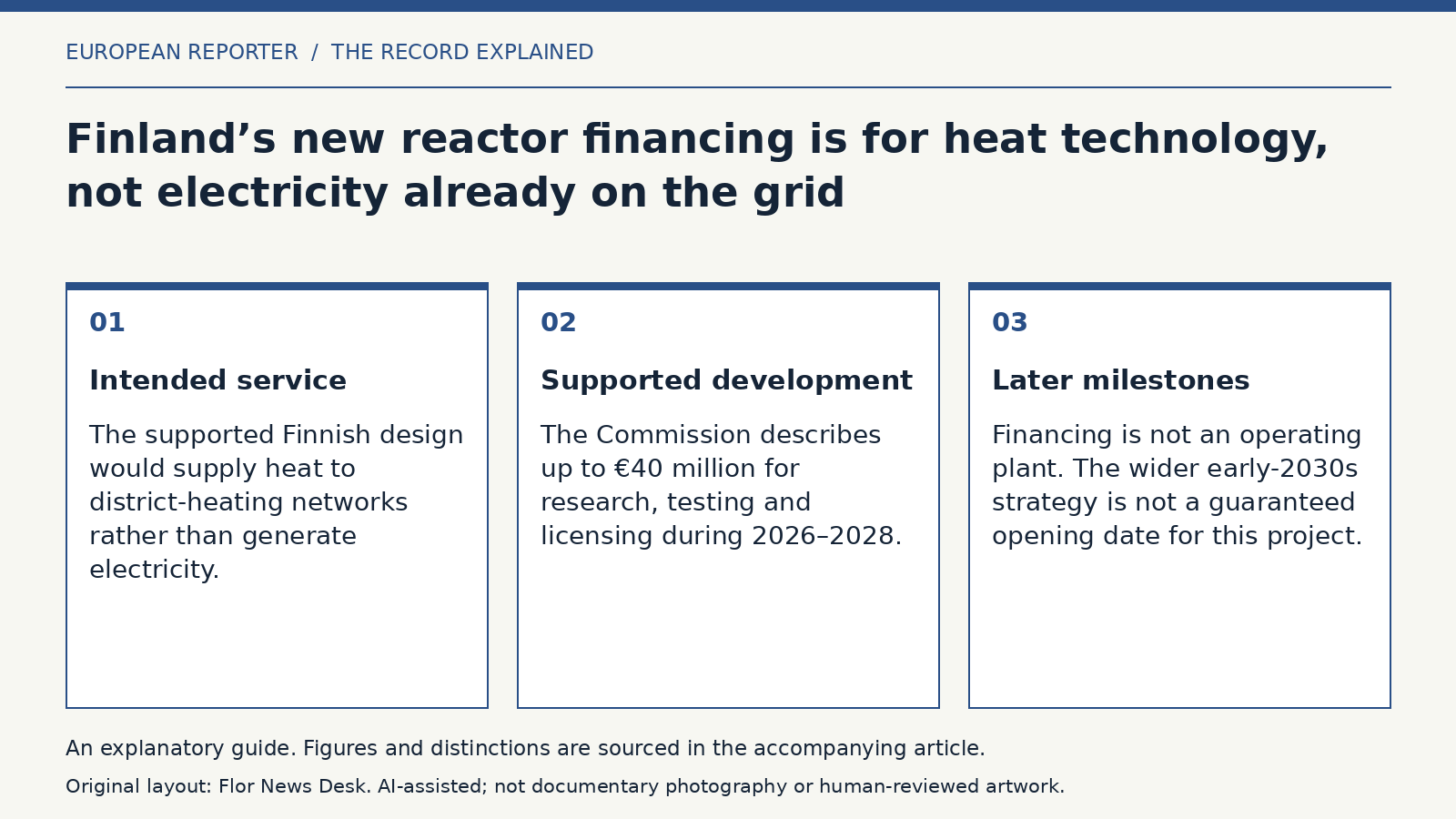
An announcement of financing for nuclear technology does not necessarily describe a new source of electricity. The European Commission’s September 15 account of support for Steady Energy concerns a Finnish small modular reactor designed to supply heat directly to district-heating networks. It describes an EIB loan of up to €40 million, backed through InvestEU, for research, testing and licensing activities during 2026–2028.
That combination of purpose and stage is the central fact. It is development financing for a heat-producing technology, not evidence of electricity already being generated or a completed heating plant serving customers. The announced ceiling also should not be reported as proof that the full amount has already been disbursed.
Start with the service being proposed
The Commission describes the design as producing heat rather than electricity. That distinction changes the question a city would ask of a potential project. An account of electrical output would not, on its own, describe the intended heating service, just as a description of heat supplied would not establish an addition to electrical generating capacity.
A hypothetical project comparison shows why the distinction matters. Two proposals can share a broad technology label while supplying different services. Comparing them only by that label would hide the relationship each needs with its intended customers. A useful comparison must first identify what is being delivered, where it is used and what evidence would demonstrate successful delivery.
This does not establish that the Finnish design is preferable to alternatives, or that a particular city should choose it. The September announcement gives the purpose of the supported work. It does not supply a completed local comparison of costs, suitability or outcomes.
A strategy is not a plant approval
The wider Commission strategy published on March 10 seeks the first European small modular reactor projects by the early 2030s. It discusses industrial cooperation, regulatory coordination, research and skills. Those are components of a development strategy, not evidence that every project associated with it has completed the necessary decisions.
The September financing and the March ambition therefore belong on different timelines. The first supports specified development activities over 2026–2028. The second sets a broader deployment objective. Treating the latter as a guaranteed opening date for this particular project would add a commitment that the two announcements do not establish.
There is a strong reason to report early-stage finance: it can identify which capabilities public institutions are choosing to support. Its significance need not be exaggerated into a claim of completed capacity. A transparent account can explain what the money is intended to enable while leaving later milestones visible.
The next useful evidence would distinguish progress in the supported research and licensing work from decisions about an operating installation and, eventually, actual service. Each is a different milestone. The financing announcement is consequential on its own terms, but those terms concern developing a heat technology rather than announcing that a new power station is already supplying the grid.