
The European Commission has finally given the European AI Office a visible public shape. A Commission page last updated on 29 October 2026 says the office sits inside the Commission, has more than 125 staff and is organised into six units; a separate Commission profile identifies Dr Lucilla Sioli as its director within DG Connect. That matters because it moves the office from legal abstraction to named management and declared capacity. But it is still institutional self-description, not proof that every post is filled, every unit is functioning or that enforcement tools have already been used. European AI Office Lucilla Sioli
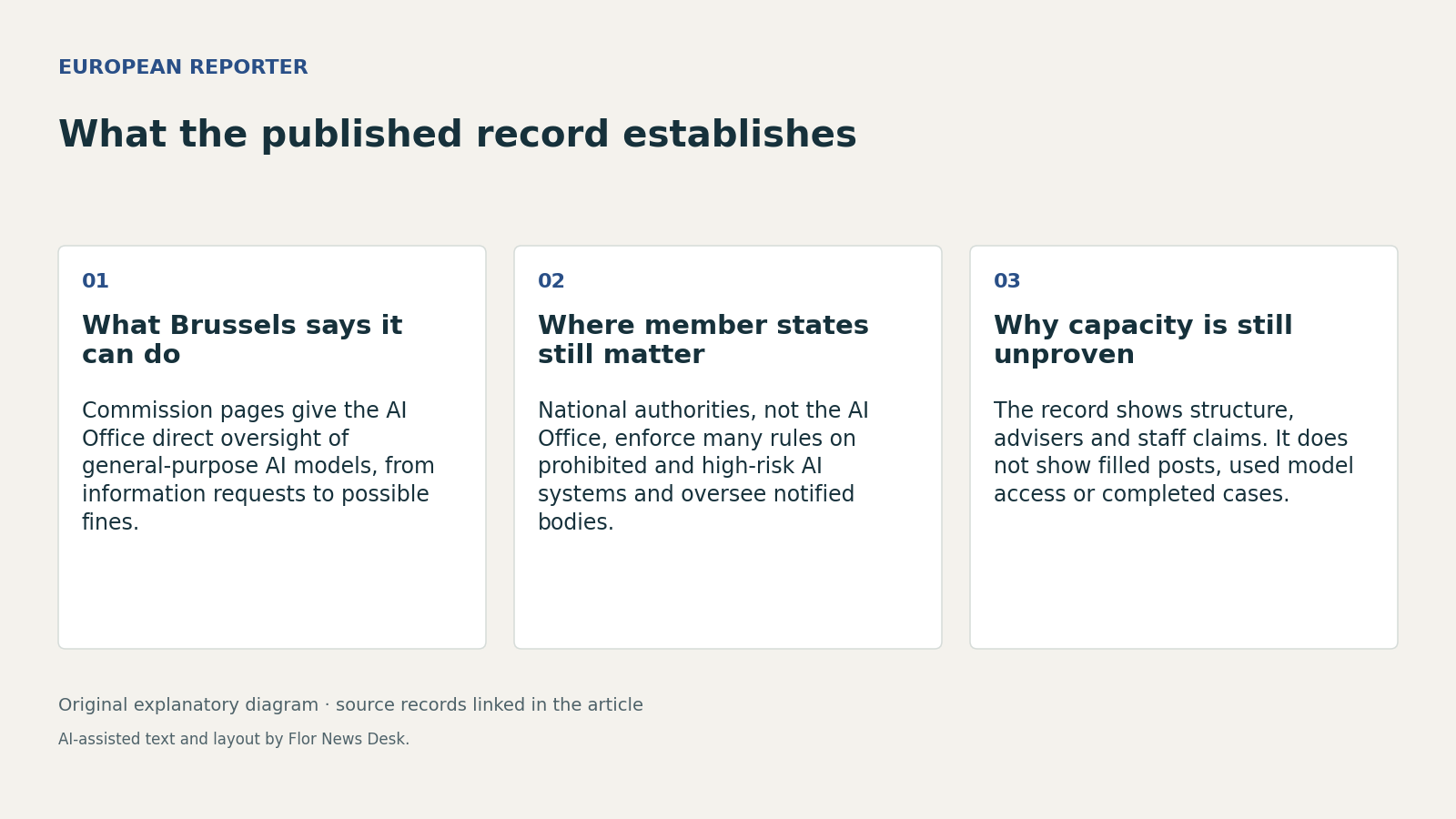
The practical consequence is narrower than the staffing page alone might suggest. The Commission’s governance page says implementation, supervision and enforcement of the AI Act are shared between the AI Office and national market surveillance authorities. It says national authorities enforce rules on prohibited practices and high-risk AI systems, while notifying authorities oversee notified bodies that handle pre-market conformity assessment. So the new organisational detail strengthens the Brussels side of the map, especially for general-purpose AI, but it does not establish full EU-wide readiness across the wider act. The same page says each member state should have designated and empowered national competent authorities by 2 August 2025, yet it does not show which countries actually did so. AI Act governance and enforcement
Where the office appears strongest on paper is general-purpose AI. The Commission says the AI Office enforces those rules directly and can carry out model evaluations, demand information, request measures, inspect suspected infringements, seek technical documentation and access models. In infringement cases, the Commission says the office can pursue corrective action, restrict public availability and impose fines. Those are significant powers. Even so, the public record still stops short of demonstrated enforcement capacity: the same page does not show completed investigations, sanctions or a case in which model-access powers have already been exercised. European AI Office
The Commission has also built advisory scaffolding around the office. A Commission announcement page last updated on 3 June 2026 says it appointed a 60-member Scientific Panel and an Advisory Forum to advise the AI Office and national authorities on issues including systemic risks, evaluation methods, standardisation and implementation challenges. That helps explain how Brussels plans to supplement in-house staff with outside expertise. It does not, however, show published opinions, meeting output or specific decisions altered by that advice. Readers can see the support architecture, not yet its public track record. AI Act enforcement gets independent expert support
The clearest documentary gap concerns technical readiness. The governance page says the Commission will launch a call to expand EU capacity to evaluate AI models before they reach the EU market, and says that added capacity is expected to be operational in 2027. With the current date at 8 November 2026, that remains a future expectation, not evidence of a functioning evaluation network today. The analytical implication is limited but important: legal powers to inspect or access models are not the same as a proved ability to test them at scale. AI Act governance and enforcement
A 19 October 2026 Commission midday briefing points in the same direction. In response to questions about a Hungarian non-paper proposing a new frontier-AI agency reporting to the EU AI Office, spokesperson Thomas Regnier said the Commission was in close contact with the parties concerned, that the AI Office was already leading work on frontier-model risks, that ENISA was handling the cyber dimension, and that support from national authorities was welcome. That exchange shows the office acting as the Commission’s coordination hub in public debate. It does not confirm any new agency, any extra legal power or any settled change in the existing division of labour. For now, the Commission has shown an organisation chart, a director and advisory bodies; it has not yet shown a comparable public enforcement record across the EU system. Midday briefing, 19 October 2026