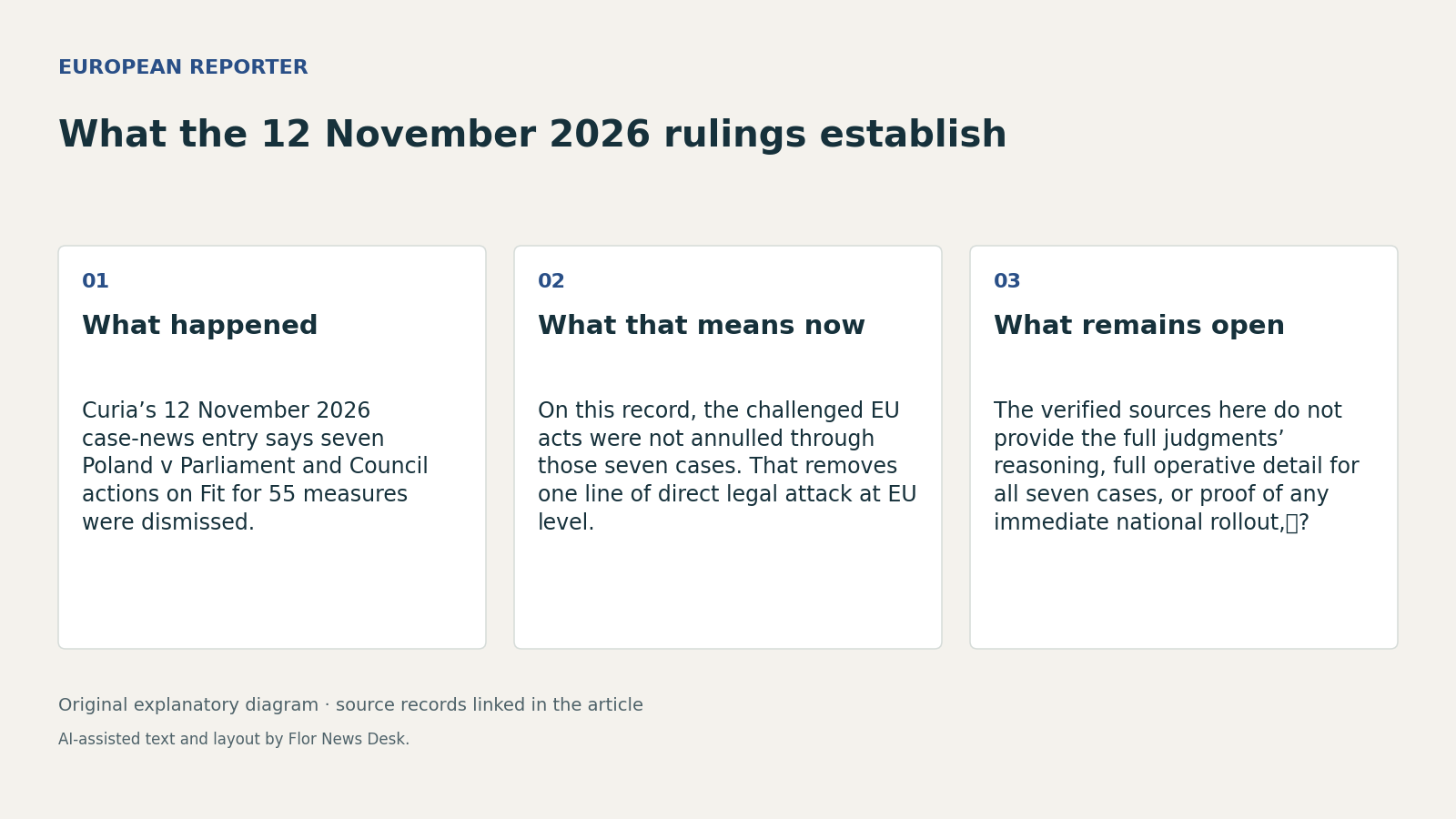

The Court of Justice of the European Union did not rewrite the EU’s climate rulebook on 12 November 2026. What the verified public record shows is narrower and still important: Curia’s case-news page lists seven actions brought by Poland against parts of the EU’s Fit for 55 package as dismissed under press release No. 163/2026 (Curia case-news page).
Those cases concerned the objectives of the LULUCF sector, strengthened vehicle performance standards, the extension of the market stability reserve, objectives for sectors covered by the ESR Regulation, emission allowances in building and road transport, the Carbon Border Adjustment Mechanism and energy efficiency (Curia case-news page). On the record available here, the immediate legal effect is that Poland’s annulment actions failed and the challenged EU measures were not struck down through these proceedings.
That is useful news for businesses and governments across the bloc because it removes one set of direct court challenges to several headline climate files at once. Importers dealing with CBAM, carmakers planning for tighter vehicle rules and governments working around ETS-related reforms now know that these seven cases did not dislodge the underlying acts on 12 November 2026 (Curia case-news page).
But readers should be careful not to read more into the source record than it supports. The verified Curia page is an index entry for a press release, not the full judgments. It names the seven cases and the dismissal outcome, but it does not set out the Court’s detailed reasoning, the operative wording of each judgment, or whether the cases all turned on the same legal analysis (Curia case-news page). A separate audiovisual entry confirms that a ruling in case C-505/23, on emission allowances in building and road transport, was read at the Court on the same date by First Advocate General Maciej Szpunar. That metadata does not supply the full text either, and it covers only one of the seven cases (Court audiovisual record for case C-505/23).
The Commission’s EU ETS explainer helps with legislative context, but not with proving what happened in court or what has already been implemented in practice. The Commission says ETS-related Fit for 55 proposals were approved by June 2023 and are law, and it describes the EU ETS as covering electricity and heat generation, industrial manufacturing and aviation, with maritime transport added from 2024 (European Commission EU ETS explainer). The same page also says ETS2 will become operational in 2027 and that the Social Climate Fund will mobilise EUR 86.7 billion in 2026-2032. As of 12 November 2026, those are best treated as Commission-described framework and planned milestones, not evidence that every next-step deadline has already been met or that money has already been raised and spent as described (European Commission EU ETS explainer).
There is another reason for caution. The Commission page retrieved on 12 November 2026 carries mixed timing signals, including a note saying it was last updated on 13 May 2026 while also containing later-dated material. That makes it useful for background, but a poor source for claiming a clean current implementation status across all files (European Commission EU ETS explainer).
So the safest conclusion is limited but significant. On 12 November 2026, the Court dismissed seven Polish challenges to core Fit for 55 measures. That narrows legal risk from those specific annulment actions at EU level. It does not, on this source record, answer the next questions about detailed judicial reasoning, later compliance steps, national administration or measured economic effects.